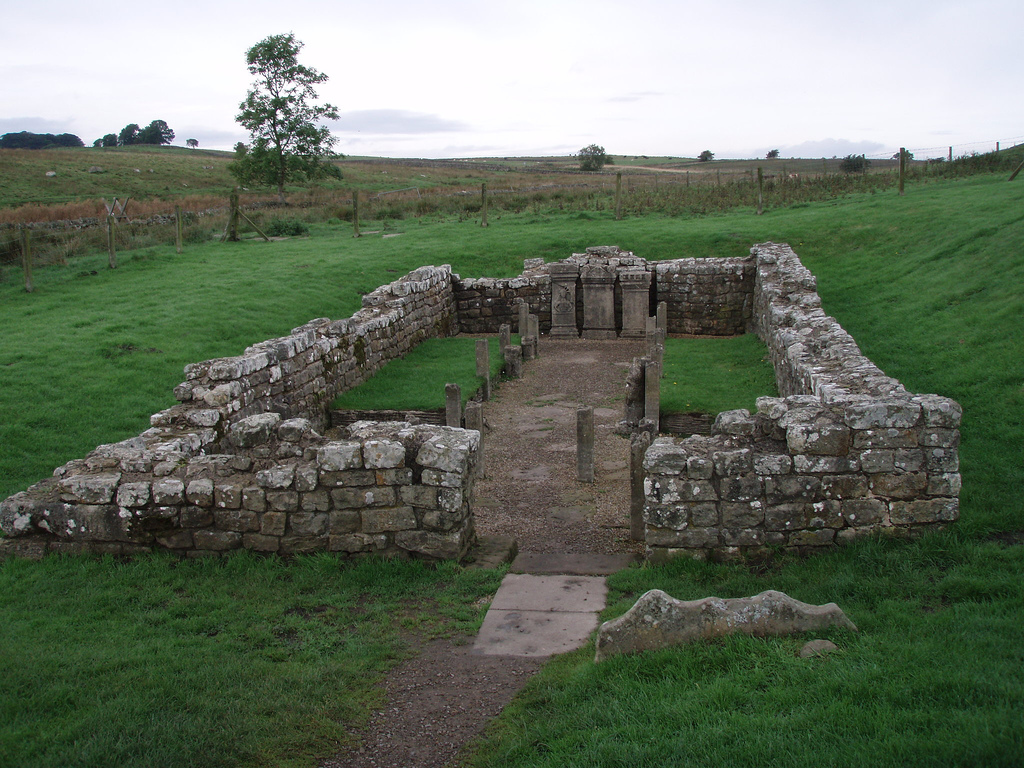
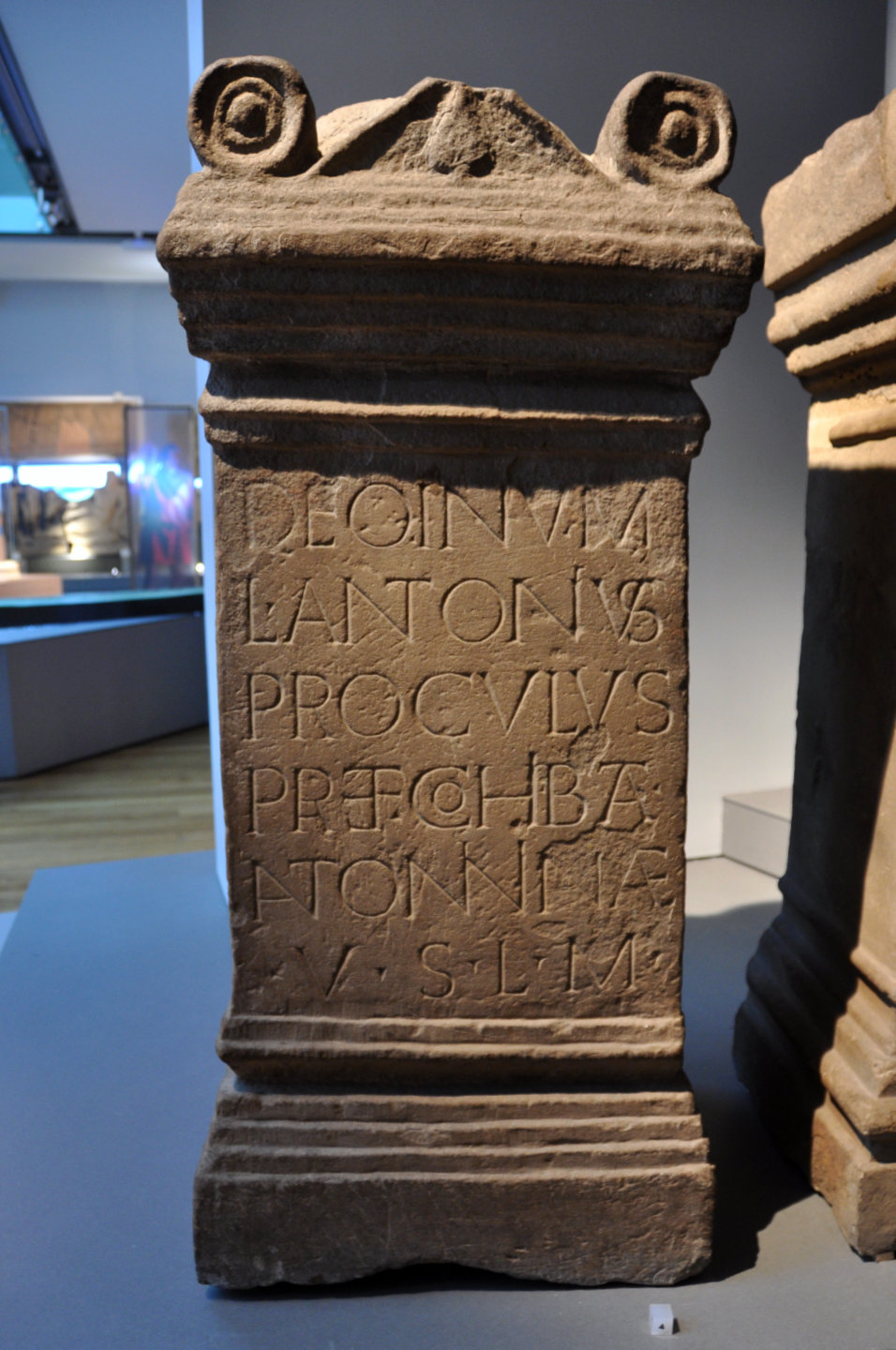
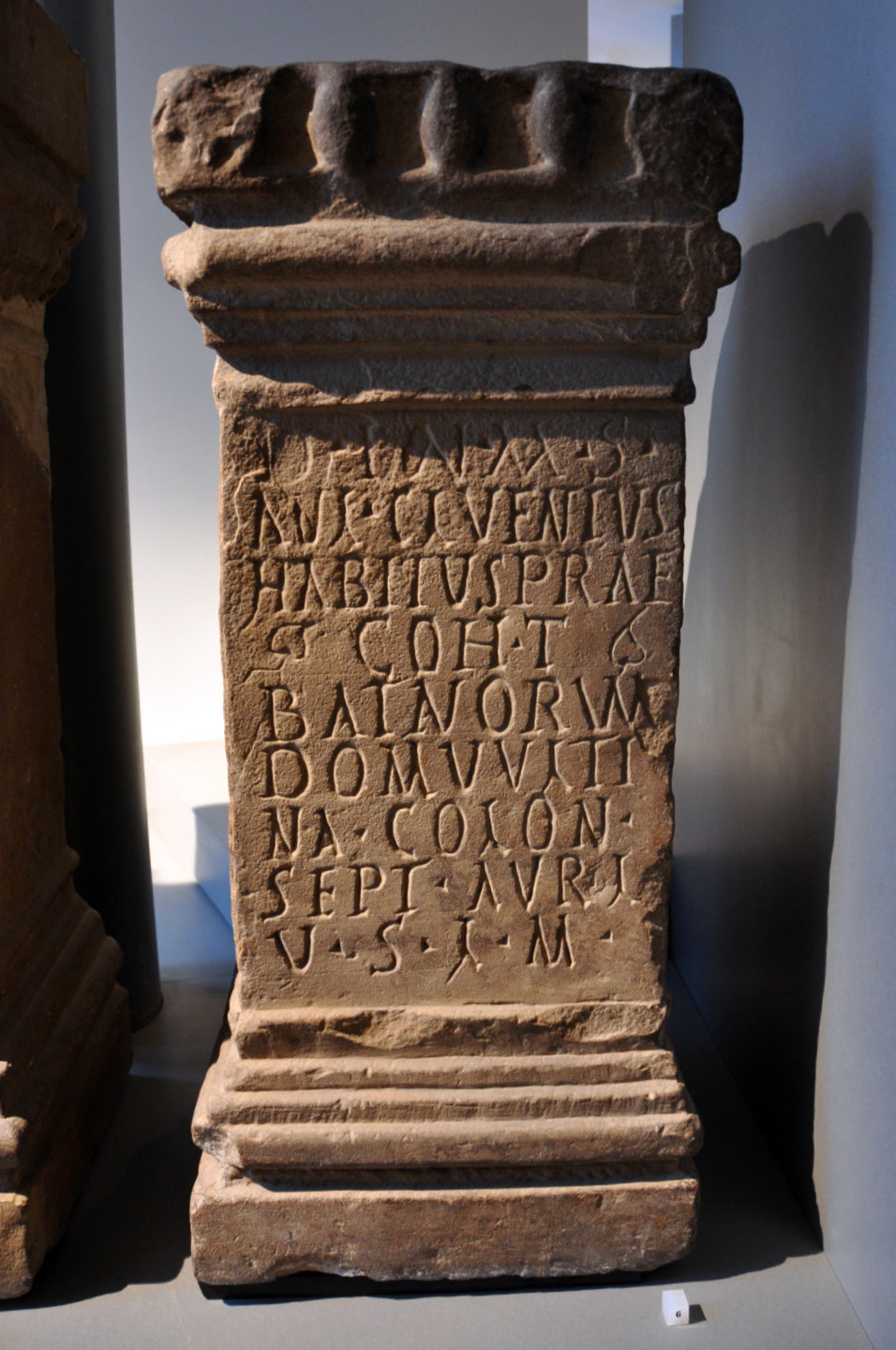
Mithras-Sol Altar from the Carrawburgh
TNMM 180 ↔ CIMRM 847 & 848
'The sides of the die are plain, the top of the capital flat; its face has four leaves with a trisceles in the centre. A cavity l0 ins. wide has been cut at the back of the capital to carry a lamp. On the upper part pf the die in-low relief is the upper part of Mithras facing front, with arms set at his waist, as he rises from the rock. His cloak covers his body and l. arm; in his r.h. he holds a whip. His head is framed by a panel of ornament, and the rays of his crown are formed by pierced openings through which a lamp, placed in the cavity could throw light. The god's cloak and hair and the inscribeg letters retain their red paint, and the panel of ornament has red paint alternating with some other colour, which has worn away' (JRS 1951). It has the following inscr.:
CIMRM 848
Deo invicto / Mithrae M(arcus) Sim/plicius Simplex / pr(a)ef(ectus) v(otum) s(olvit) l(ibens) m(erito).
After Deo an ivy-leaf; after invicto a palmbranch.
It seems to me, that we have a representation of Sol: cf. Ostia: No. 267.
For bearers of the name M. Simplicius, see: Birley in Richmond-Gillam, 49ff who points at some inscriptions dedicated to the goddess Vagdavercustis. 'The weight of evidence points to Lower Germany, and we shall not be far wrong in supposing that the prefect of Carrawburgh looked on V. as his patron goddess, when he was not preoccupied with the worship of Mithras'.
CIMRM II 847
Richmond in Bruce-Mitford, 74 and Pl. XIV, b; fig. 24. See fig. 256.
Main inscription
References
ILN 1951, 455; Richmond-Gillam, Pl. XII, B.
- Vermaseren, Maarten Jozef (1956) Corpus Inscriptionum et Monumentorum Religionis Mithriacae

Comments
Batava Auxiliary Units where stationed at Xanten and Kalkar until they where transfered in disgrace (after the Batava uprising 69/70AD) to the Vindolanda area.
I was just checking the connection and if the same Batavian Cohort had maybe built and used the two temples and had maybe brought the cult to the area of north England
I was pleasantly surprised to read thie inscription on the other Altar proving a Betavian connection to Mitras at Carrawburgh and to read that evidence points to the lower Rhein area. Although it must not be forgotten that the Betavas home land was in the area of todays Nijmegen in Holland and directly connected to the Northern Lower Rheinarea of Roman Germania Inferior.
The Altar found at Kalkar (not in situ.) is unfortunately dated after the official exodus of the Batavians although the Temple itself has not been found or excavated and the founding of the temple could possibly of an earlier date!