This site uses cookies to offer you a better browsing experience.
Find out more on how we use cookies in our privacy policy.

 
Support The New Mithraeum The New Mithraeum is an independent, non-profit project dedicated to Mithraic studies, ancient religions and classical culture. Developed and maintained independently since 2007, the site exists without advertising, paywalls or institutional funding. If you have found value in its articles, interviews, photographs or database, please consider supporting the project with a contribution. Every contribution helps keep The New Mithraeum open, free and alive. Thank you.
Support us →
Monumentum

Mithraeum of Housesteads

The Housesteads Mithraeum is an underground temple, now burried, discovered in 1822 in a slope of the Chapel Hill, outside of the Roman Fort at the Hadrian's Wall.
1 / 3
 
The New Mithraeum
12 Aug 2021
Updated on May 2026

TNMM 309 ↔ CIMRM 852

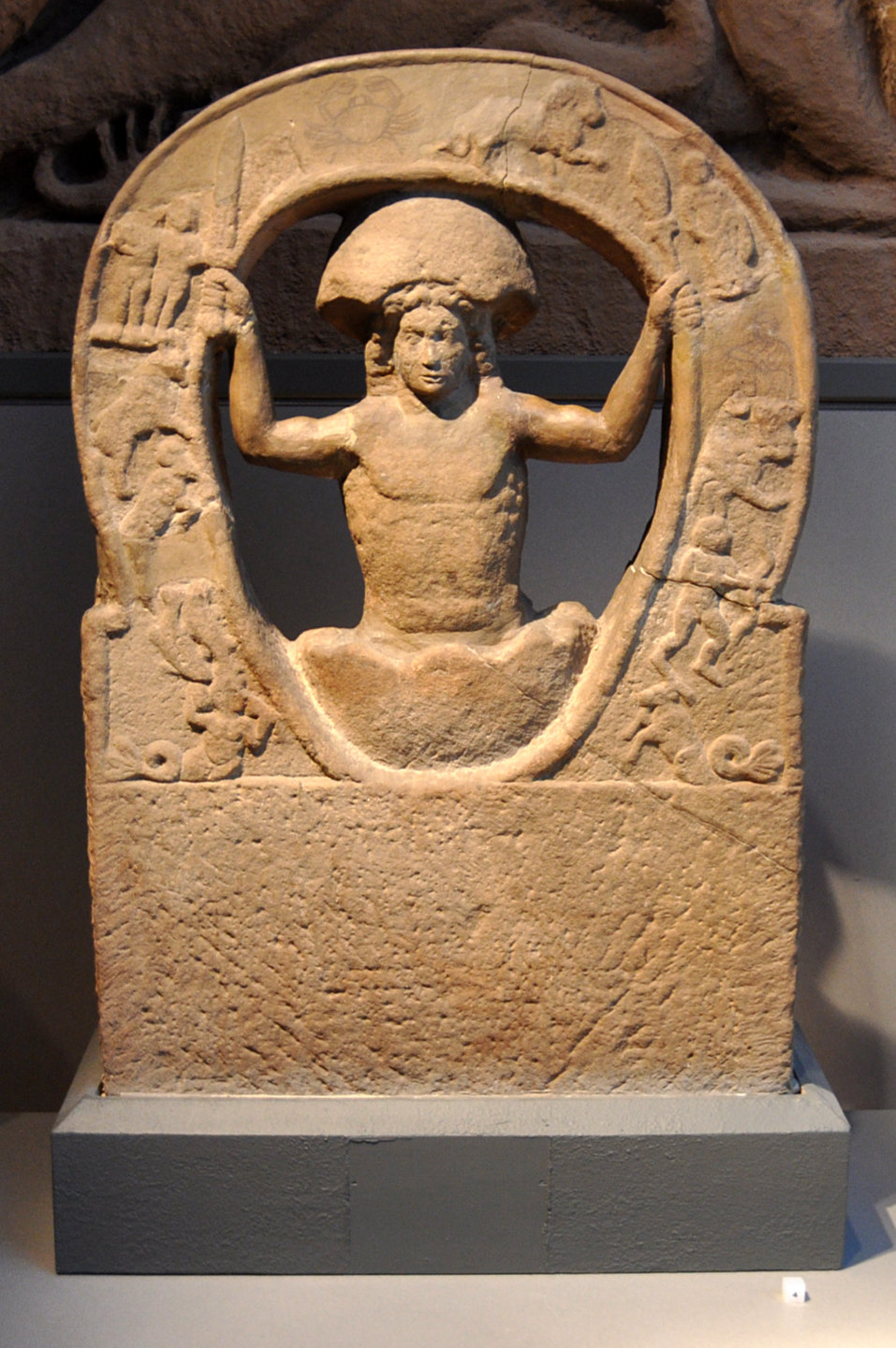
The mithraeum was excavated in 1898. It consisted of a rectangular room flanked with benches, at the end was a sanctuary which contained a relief of Mithras surrounded by the zodiac. It survives as a circular platform, about 11 metres across, set into a southeast-facing slope to a maximum depth of 1.1 metres. None of the stonework is visible. Lying on the ground surface in the centre is what appears to be a section of stone water channel, and about 5 metres to the east is a silted spring containing some stone, but no apparent walling in situ, into which is inserted a modern porcelain basin for cattle. The remains of the temple were surveyed by RCHME Newcastle at 1:1000 as a part of the Housesteads Survey.

The Mithraeum survives as a circular platform, about 11m across, set into a SE-facing slope to a maximum depth of 1.1m. None of the stonework is visible. Lying on the ground surface in the centre is what appears to be a section of stone water channel, and about 5m to the E is a silted spring containing some stone, but no apparent walling in situ, into which is inserted a modern porcelain basin for cattle. The remains of the temple were surveyed by RCHME Newcastle at 1:1000 as a part of the Housesteads Survey.

A elongated circular depression is visible on air photographs at NY 7905 6846, and presumably represents the site of the Mithraeum.

Located on the English Heritage map of Hadrian’s Wall 2010.


Underground Mithraeum, discovered in 1822 in a slope W. of the Chapel Hill, outside of the Roman Fort at Housesteads. It was excavated definitely in 1892 by Bosanquet.

The sanctuary (L. 14.00 Br. 5.45) is enclosed by brick walls (max. H. 0.66), which are plastered only on the East side. New excavations have revealed, that it might have consisted of a vestibulum, through which on the East side by an entrance the main room could be entered. This consists of a central aisle (Br. 2.65) and two elevated side-benches (Br. 1.65). Traces of the wooden beams of their sidewalls have been preserved.

Previous excavations had revealed the hindmost part of the cult-room with the niche (Br. 2.33 D. 0.75) with several altars and reliefs. The floor was covered with tiles, but later on the floor seems to have been raised by another layer, consisting of wood and tiles to prevent itfrom being flooded by the water from the spring. This spring lies on the N.-side in a basin (L. 0.52 Br. 0.37 D. 0.45) of brick work in the floor. Excess water can be drained off through two narrow gutters.

References

Th. Hodgson in Newcastle Chronicle, 26 Oct. 1822 (quoted by Bruce, 93); J. Hodgson in Archaeologia Aeliania 1,1822, 263ff; History of Northumberland, II (3)1,190; Lauchlan, Rome Wall, Sheet III; Bruce, Lap. Sept., 96f; MMM II 393ff No. 273 and fig. 312; Bosanquet in Arch. Ael. XXV, 1904, 257ff. See fig. 224. The finds are all in the Blackgate Museum in Newcastle-on-Tyne.

Related monuments

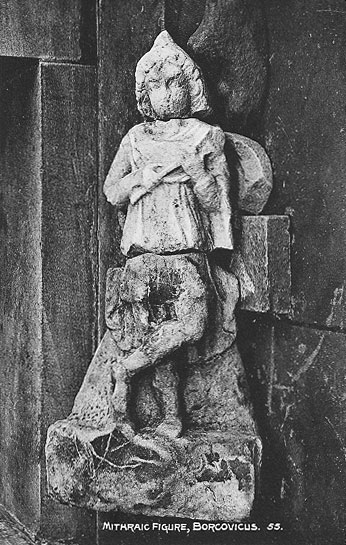
Cautes Borcovicus

The head this statue of Cautes from Carrawburgh has been lost.

Mithras rock-born from Housesteads

A naked Mithra emerges from the cosmic egg surrounded by the zodiac, as always carrying a torch and a dagger.

 
Back to Top