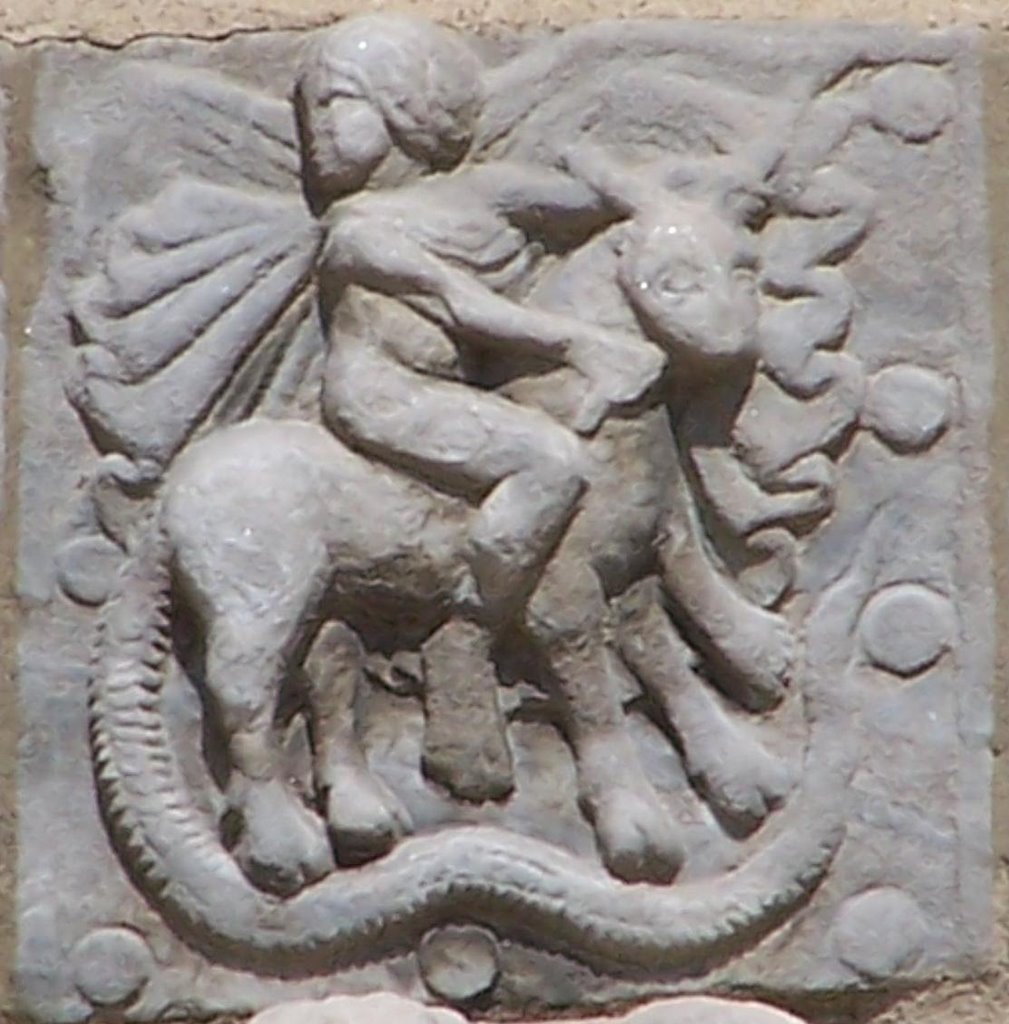
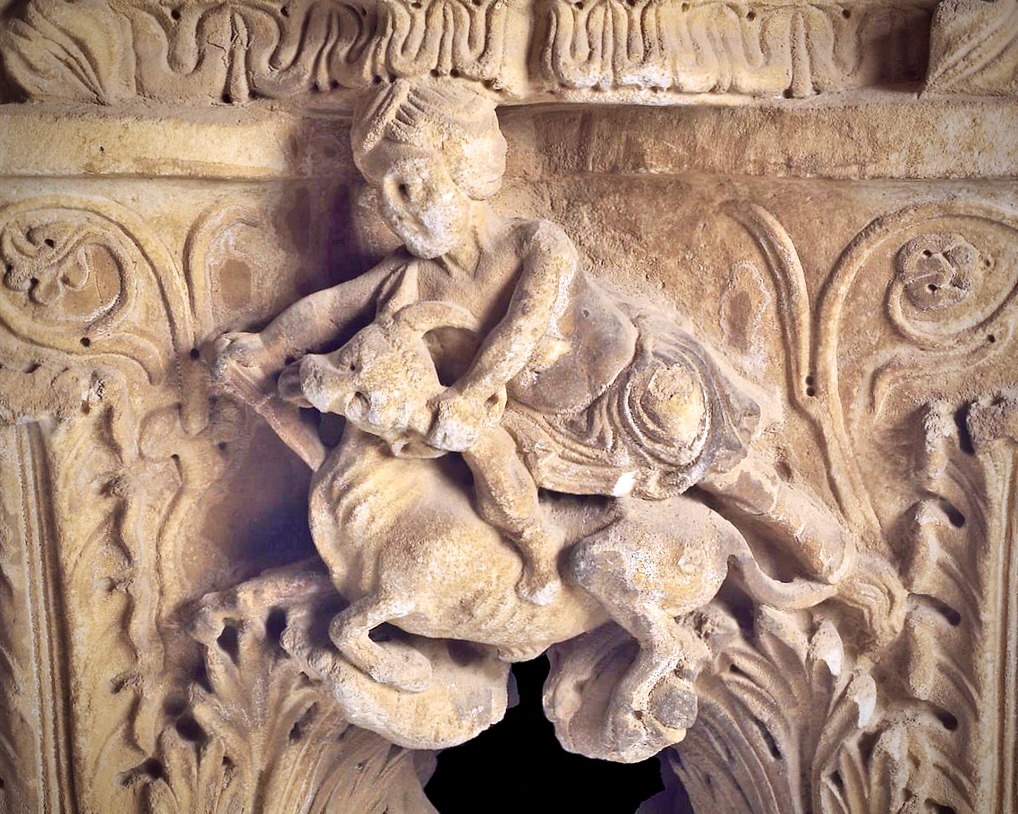
Tauroctony from Aula Gotica
TNMM 762
In 1996, while cleaning the walls of the so-called Gothic Hall of the Convent of the Saints Quattro Coronati, Andreina Draghi and her team discovered an impressive cycle of medieval frescoes. The frescoes were covered by a blue paint. After the removal of about 850 square metres of surface, more than 300 very vivid paintings have been revealed, reproducing a wonderful repertoire of wall motifs and decorations, most of them excellently preserved.
The paintings date from a pre-Gothic period between 1246 and 1255. Most of the scenes are of a profane nature and are largely attributed to Maestro di Anagni. They include metaphorical representations of the winds, the four seasons, the liberal arts, the zodiac and constellations, vices and virtues, Solomon dispensing justice and what appears to be Mithras as a bull slayer.
The male figure killing the bull, as in the Roman reliefs, rests one of his knees on the animal’s back while grasping its head with one hand and thrusting his dagger with the other. While his torso is naked, he is wearing the usual oriental trousers. Instead of his usual cloak, a kind of foulard floats over his shoulders. Instead of his Phrygian cap, he wears a turban. Contrary to the usual depiction, the scene is facing left and the male figure doesn’t turn his head.
The conventional complex is located on a lower hill of the Celio, along the route of the ancient Via Tuscolana in Rome. The original nucleus of the church can be identified in a rectangular hall with an apse dating from the 4th century, the remains of which were found in 1957 under the current basilica. It was probably a pagan hall acquired by the Christians, perhaps before 499, when the Titulus Aemilianae is attested, identified with the later one of the Santi Quattro Coronati, dating back to the time of Honorius I (625-638).
In the 9th century, during the reign of Leo IV (847-855), the church was transformed into a three-nave basilica and given a massive bell tower. It was rebuilt again in the 12th century, after the fire set by Robert Guiscard’s Normans in 1084. During this last renovation, under Pasquale II (1099-1118), the church was reduced in size and a convent was added, entrusted in 1138 to the Benedictines of the Abbey of Sassovivo. In 1521 the complex was entrusted to the Camaldolese and in 1560 to the Augustinian nuns, who still live there today.
Nica Fiori, writer of history, expresses her wonder at how "we find some ideals and symbols of Freemasonry" exemplified on the frescoes. "Even from a religious point of view, there seems to be a link with the architecture of the proto-Masons, who worshipped the Great Architect of the Universe. [...] The Temple of Solomon, which contains the Ark of the Covenant, is at the same time an image of the inner Temple and a prefiguration of the heavenly city. Let us remember that the Temple is the first and greatest monument revered by Freemasons, and that its architect, Hiram, who was killed so as not to reveal the secrets of his work, is metaphorically reborn in each new Master".
References
- Helga Marsala (2014) ‘Roma ritrova un tesoro medievale: restituiti al mondo gli affreschi del convento dei Santi Quattro Coronati. Sotto gli sguardi delle monache di clausura’. Artribune.
- Nica Fiori (2020) ‘Il medioevo ritrovato, i Ss Quattro Coronati, dove si riscrive un periodo storico artistico’. About Art Oline.
- Nicolas Amoroso (2022) Des images mithriaques à l’époque médiévale ?.