Tertullian on Mithras
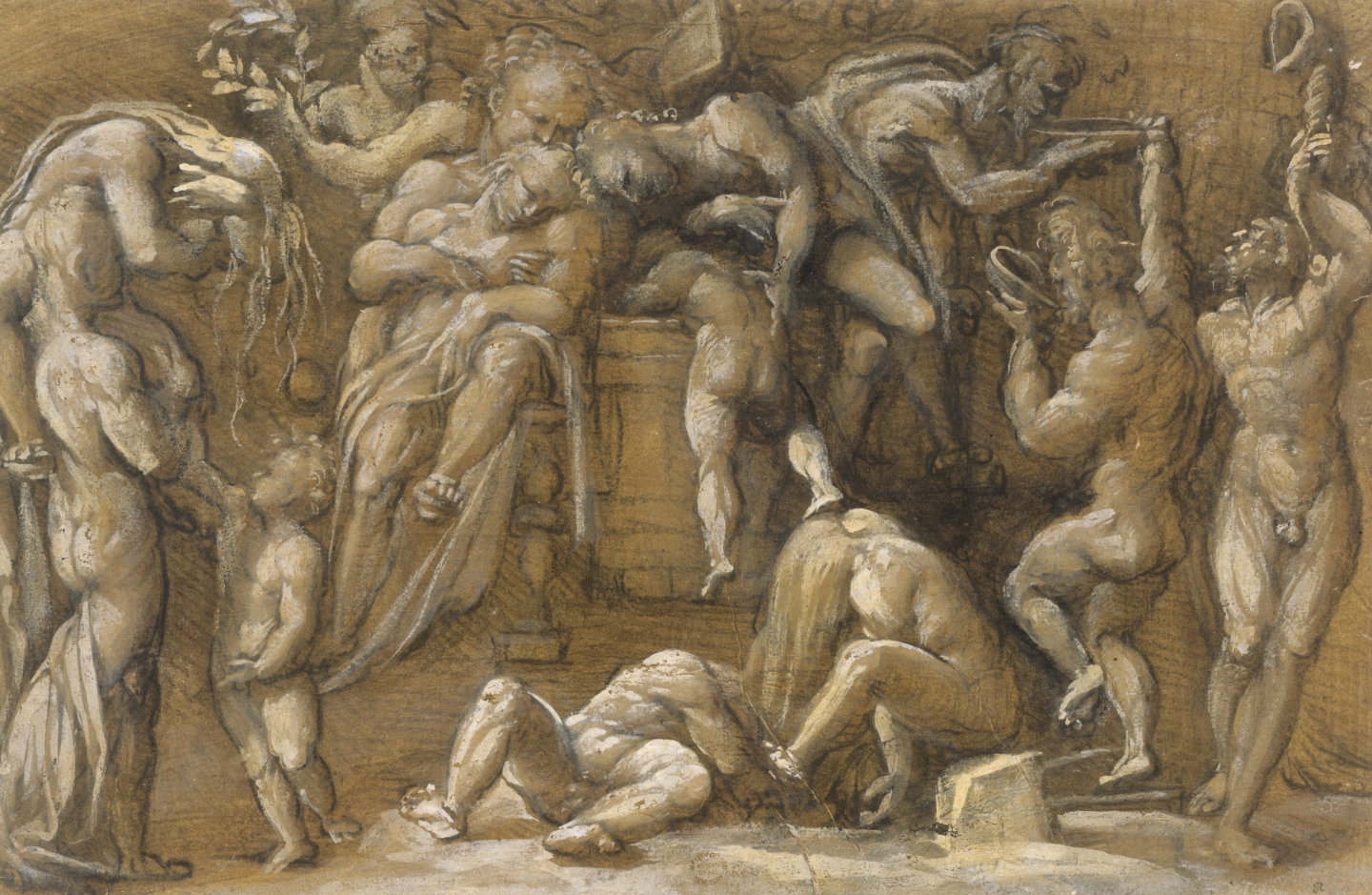
Amico Aspertini, Bacchanalian Scene, 1520
Rogers Fund, 1908
These excerpts come from works written by Tertullian in Carthage in the late second and early third centuries. This was a pivotal period in which Christianity was still defining itself in relation to Roman religion and rival mystery cults. His references to Mithras are openly polemical and partisan. Even so, they are valuable for the study of Mithraism, as they point to practices such as cave initiation, ritual use of water, communal meals, military imagery, marks placed on initiates, and the symbolism of the crown.
Throughout these texts, Mithraic rites are not treated as an independent phenomenon, but as demonic imitations of Christian practices. This framework shapes Tertullian’s language and imagery. At the same time, it shows how closely Mithraic rituals were perceived to parallel Christian sacraments.
The passages are presented here in English translation, with references to the Ante-Nicene Fathers edition and, where relevant, to Geden’s alternative renderings.
Adversus Marcionem
Book 1, chapter 13:4
The very superstition of the crowd, inspired by the common idolatry, when ashamed of the names and fables of their ancient dead borne by their idols, has recourse to the interpretation of natural objects, and so with much ingenuity cloaks its own disgrace, figuratively reducing Jupiter to a heated substance, and Juno to an aërial one (according to the literal sense of the Greek words); Vesta, in like manner, to fire, and the Muses to waters, and the Great Mother to the earth, mowed as to its crops, ploughed up with lusty arms, and watered with baths. Thus Osiris also, whenever he is buried, and looked for to come to life again, and with joy recovered, is an emblem of the regularity wherewith the fruits of the ground return, and the elements recover life, and the year comes round; as also the lions of Mithras are philosophical sacraments of arid and scorched nature.
—ANF
The lions of Mithra are represented as types of an eager and impetuous nature.
—Geden
De Baptismo
Chapter V
"Well, but the nations, who are strangers to all understanding of spiritual powers, ascribe to their idols the imbuing of waters with the self-same efficacy." (So they do) but they cheat themselves with waters which are widowed. For washing is the channel through which they are initiated into some sacred rites-of some notorious Isis or Mithras. The gods themselves likewise they honour by washings.
—ANF
For nations destitute of all understanding of spiritual powers attribute the same efficacy to their idols; but they cheat themselves with springs that yield no living water. For in certain rites also of an Isis or Mithra initiation is by means of baptismal water.
—Geden
De corona
Chapter XV
Blush, ye fellow-soldiers of his, henceforth not to be condemned even by him, but by some soldier of Mithras, who, at his initiation in the gloomy cavern, in the camp, it may well be said, of darkness, when at the sword’s point a crown is presented to him, as though in mimicry of martyrdom, and thereupon put upon his head, is admonished to resist and east it off, and, if you like, transfer it to his shoulder, saying that Mithras is his crown. And thenceforth he is never crowned; and he has that for a mark to show who he is, if anywhere he be subjected to trial in respect of his religion; and he is at once believed to be a soldier of Mithras if he throws the crown away----if he say that in his god he has his crown. Let us take note of the devices of the devil, who is wont to ape some of God’s things with no other design than, by the faithfulness of his servants, to put us to shame, and to condemn us.
—ANF
Be ashamed as Christ’s fellow-soldiers to be open to reproach not only from Christ himself but from any soldier of Mithra. For to him when he is initiated in a cavern, a veritable home of darkness, a crown is offered on a naked sword, as if in parody of martyrdom; this then is placed on his head, and he is enjoined with his own hand to lift it from his head and voluntarily to transfer it to his shoulder, declaring that Mithra is his crown. Thereafter he is never crowned. And this is regarded as evidence of his steadfastness, if ever he is tempted to break his oath, and forthwith he is regarded as a soldier of Mithra, should he have rejected the crown and claimed the god himself as his crown. We may recognise the craft of the devil, who counterfeits divine things to turn us from our faith and bring us into condemnation. (Geden)
De praescriptione haereticorum
Chapter 40. 3-4
The question will arise, By whom is to be interpreted the sense of the passages which make for heresies? By the devil, of course, to whom pertain those wiles which pervert the truth, and who, by the mystic rites of his idols, vies even with the essential portions of the sacraments of God. He, too, baptizes some-that is, his own believers and faithful followers; he promises the putting away of sins by a layer (of his own); and if my memory still serves me, Mithras there, (in the kingdom of Satan,) sets his marks on the foreheads of his soldiers; celebrates also the oblation of bread, and introduces an image of a resurrection, and before a sword wreathes a crown. What also must we say to (Satan’s) limiting his chief priest to a single marriage? He, too, has his virgins; he, too, has his proficients in continence.
—ANF
The devil (is the inspirer of the heretics) whose work it is to pervert the truth, who with idolatrous mysteries endeavours to imitate the realities of the divine sacraments. Some he himself sprinkles as though in token of faith and loyalty; he promises forgiveness of sins through baptism; and if my memory does not fail me marks his own soldiers with the sign of Mithra on their foreheads, commemorates an offering of bread, introduces a mock resurrection, and with the sword opens the way to the crown. Moreover has he not forbidden a second marriage to the supreme priest? He maintains also his virgins and his celibates.
—Geden
Apologeticum
Chapter 7
Those who aspire to initiation first I believe approach the father of the ceremonies to learn from him the preparations that are to be made.
—Geden
Details
- Author
- Tertullian
- Publication date
- 197 – 211
