This site uses cookies to offer you a better browsing experience.
Find out more on how we use cookies in our privacy policy.

 
Monumentum

Frescoes with standing figures of Mitreo delle Pareti Dipinte

The frescoes depict several figures dressed in different garments associated with the Mithraic degrees.
1 / 5
 
The New Mithraeum
15 May 2007
Updated on Jan 2025

TNMM 104 ↔ CIMRM 268

On the back wall of the sanctuary there must have been a large painting, probably the scene of Mithras as a bullkiller, because many traces in blue and brown (the grotto) and red are visible. The right wall of the inner part of the sanctuary is divided in three parts:

1) In the left section a standing woman, frontal (Becatti, Pl. XII, 1), in short hair dress, dressed in a violet tunica and yellow himation. In her right outstretched hand she holds a mirror; with her left hand she arranges a leaf-crown (Venus-Nymphus). The woman is standing on the greenish soil and on her right side there is a tree with red and yellow flowers.

2) In the middle section (Br. 2.20) equally on a greenish soil, there are on either side of a large tree two young men. The left one in long violet tunic, which, however, does not cover the front part of his body; he runs in the direction of the tree. In his left hand he holds a long javelin. On the other side a youth dressed in short violet tunic, which blows out. With both hands he holds a long torch. The heads of both figures are encircled by a nimbus.

3) In the right section (Br. 15) a standing youth in green tunic, violet cape and red Phrygian cap. He seems to be cross-legged. With his left hand he keeps down a torch (Cautopates). On his left side a tree (Becatti, Pl. XII, 2).

4) On the opposite wall there are remnants of a painted procession, which progresses in the direction of the cult-niche. Underneath it different plants have been painted.

a) A leg of a walking person;

b) two legs and remnants of a yellow tunic;

c) head and bust of a person in red tunic and blue nimbus;

d) blue globe;

e) traces of another person in reddish-yellow;

f) traces of a person with torch.

5) The right wall of the foremost part of the Mithraeum is divided by red lines in four (originally eight?) panels in each of which is represented a standing or walking person; the figures are turned to the cult-niche (Becatti, Pl. XIII, 2).

In the two upper panels:

a) standing person in short yellow tunic with red bands. In his hand he holds a red cloth (flammeum). Head and shoulders lost (Nymphus).

b) Walking person in the same dress with upraised left hand in which some yellow. traces are visible (ears?) (Perses). Both persons are standing on a green soil.

In the lower panels:

c) walking bearded person in short tunic and small cap. In his upraised r.h. a torch (Leo).

d) Upper part of a person, looking back. His l.h. is outstretched without torch.

The whole painting of the Mithraeum has been correctly dated by Becatti to the end of the second century A.D.


The right wall of the foremost part of the Mithraeum is divided by red lines in four (originally eight ?) panels in each of which is represented a standing or walking person; the figures turned to the cult-niche.

In the two upper panels:

a) standing person in short yellow tunic with red bands. In his hand he holds a red cloth (flammeum). Head and shoulders lost (Nymphus). 

b) Walking person in the same dress with upraised left hand in which some yellow traces are visible (ears ?) (Perses). Both persons are standing on a green soil.

In the lower panels:

c) Walking bearded person in short tunic and small cap. In his upraised r.h. a torch (Leo).

d) Upper part of a person, looking back. His l.h. is outstretched without torch.

—Becatti

References

Related monuments

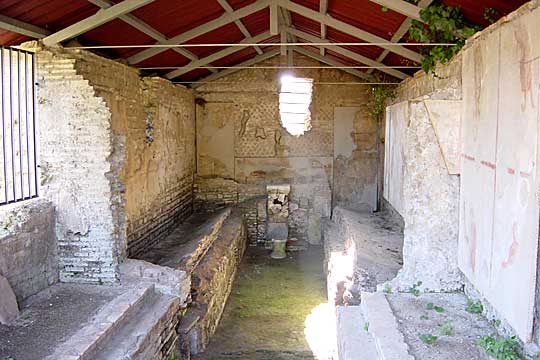
Mitreo delle Pareti Dipinte

The House of the Mithraeum of the Painted Walls was built in the second half of the 2nd century BC (opus incertum) and modified during the Augustan period.

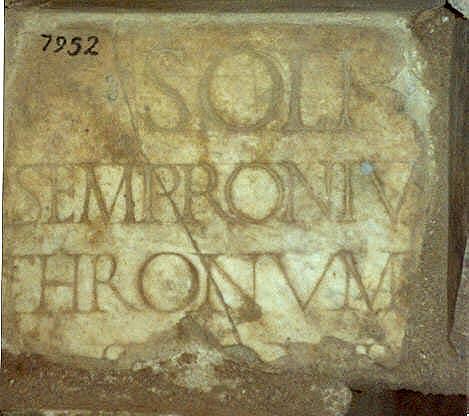
Inscription of Lucius Sempronius

Slab marble indicates that Lucius Sempronius has donated a throne to the Mitreo delle Pareti Dipinte.

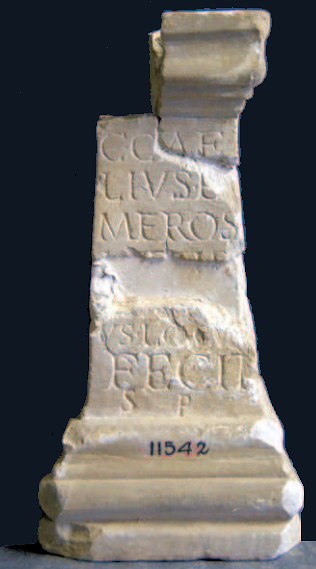
Cippus from the Mitreo delle Pareti Dipinte

This small monument bears the inscriptions of a certain Caelius Ermeros, antistes at the Mithraeum of the Painted Walls.

 
Back to Top