This site uses cookies to offer you a better browsing experience.
Find out more on how we use cookies in our privacy policy.

 
Support The New Mithraeum The New Mithraeum is an independent, non-profit project dedicated to Mithraic studies, ancient religions and classical culture. Developed and maintained independently since 2007, the site exists without advertising, paywalls or institutional funding. If you have found value in its articles, interviews, photographs or database, please consider supporting the project with a contribution. Every contribution helps keep The New Mithraeum open, free and alive. Thank you.
Support us →
Monumentum

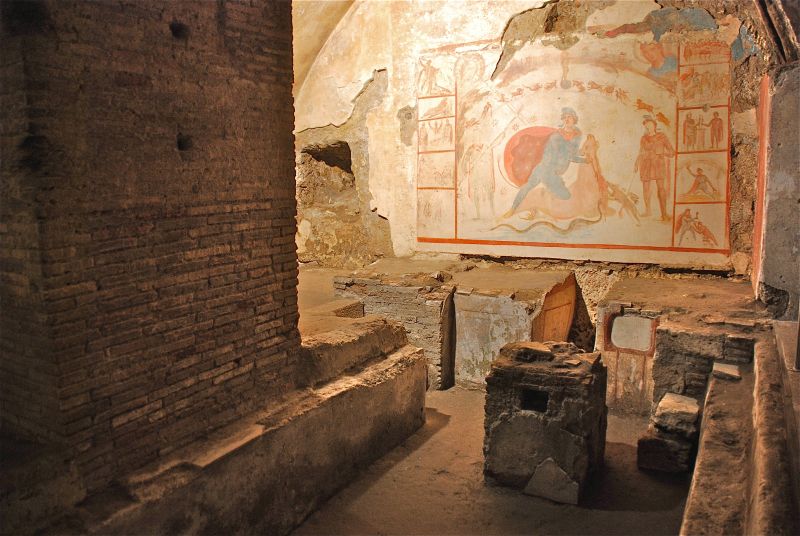
Major fresco of the Mitreo Barberini

The votive fresco from the Mithraeum Barberini displays several scenes from Mithras’s myth.
  • Fresco del Mitreo de Barberini.

    Fresco del Mitreo de Barberini.
    WantedinRome.com

  • Fresco del Mitreo de Barberini.

    Fresco del Mitreo de Barberini.
    WantedinRome.com

  • CIMRM 390

    CIMRM 390
    Vermaseren's Corpus

 
The New Mithraeum
10 Jul 2009
Updated on May 2026

TNMM 167 ↔ CIMRM 390

The substantial temple (18.3 x 7.6m) was built in stone from the beginning, it maintained throughout its history a standard plan of a central nave aisle flanked by podium benches. An apse stood at the West end. There was evidence of a narthex on the east side, however it was not possible to excavate this area.

A brief history

The first shrine (Temple 1) was founded cAD240-50. Bases for seven pairs of columns stood on the sleeper wall at the front of the benches. Two steps lead down to the earthern floor of the lower-level nave. Timber boards survived from the floor of the two side aisles (what i refer to as the benches). A wooden well stood to the left of the apse in the (according to the original orientation) SW corner.

Temple 2 was characterised by the raising of the nave floor cAD 280 almost to the top of the benches. There was no longer any significant step down and the podium in front of the apse was buried. During the 3rd phase the floor was raised even further, now raised over the original sleeper wall by several inches creating a single undivided room. In this phase (dating to the early 4th century) the cult objects and sculptures were all buried in a pit within the temple and sealed by a final floor surface.

The cause behind the constant raising of the floor may be attempts to combat the damp conditions of the stream-side location as well as having to deal with subsidence (the apse was supported by 3 strong buttresses from the start). Certainly there are signs of structural collapse occurring in the 4th and final phase which would have resulted in the roof caving in. Recent interpretations have even suggested that the mithraic community abandoned the temple and that it was occupied by a cult community dedicated to the worship of Bacchus in its last phase of use.

Sculptures and inscriptions

Marble tauroctony relief (58.5cm x 52.8cm) dedicated by Ulpius Silvanus, an emeritus of Legio II Augusta who had ’enlisted’ at Orange. Marble head of Mithras. Marble head of Serapis. Marble head of Minerva (with metal helmet missing). Marble statuette of Mercury. Marble hand of Mithras holding knife. Fragment of a marble statue of a water deity.

Excavated: 1954

Its discovery in 1954 caused a sensation with 80,000 visitors flocking to see it. By public demand the remains were saved, lifted and re-erected at the nearest available place it was unfortunately turned 90 degrees to now face north as well as being built on a high podium far above ground level. Other aspects of the restoration were my no means satisfactory (crazy paving on all the interior floors?!) but was probably the best that could be done at the time and at least did enable the ruins to be seen, no matter how grim the surroundings were. A long overdue face lift is currently being planned as the adjacent office block is due for demolition.

Visible remains: The Mithraeum is laid out in its first phase cAD 240. Note the original well-worm threshold stone. The wooden water-tank is replaced here in stone.

The sculptural remains are superbly displayed in the Museum of London.

References

Related monuments

Mitreo Barberini

The Barberini Mithraeum was discovered in 1936 in the garden of the Palazzo Barberini, owned by Conte A. Savorgnan di Brazza.

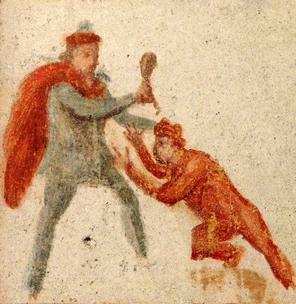
Submission scene from Barberini

This scene of the main fresco of the Mithraeum Barberini seems to depict part of the initiation into the Mithraic Mysteries.

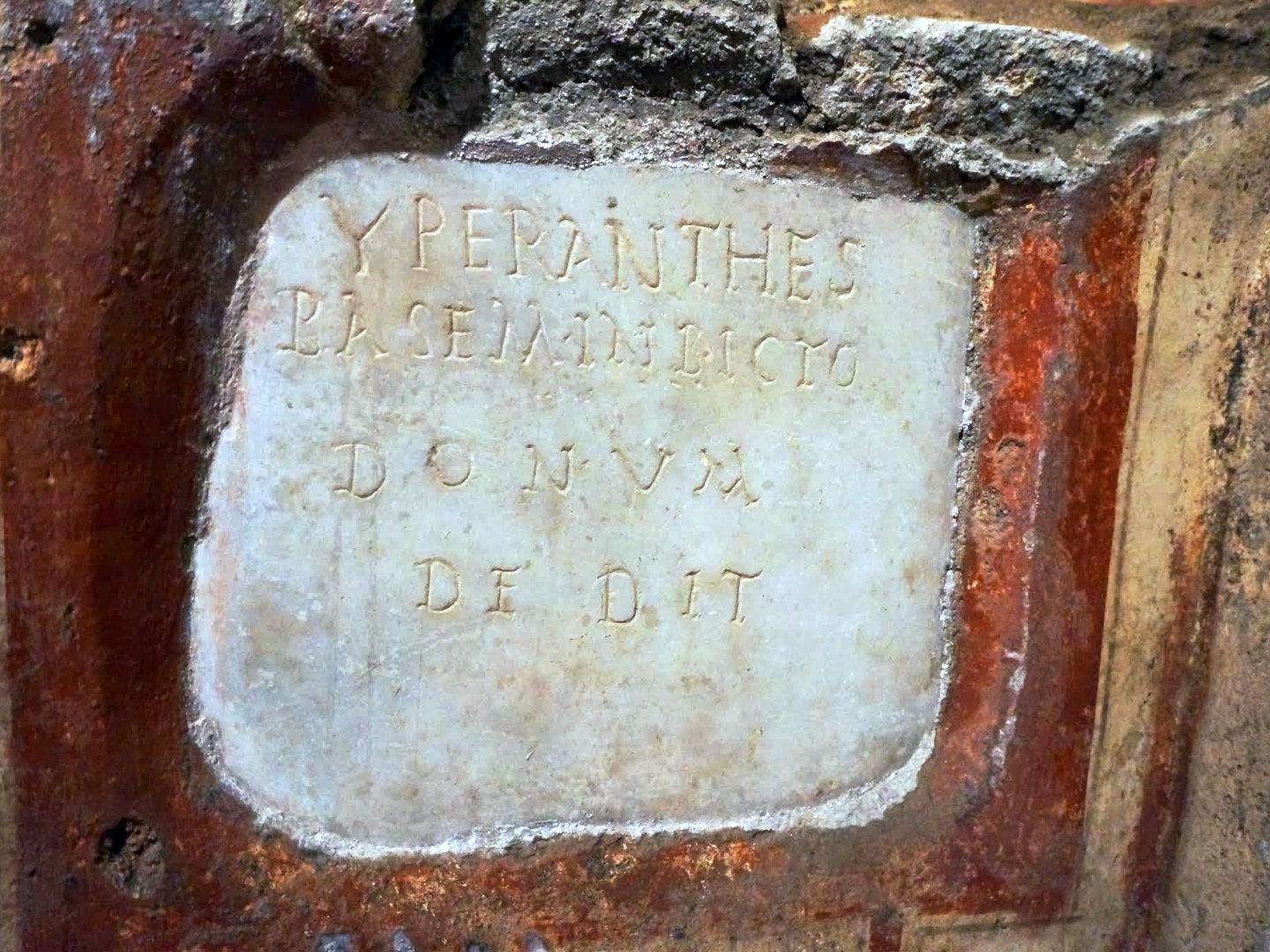
Marble slab with inscription from Mitreo Barberini

The inscription mentions the name of the donor, Yperanthes, of Persian origin.

 
Back to Top