This site uses cookies to offer you a better browsing experience.
Find out more on how we use cookies in our privacy policy.

 
Support The New Mithraeum The New Mithraeum is an independent, non-profit project dedicated to Mithraic studies, ancient religions and classical culture. Developed and maintained independently since 2007, the site exists without advertising, paywalls or institutional funding. If you have found value in its articles, interviews, photographs or database, please consider supporting the project with a contribution. Every contribution helps keep The New Mithraeum open, free and alive. Thank you.
Support us →
Monumentum

Mitreo Barberini

The Barberini Mithraeum was discovered in 1936 in the garden of the Palazzo Barberini, owned by Conte A. Savorgnan di Brazza.
  • General view of the Mitreo de Barberini

    General view of the Mitreo de Barberini
    WantedinRome.com

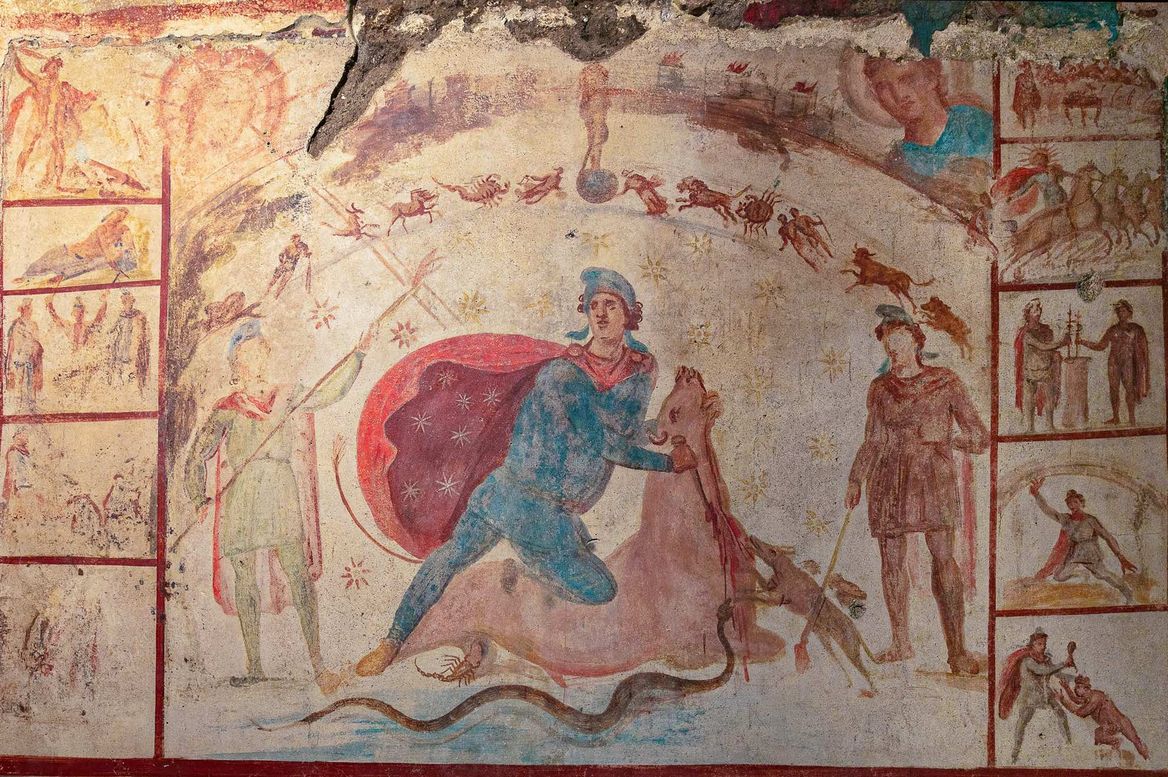
  • Fresco del Mitreo de Barberini.

    Fresco del Mitreo de Barberini.
    WantedinRome.com

  • Fresco del Mitreo de Barberini.

    Fresco del Mitreo de Barberini.
    WantedinRome.com

  • One of the frescoes of Mithraeum Barberini

    One of the frescoes of Mithraeum Barberini
    CoopCulture

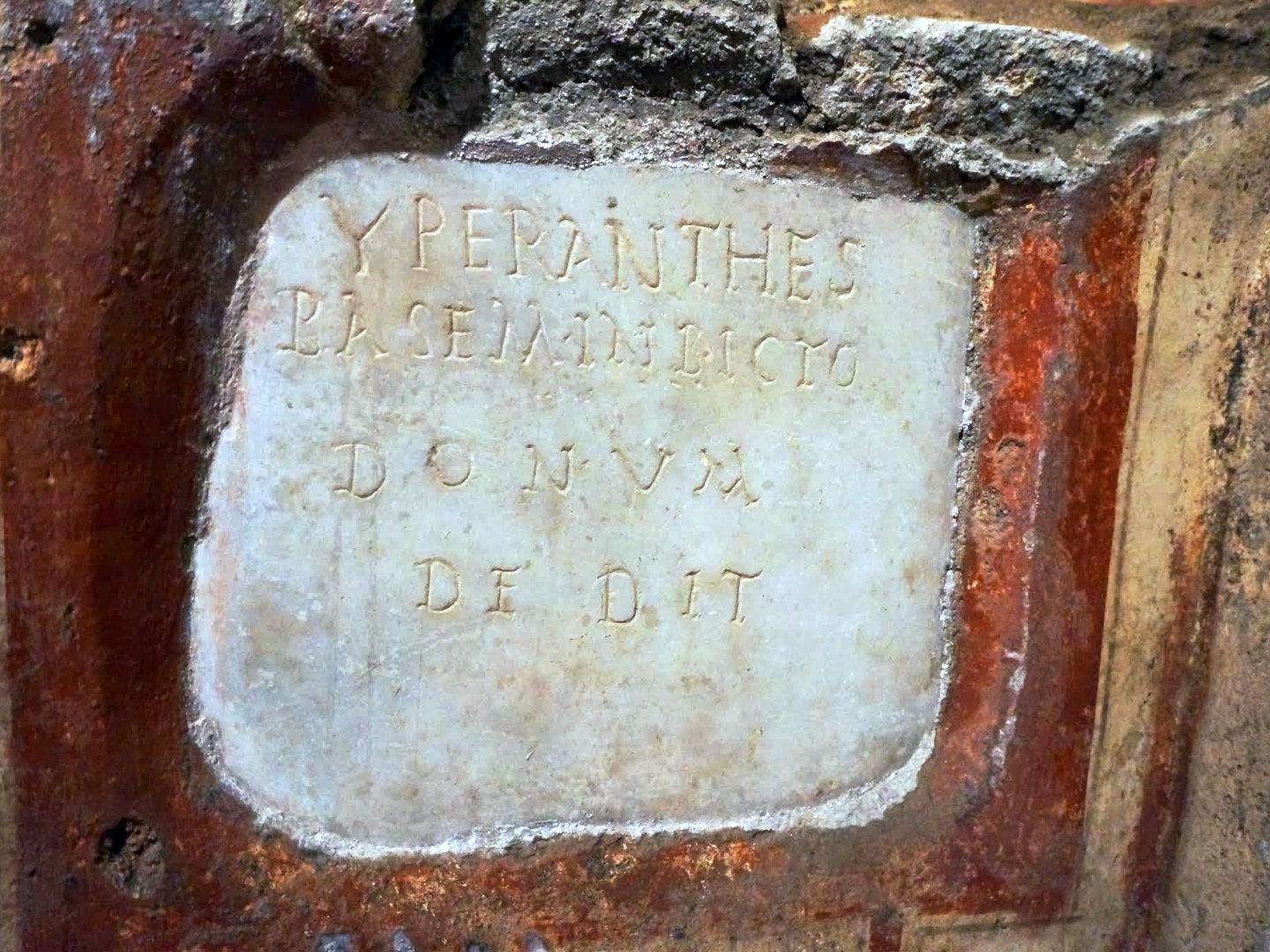
  • Inscription slab of Barberini Mithraeum

    Inscription slab of Barberini Mithraeum
    Pascal Lemaire

 
The New Mithraeum
17 May 2007
Updated on Nov 2022

TNMM 14 ↔ CIMRM 389

In 1936 in the garden of the Palazzo Barberini a Mithraeum was discovered under a house, which is the possession of Conte A. Savorgnan di Brazza.

The excavated room consists of a central room, on either side of which there is a smaller, narrower room; they are of the same size (probably first cent. A.D.). One of these rooms was changed into a Mithraeum later on. The sanctuary is rectangular (H. 4.42 L. 11.83 Br. 6.25) and is divided into a central aisle (Br. 1.95) and two side-benches, sloping towards the walls. Along the front of the r. bench (H. 0.83 Br. 1.40) as well as of the l. bench (Br. 2.45) runs a broad ledge, covered with marble.

The two benches show moreover, approximately in the middle and on floor-level, hollows for the basins. The basin of the l. bench is half-round and covered by a lid. This bench can be ascended via three steps, and it supports four brick columns, which help to support the arched roof. Behind the r. bench, which can be ascended via two steps, runs a small canal.

On the level with the side-benches against the back wall, the arched cult-niche (H. 2.15 D. 1.03) has been constructed. The arch joins the last column of the bench. On its right two fishes are painted, a remnant of the signs of the zodiac. The inside of the niche is covered with sea-shells and pumice to give it a cave-like appearance. At the foot of the niche two projecting elevations have been made (H. 0.82 Br. 0.50-0.70 D. 0.90), which are plastered on the inside and painted with undefiniable motives in blue, green and red.

References

Annibaldi in BCR 1938, 251f; R. Horn in AA 1936,475f; Lugli, Mon. Ant., 1938, 320 and Suppl., III, 31ff; Annibaldi in BCR LXXI,1943-45 (1947), 97ff. See fig. 111, taken from Annibaldi's publication, which he kindly sent to me.

Related monuments

Major fresco of the Mitreo Barberini

The votive fresco from the Mithraeum Barberini displays several scenes from Mithras’s myth.

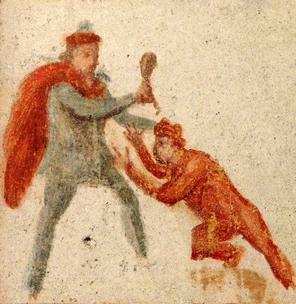
Submission scene from Barberini

This scene of the main fresco of the Mithraeum Barberini seems to depict part of the initiation into the Mithraic Mysteries.

Marble slab with inscription from Mitreo Barberini

The inscription mentions the name of the donor, Yperanthes, of Persian origin.

 
Back to Top