This site uses cookies to offer you a better browsing experience.
Find out more on how we use cookies in our privacy policy.

 
Monumentum

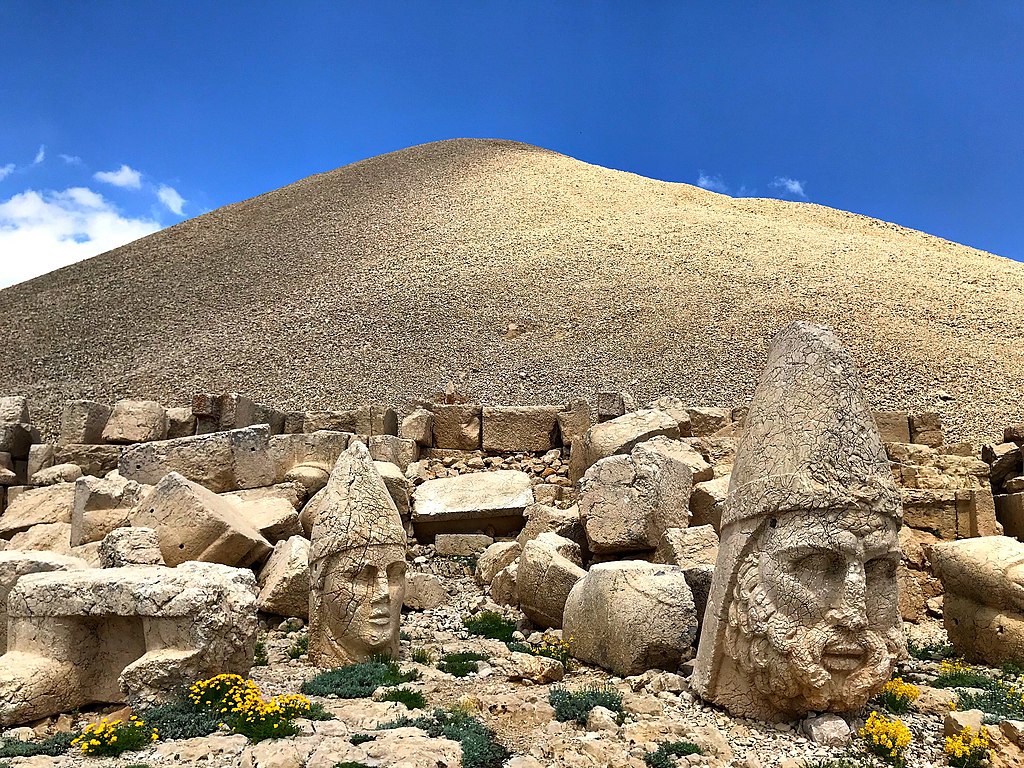
Head of Mithras at Nemrud Dag

The colossal head has been identified as a solar god, Apollo-Mihr-Mithras-Helios-Hermes.
1 / 6
 
The New Mithraeum
22 May 2021
Updated on May 2026

TNMM 275 ↔ CIMRM 29

Head of the Mithras-statue at Nemrud-Dagh.

Head of beardless Mithras in Phrygian cap, point of which is missing. Round the hem of the cap a diadem, omated with thunderbolts. Two hanging ribbons cover his ears.

CIMRM II 29

Miss Theresa Goell in AJA 62, 1958, 102f and Pl. 19 fig. 14 (cf. AJA 60, 1956, 383f): Syria XXVI, 222 n. 4) which is generally regarded as ’un témoin du culte d’Ahuramazda et de Mithra dans la montagne alaonite.’

“In 1953, when clearing the passage behind the bases of the colossi of the East Terrace, we found the ‘missing’ head of Apollo-Mithra. The head with rayed keel-shaped tiara, was lying on the rock-cut floor of the passage, indicating that it had fallen before the tumulus had been disturbed. In 1956, we lifted the head. Its schematic rendering and remote, sombre expression contrast sharply with the animation of the Apollo-Mithra of the West Terrace.”

“The deification relief of Antiochus and the Tyche of Commagene of East Socle I was enriched by the addition of the head of Antiochus (missing until now), wearing a tiara, decorated with a striding lion against a background of pomegranate blossoms and fruit. The diadem carries an orientalizing procession of lions.”


Mount Nemrut (Armenian: Նեմրութ լեռ) is a mountain in southeastern Turkey, notable for the summit where a number of large statues are erected around what is assumed to be a royal tomb from the 1st century BC. It is referred as the pantheon of the Armenian gods.

In 62 BC, King Antiochus I Theos of Commagene built on the mountain top a tomb-sanctuary flanked by huge statues 8–9 m high of himself, two lions, two eagles and various Greek, Armenian, and Iranian gods, such as Vahagn-Hercules, Aramazd-Zeus or Oromasdes (associated with the Iranian god Ahura Mazda), Bakht-Tyche, and Mihr-Apollo-Mithras. These statues were once seated, with names of each god inscribed on them.

They were presented in the form of monumental statues on Mount Nemrut. Looking at the group of seated figures from left to right, these were: Antiochus himself, the goddess of Commagene, Zeus-Orosmasdes-Ahura Mazda, Apollo-Mithras-Helios-Hermes, and Artagnes-Bahram-Heracles-Ares. The complex nomenclature of these deities results from the syncretic character of the religion promoted by Antiochus, which combined the elements of Zoroastrianism and the classical Greek pantheon.

The heads of the statues have at some stage been removed from their bodies, and they are now scattered throughout the site. The pattern of damage to the heads (notably to noses) suggests that they were deliberately damaged as a result of iconoclasm.


The famous funerary monument of Antiochus I of Commagene on the Nemrud Dagh has two groups of five gigantic statues, among which those of Antiochus (79 – 38) and of Mithras are very similar in appearance. They are both depicted as young gods. Consequently, modern scholars could scarcely distinguish one from the other until John Young established that Antiochus always wears an Armenian tiara, whereas Mithras wears the Persian one. Apart form their headdresses, though, they appear to be the same, and all researches prior to Young’s clarification had actually inverted the identification of the two.

References

Humann-Puchstein Reisen 295 and Pl. XXXI I; MMM II 187 No. 2 and fig. 9; Goell in ILN 1955 1094 ff gives a report about new excavations.

Related monuments

Mount Nemrut Dağı

Mount Nemrut or Nemrud is one of the highest peaks in the eastern Taurus Mountains, southeastern Turkey. On its summit large statues stand around what is supposed to be a royal tomb from the 1st century BC.

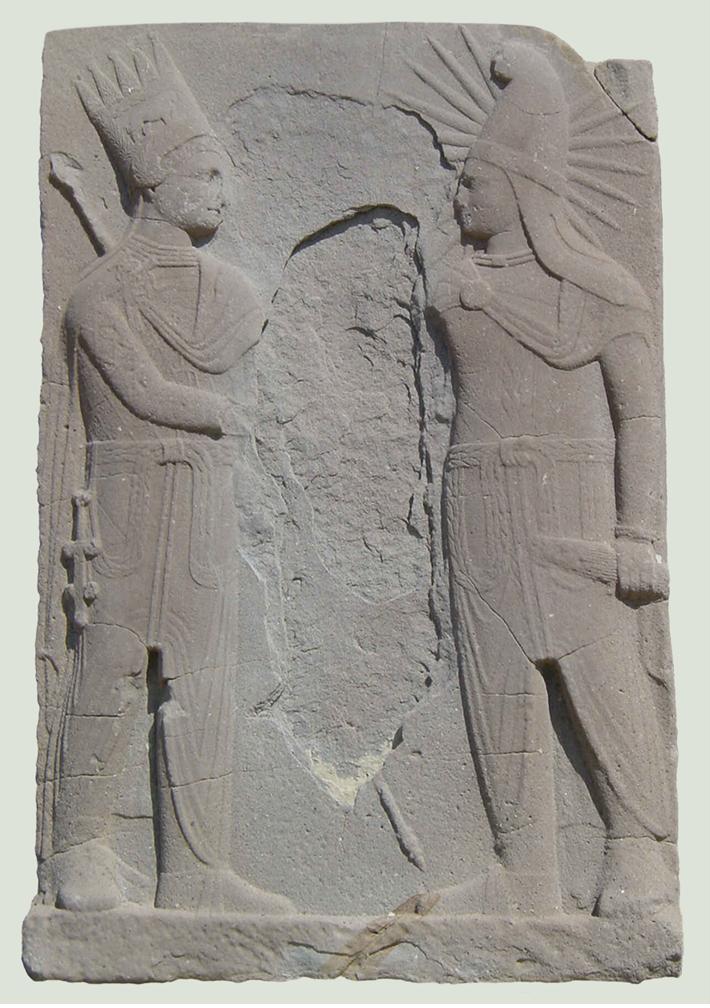
Antiochus I shakes hands with Mithras

Antiochus I of Commagene shakes Mithras hands in this relief from the Nemrut Dagi temple.

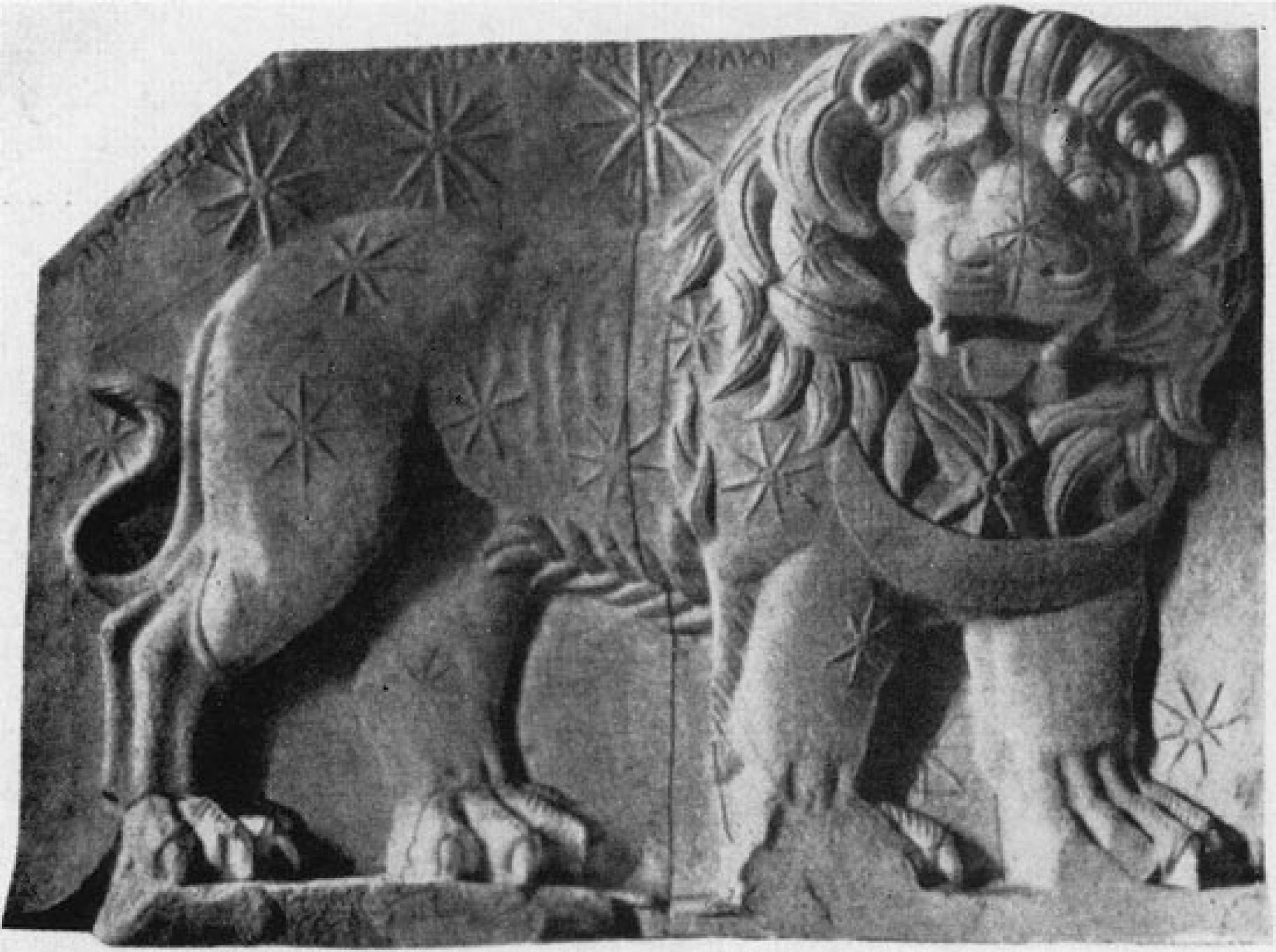
Lion relief from Nemrut Dağı

The lion relief from Nemrut Dag has the moon and several stars over his body.

 
Back to Top