Hekataion of Sidon
TNMM 305 ↔ CIMRM 84 & 85
Statue of Parian marble (H. 0.755; diam. base 0.245).
On a base, in which an inscription (No. 85), a standing triple Hekate, the heads of whom bear a commune polos. The figure is encircled by three dancing Nymphs.
CIMRM 85
Φλ. Γερόντιος, πατὴρ νόμιμος, εὐχαριστῶν τὴν θέον ἀφιερωσάτω φʹ ἔτι.
The goddess stands on a circular plinth, taking the form of a female figure repeated three times and transformed into Hermes. The arms are missing: they have been replaced by three massive tenons extending from the shoulders. The lower body is not visible, hidden by a circle of three young dancers. The three divine figures stand closely together; they wear the same costume, a long chiton clinging to the chest, from which long folds fall. The face is regular, yet takes on a different expression depending on the treatment of the mouth, which is more or less pursed. The pupils are deeply marked by a small cup-shaped indentation. The abundant hair is divided into two masses above the forehead, on either side of a central parting; a ribbon holds it in place; a long strand twisted into ringlets frames the face on each side. A hollow, cylindrical element rests on the three heads, forming a sort of crown.
All around the goddess, a circle of three young girls—much smaller than Hecate—is dancing. They hold hands, and the movement carries them now to the left, now to the right. They wear a chiton cinched beneath the breasts with a belt, with short sleeves or sleeveless depending on the figure, over which is draped a cloak fluttering in the wind. Their feet are shod in pointed shoes stitched at the top, a style characteristic of late antiquity. Their hair, as abundant as Hecate’s, is styled in bands and gathered into a thick mass at the nape of the neck. The statue is impeccably polished. The edge of the plinth bears the dedication of Flavios Gerontios in tall, narrow letters.
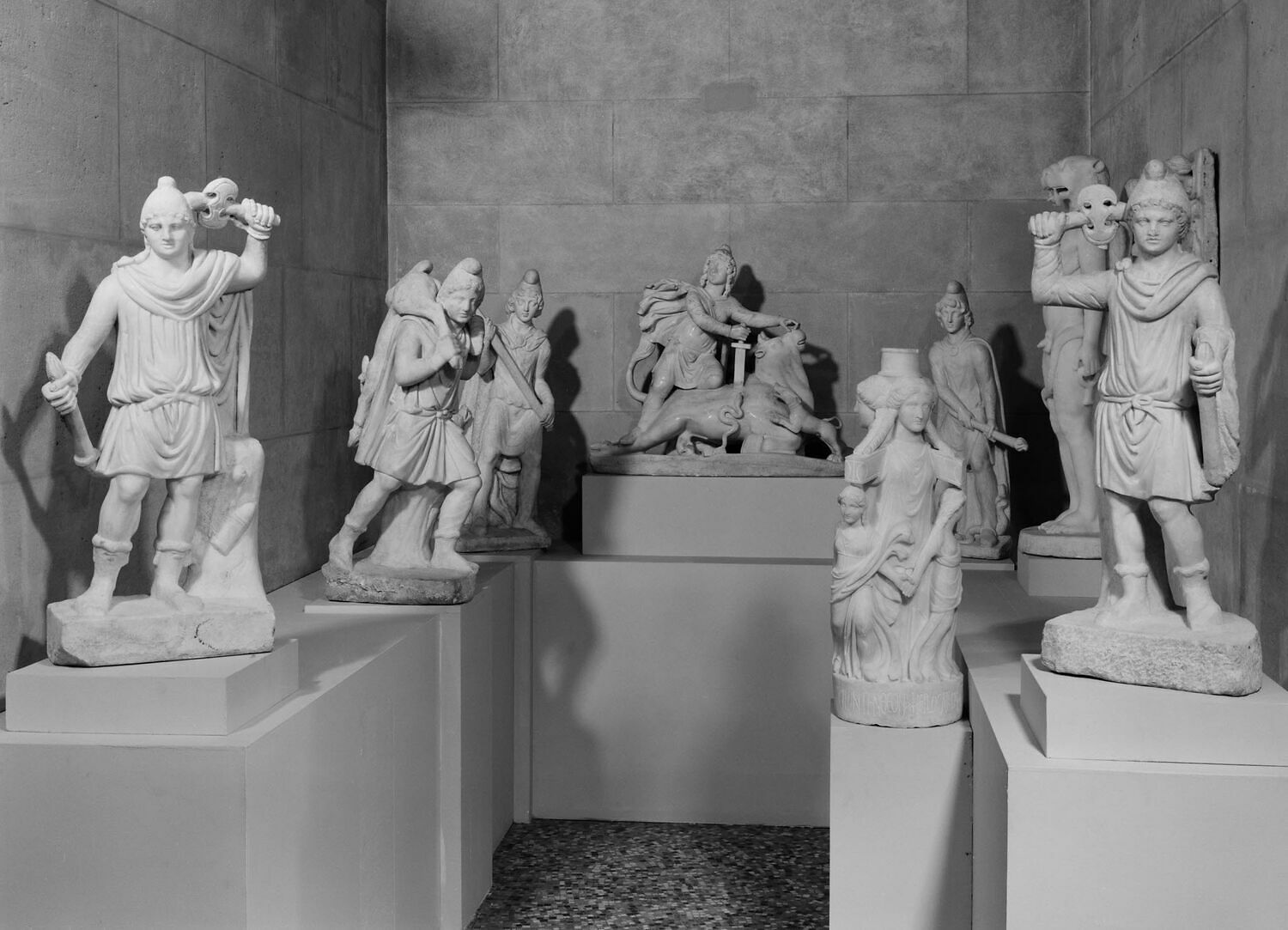
The depiction of a triple Hecate in the form of a hermaic pillar—here strongly emphasised by the prominent presence of the tenons replacing the arms and by the cylindrical support at the top—is common. She is thus often accompanied by dancers, whose appearance harks back to the art of the late Hellenistic period. The Sidon group is therefore not an isolated case in iconography. It is, moreover—as we shall recall—one of the deities for whom certain members of the Roman aristocracy still held the priesthood at the end of antiquity. Yet one might nevertheless be surprised by her presence amongst the statues of the mithraeum: perhaps his connections with the underworld forces – Hecate is a chthonic deity – may explain it. Or perhaps we should simply consider, as is clearly seen in other cases, that ancient sanctuaries were less exclusive than we might tend to think, and were more welcoming to other deities.
La plus curieuse de nos trois pièces, l’Hécataion n° 54, nous fournit d’abord une preuve indirecte de sa date tardive. Cumont a cherché jadis à éclairer le rôle de la déesse infernale dans le mithriacisme (Cumont, Textes et mon., I, p. 140 avec référ.) mais on remarque que le groupe de Sidon est la preuve majeure des rapports d’Hécate avec le dieu iranien : on ne saurait pour le reste invoquer qu’une dédicace d’Apulum qui doit appartenir au IIIe siècle et un fragment de sculpture du Mithréum de S. Prisca à Rome. Le nom de la Trivia apparaît ensuite fréquemment dans les inscriptions du groupe de Vettius Agorius Praetextatus, mais en compagnie d’autres divinités orientales dont la connexion profonde, et surtout ancienne, avec Mithra n’est pas démontrée. Ces textes sont une preuve plutôt de la vigueur que conservait le culte d’Hécate, ou qu’il avait regagnée, à cette date. Et l’on peut citer d’autres indices : ainsi Malalas nous raconte qu’à Antioche Dioclétien consacra à la déesse une crypte où l’on descendait par un escalier de 365 marches; et, à Rome, son sanctuaire, qu’il faut sans doute chercher dans les grottes du Capitole, fut détruit par Stilicon seulement. L’Hécataion de Sidon peut ainsi fort bien se rattacher à ce même courant tardif.
Le même Hécataion offre une autre particularité notable. Examinons un instant la chaussure que portent les trois Grâces évoluant autour de l’idole centrale : c’est un soulier fermé, pointu, et montrant soit une couture, soit une pièce rapportée longitudinale sur l’empeigne. Ce type peut être antérieur au IVe siècle, mais il est attesté nettement à cette période et postérieurement. En tout cas, où voit-on au IIe siècle des Grâces portant des chaussures autres que des sandales, à moins qu’elles ne soient pieds nus ?
Main inscription
References
de Ridder, 67ffNo. 54 and Pl. XXVIII; Will in Syria XXVII, 1950, 167 fig. 1.
- Vermaseren, Maarten Jozef (1956) Corpus Inscriptionum et Monumentorum Religionis Mithriacae
- Ernest Will (1950) La Date du Mithréum de Sidon. Syria. Tome 27 fascicule 3-4, pp. 261-269.
- François Baratte (2001) Le mithreum de Sidon : certitudes et questions.