This site uses cookies to offer you a better browsing experience.
Find out more on how we use cookies in our privacy policy.

 
Monumentum

Cippus à Zeus Helios great Serapis

This small cippus to Zeus, Helios and Serapis includes Mithras as one of the main gods, although some authors argue that it could be the name of the donor.
 
The New Mithraeum
23 Sep 2023
Updated on May 2026

TNMM 628 ↔ CIMRM 463 & 463,I

In the hall (near η) stood a small marble cippus (H. 0.33 Br. 0.18 D. 0.21) with on both sides a patera, on the front and back an inscription (Mus. Naz. Therme, Inv. No. 69651).

  1. Εἷς Ζεὺς / Μίτρας / ῞Ηλιος / κοσμοκράτωρ / ἀνείκητος.
  2. Διὶ Ἡλίῳ / μεγάλῳ / Σαράπιδι / σωτῆρι / πλουτοδότῃ / ἐπηκόῳ / εὐργέτῃ / ἀνεικήτῳ / Μίθρᾳ / χαριστήριον.

CIMRM 463, I

In the inscription the word Sarapis has been altered into Mitras.


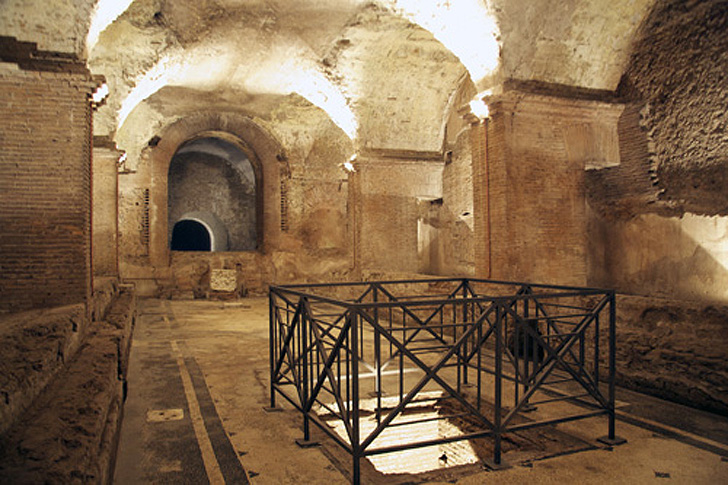
Marble cippus found in 1912 in the pronaos of the Mithreum in the Baths of Caracalla in Rome. It bears two Greek inscriptions engraved on the front and back of the monument. On the reverse side, there is a relative accumulation of theonyms and epithets that affirm the identity of the essential functions of the gods named, reinforcing the intensification expressed by the acclamation on the front. In this way, two ritual forms are combined: communication through the expression of a wish and communication through the proclamation of a shared identity.

The stone was later reused by a Mithraic brotherhood and the name Sarapis was replaced by Mithras on the front. On the back of the stone, some scholars, such as F. Cumont, believe that it is a theophoric name in the nominative, and others that it is a theonym in the dative (L. Moretti in the IGUR). The latter hypothesis, which would add the name of Mithras to the list above, cannot be ruled out if we consider that this second text is later than the first. But this is hardly convincing. If a worshipper of Mithras had wanted to celebrate his god in this way, why would he have bothered with Sarapis and, above all, why would he have waited until the end of the inscription to add the divine name? Instead, we should consider that Mithras refers to the dedicator, whose oriental origin is hardly in doubt, judging by the laudatory vocabulary used. Other worshippers of Isis bear this theophoric name, again in Rome (RICIS 501/0125 [TNMM 630]) or in Apuleius’ Metamorphoses, where the high priest of Isis himself is called Mithras. It was undoubtedly because of this ambiguity that the stone was brought to the mithraeum and the name Sarapis was erased in favour of Mithras, an action that was not necessary for the second text.

The epithets attached to the names of the gods express their almightiness and omnipotence, an absolute supremacy that we find again later in a speech by the Emperor Julian (Discourse XI On Helios-King 10).

CIMRM II 463,I

In the inscription the word Sarapis has been altered into Mitras.

Main inscription

Εἷς Ζεὺς / [[Σάραπις]] / ῞Ηλιος / κοσμοκράτωρ / ἀνείκητος.
Διὶ Ἡλίῳ / μεγάλῳ / Σαράπιδι / σωτῆρι / πλουτοδότῃ / ἐπηκόῳ / εὐργέτῃ / ἀνεικήτῳ / Μίθρα / χαριστήριον.
One is Zeus [[Sarapis]] Helios, lord of the world, invincible.
To Zeus Helios, great Sarapis, saviour, bringer of wealth, hearer of prayers, benefactor, invincible Mithras, in gratitude.

References

Ghislanzoni 323; Parpaglio Zon. Mon. 58 en fig. XIII; Cumont-Canet in eRA! 1919 315f; Weinreich Urk. Sar. 24ff; Paribeni Terme Diocl. 140 No. 288; Nock in JHS 192589; Peterson 227ff; Cumont in RHR 1934 64.

Related monuments

Mithraeum of the Baths of Caracalla

The Mitreo delle terme di Caracalla is one of the largest temples dedicated to Mithras ever found in Rome.

Fresco of Mithras

Fresco of Mithras found in an arched niche above the right bench of the Baths of Caracalla’s Mithraeum in Rome.

 
Back to Top