Mithräum von Friedberg
TNMM 87 ↔ CIMRM 1052
During excavations in the years 1849, 1881 and 1894 on the eastern slope of the town of Friedberg, a Mithraeum was found in the Grosse Klostergasse.
The Mithraeum is situated near a crossing of Roman roads, one of which leads towards the entrance. One enters this sanctuary (L. ± 11.00; Br. 5.45) by means of stairs which are constructed between walls with niches. It is not certain if there was a pronaos. The sanctuary, which actually lies three metres underground, has the normal division into a central aisle (Br. 1.87) and two benches (Br. 1.24). The floor of the central aisle rises towards the back-wall. It was not possible to determine if the podia reached the north wall, nor is it clear how the roof was made.
The side-walls were plastered: traces of red and white painting are preserved. The Mithraeum had no cult-niche, but three bases were set up in the central aisle at some distance from the back-wall.
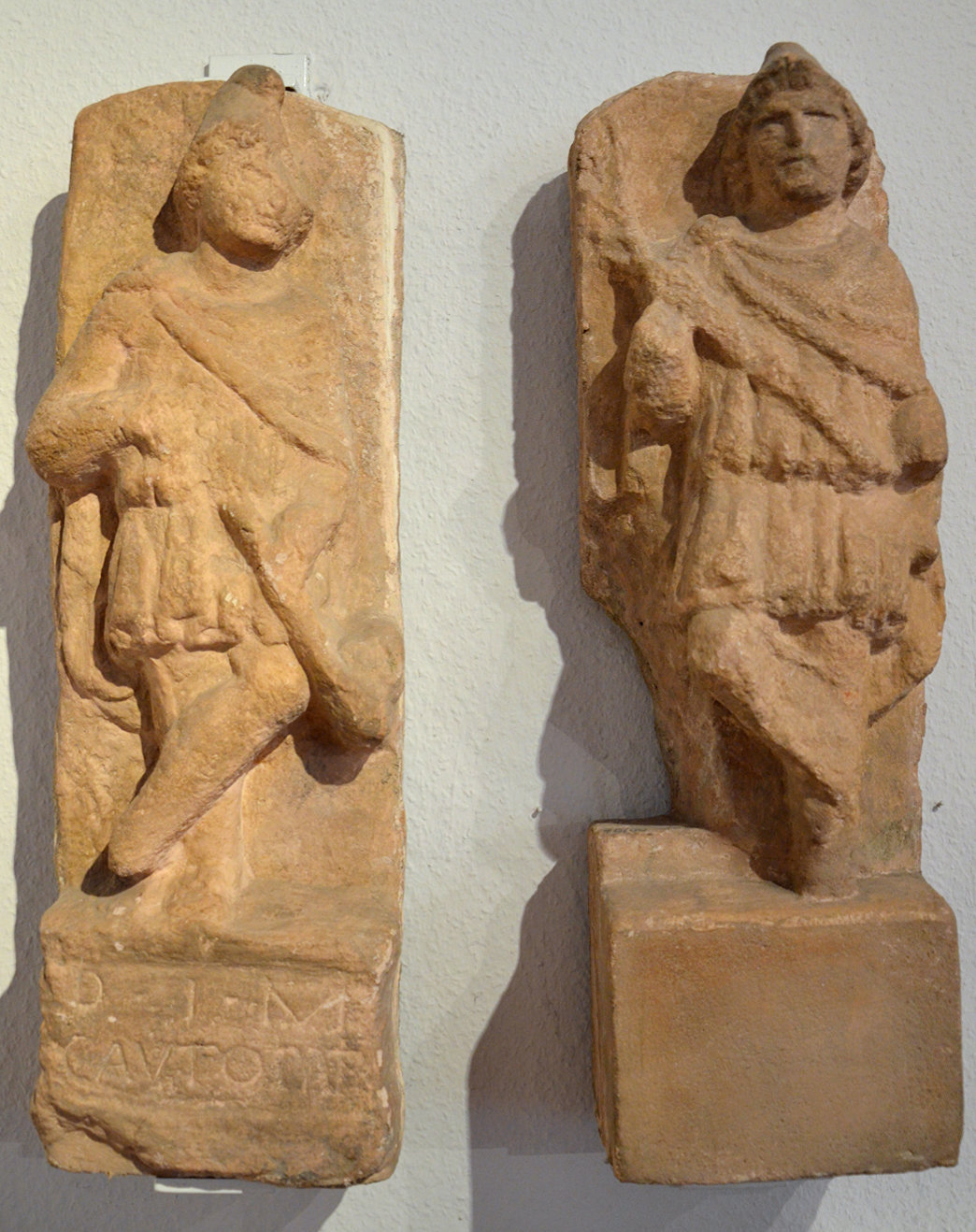
There have probably been three mithraea discovered at Friedberg. These were found in 1849,1881, 1894. The most prominent of these three was found at the Grosse Klostergasse near the old train station. A tauroctony was found depicting Mithras slaying the bull. His attendants Cautes and Cautopates were to his left and right. Cautes was holding a torch pointed upward, and Cautopates had a torch pointing downward. Two alters were found beneath the relief. One was dedicated to Soli Invicto Imp, the Sun God the Invincible Emperor.
The other altar was dedicated to Virtuti Invictae Imp, the Invincible Goddess Virtus. Both altars were dedicated by Gaius Paulinius Justus who was the benficiarius consularis or the officer in charge of the road police under the direct control of the provincial governor.
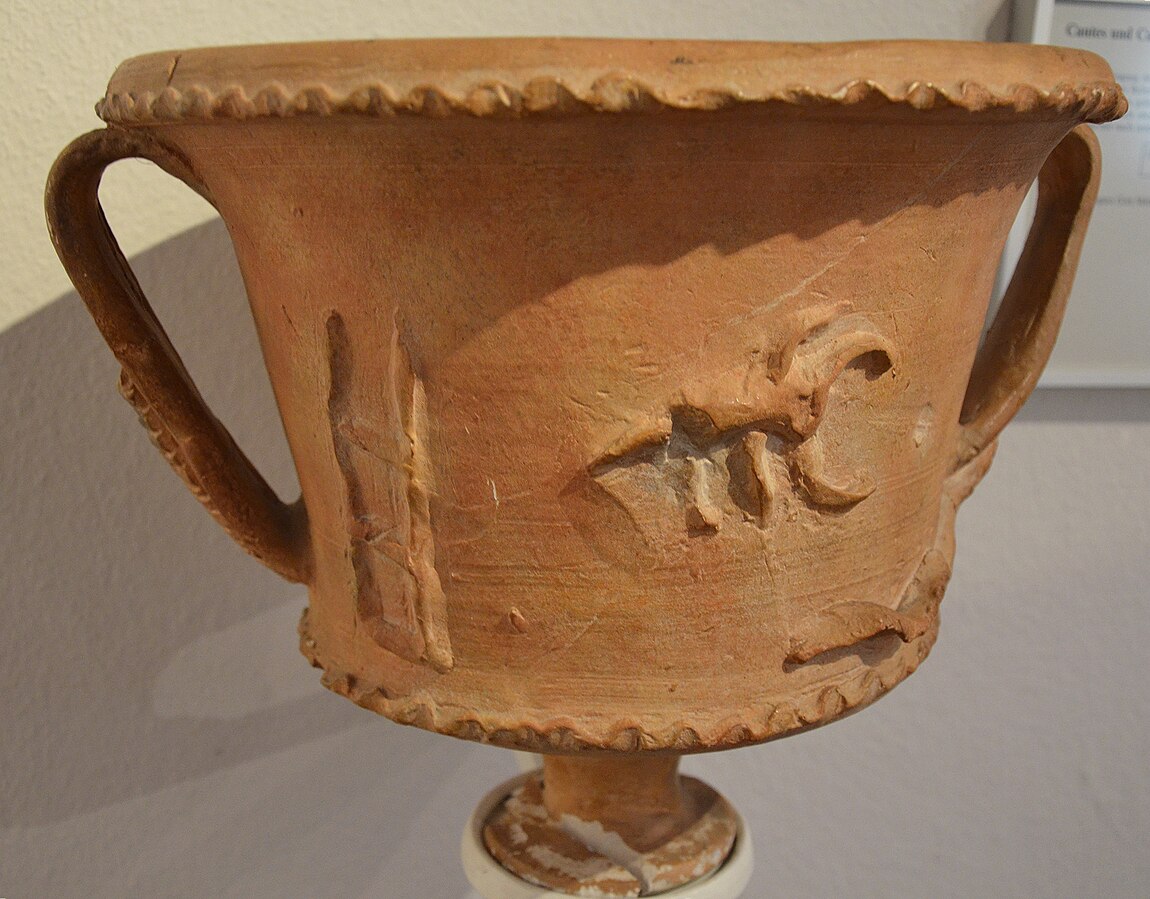
There were also two pottery vessels found in this mithräum which are called Schlangengefässe. The smaller one was probably used as an offering dish and is decorated with a snake and a frog on the rim. The other is the well-known Friedberg Krater which is 0.32 meters high and 0.36 meters in diameter. This crater is decorated with a scorpion and snake facing right. There is also a ladder-like symbol with three horizontal bars resembling rungs. There are two handles with a snake coiled around each one. The base has a small foot. The crater is dated to the late second or early third century. Scholars have speculated that the crater was used in the fourth degree of Leo to pour honey on to the hands of new initiates. Hideo Ogowa discussed the meaning of the ladder symbol to the Mithraic cult in detail.
All of these finds are on display at the Wetterau-Museum in Friedbergn Goldmann. Neue Funde.
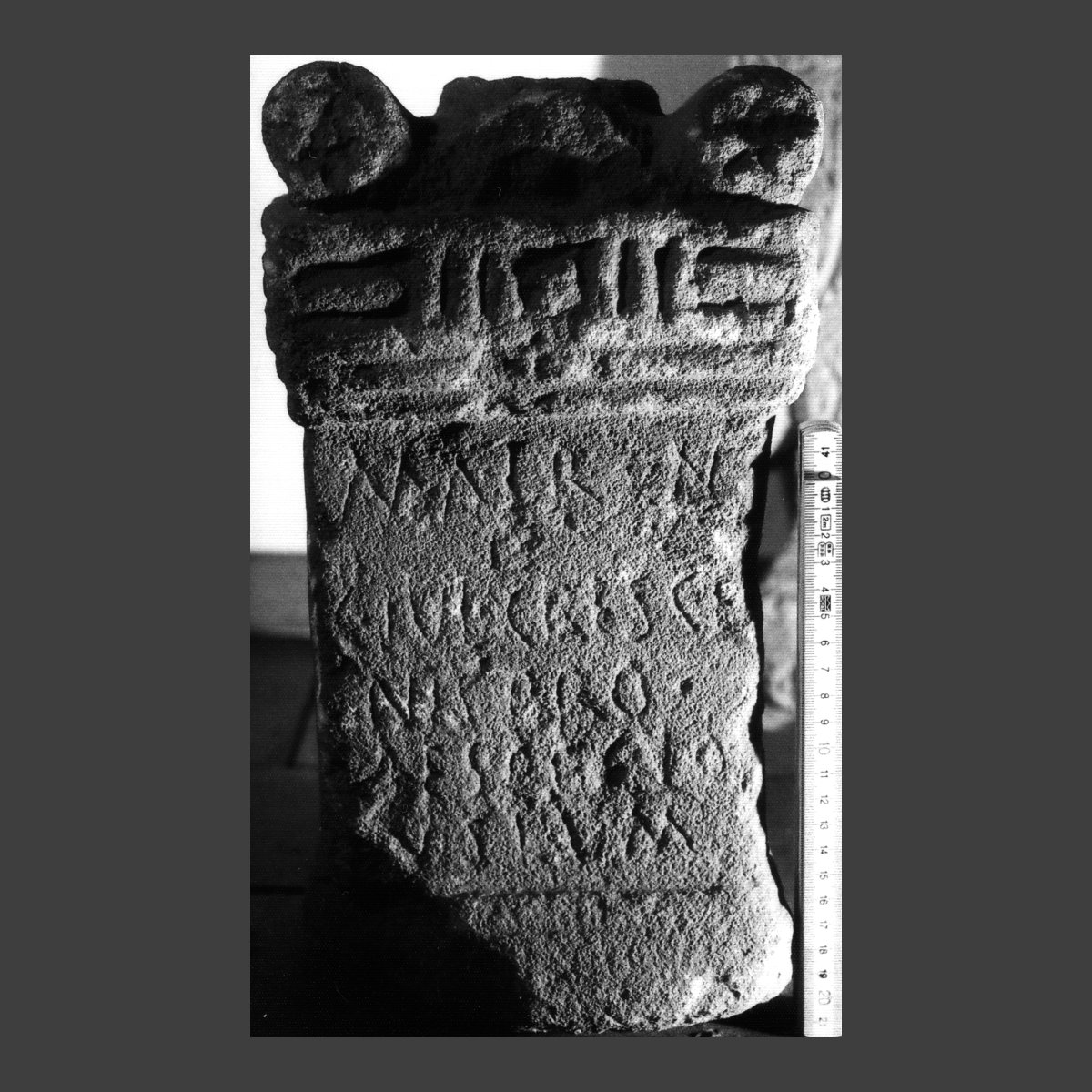
The mithraeum at Friedberg, the ancient Taunum in Upper Germania, discovered in 1849 and completely excavated in 1881 and 1894, has yielded a number of monuments that would appear to be unrelated to the cults of Mithras proper. This is the case of a fragmentary sandstone altar, found lying on top of another altar dedicated to Sol invincible and bearing a dedication to the matrons engraved on the capital, by a citizen of Gallic or Germanic origin.
References
Ph. Dieffenbach in AHGA VI, 1851, 243 ff.; de Ring, Cautopates; G. Dieffenbach in KGV 1881, 73; Tagebuch VIII, 61 ff.; XVIII, 1 ff.; G. Wolff in KGV 1882, nos. 11–12; R. Schäfer in KGV 1881, 73 f. and 1883, 10; WsdZ (Korr.) 1882, 18 f. and 1883, 5; Goldmann in WsdZ (Korr.) 1894, 179 ff.; AHGA 1895, 275 ff.; MMM II, 354 ff. no. 248; Buchhold, Mus. Darmstadt, 31 ff.; Schmidt, Friedberg, 10 ff.; G. Blecker, Das Wetterauer Museum in Dreher-Blecker, Friedberg; Esp. Rec. Germ., 57 ff. no. 83 ff. See our fig. 268 from Goldmann.
- Vermaseren, Maarten Jozef (1956) Corpus Inscriptionum et Monumentorum Religionis Mithriacae
- Bricault; Roy (2021) Les cultes de Mithra dans l'Empire Romain.
- Hideo Ogowa (1978) Mithraic ladder symbols and the Friedberg Crater.
- Kb. Wd. Z. Ges. K. (1897) Ein drittes Mithraeum in Friedberg.