A name older than Greece
Whats in a Name
Lenni George
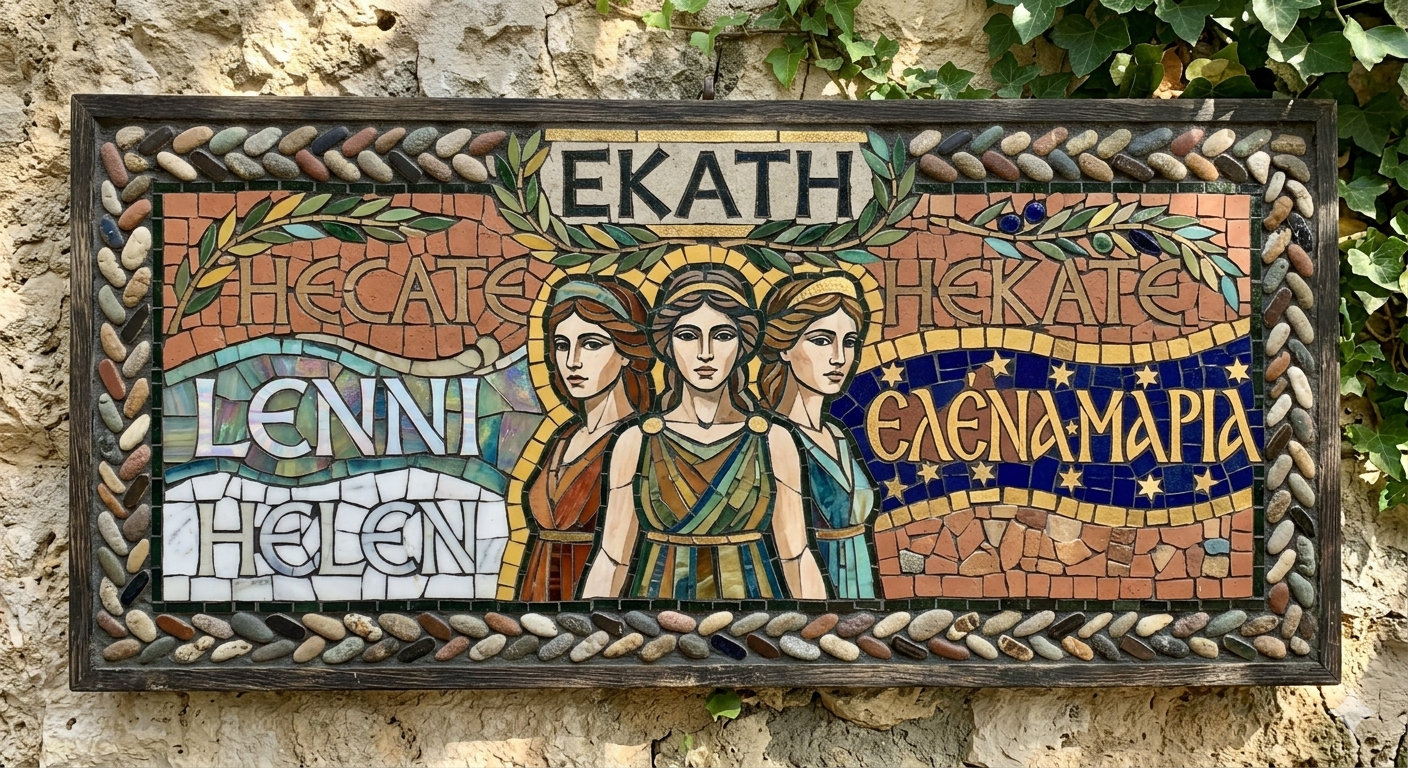
I was baptised in the Greek Orthodox Church as Elenamaria. The priest was not pleased. There is no Saint Elenamaria, and in the Greek tradition you are expected to carry the name of a saint into the world as a form of spiritual protection and genealogical continuity. The name was itself a compromise reached on the way to the church: my maternal grandmother, Eleni, had claimed me as the first grandchild and fully expected me to carry her name forward. My mother had wanted Maria, after her closest friend. Elenamaria was what emerged from the negotiation, an act of naming that attempted to serve everyone and satisfied no one completely, least of all the priest who had to register it.
My Greek Cypriot family called me Elenamaria, or simply Eleni when they wanted to emphasise the grandmother’s claim. My English family, with the cheerful pragmatism of people who find foreign syllables mildly inconvenient, settled on Helen. At seventeen I chose Lenni for myself, a name that felt like mine in a way that neither the baptismal compromise nor the anglicised version ever quite had. I am now, at some distance from seventeen, in the process of formally registering the name Lenni in Cyprus, which means navigating the bureaucratic machinery of a state that last had official sight of me as Elenamaria. The name, in other words, has been transliterated, anglicised, claimed by other people’s emotional investments, and finally reclaimed. What it was at the beginning and what it is now are not entirely different things. But the journey between them is not trivial.
I think about this when I read the scholarly debates about Hekate’s name. The question of what the name means, where it comes from, and what it tells us about who she was before she entered the Greek literary record is not merely academic. It is a question about how a name carries identity across time, through languages and cultures that each impose their own claims, and what survives that process.
The Greek derivation and its limits
The etymology most commonly offered begins with the Greek hekatos, meaning far-shooting or far-working, an epithet applied to Apollo in his aspect as the archer god who strikes from a distance. The feminine form would give us Hekate as, in some sense, a female equivalent: she who works from afar, whose power operates at a remove. The derivation is tidy and has been accepted by a number of scholars.
It is also, probably, a folk etymology. The term hekatos appears to have been applied to Apollo as a description of his particular mode of action, not as a root from which deity names were formed. Working backwards from the epithet to claim it as the origin of Hekate’s name assumes a derivation that the linguistic evidence does not firmly support. As the mythographer Karl Kerenyi observed, names in the Greek divine tradition were often rationalised after the fact, their origins explained by association with attributes the deity had already accumulated rather than from genuine etymological descent (Kerenyi, 1951).
This does not mean the hekatos connection is worthless. It may reflect how Greek-speaking worshippers understood her name once she was established in their tradition. But understanding how a name was received is not the same as knowing where it came from.
Persis: daughter of Perses, or something older
One of Hekate’s most consistent epithets across the ancient sources is Perseian, or Perseis, recorded in the Orphic Hymns, in Apollonius of Rhodes’s Argonautica, and in the Pseudo-Apollodorus Bibliotheca. The standard interpretation, which is correct as far as it goes, is that this epithet simply means daughter of Perses, Hekate’s Titan father in Hesiod’s genealogy.
Perses is described in the Theogony as a son of the Titan Crius and Eurybia, a daughter of the primordial sea deity Pontus (Hesiod, trans. Most, 2006, lines 375 to 410). His name derives from the Greek perthō, to sack, to ravage, to destroy, which places him in a tradition of cosmic destructive forces that preceded the Olympian order. His brothers were Astraeus, the Titan of the stars and planets, and Pallas, a Titan of warfare. Perses married his cousin Asteria, the Titaness of falling stars and nocturnal divination, daughter of Coeus and Phoebe. Hekate was their only child.
There is, however, a second Perses in the mythological tradition who also appears as Hekate’s father in some accounts. This Perses is a son of Helios, the sun god, and the Oceanid Perse (also called Perseis), and in some versions he is a king of Colchis, the land of Medea. Diodorus Siculus records a rationalised version of Hekate’s story in which she is a mortal priestess of Artemis, daughter of this Colchian Perses and granddaughter of Helios, whose botanical and magical knowledge forms the basis for the later divine mythology (Diodorus Siculus, Library of History, 4.45). This version is secondary and probably represents an attempt to make sense of the goddess in more humanised terms, but it produces a fascinating knot: both Titan Perses and the Colchian Perses carry names that overlap phonetically with the Greek word for Persian, and Hekate’s Perseis epithet has accordingly attracted speculation about whether there is a genuine Persian strand in her origins.
The connection cannot be pressed too far. The Greek word Persís meaning female Persian and the name Perses meaning the destroyer share a phonetic similarity that may be coincidental. But Kerenyi, writing in 1951, noted that the cluster of names in Hekate’s family, Perses, Perseis, Persephone, all of which share that Pers root, appears to designate a chthonic and lunar quality that runs through several distinct mythological figures and may reflect a very old stratum of religious thought about the relationship between the moon, the underworld, and the destructive aspects of the divine feminine (Kerenyi, 1951). Whether that stratum has any genuine connection to Persia, or whether the phonetic overlap is a red herring that attracted the attention of later mythographers, is a question the evidence does not resolve.
A Titaness, not a latecomer
It is worth pausing on what Hekate’s parentage actually means within the Hesiodic cosmological framework. Both her parents are Titans: Perses, a second-generation Titan, son of Crius and Eurybia; Asteria, a first-generation Titaness, daughter of Coeus and Phoebe. This makes Hekate herself a figure of Titan descent, a pre-Olympian lineage that places her outside the family structure within which Zeus and the other Olympian deities operate.
The Titans were not simply the generation of gods that the Olympians defeated and replaced. In Hesiod’s account they represent a cosmic order that preceded and underlies the Olympian one, and figures of Titan descent who survived into the post-Titanomachy world, such as Prometheus, Leto, and Hekate, carry within them a quality of authority that does not derive from Zeus and cannot be revoked by him. This is precisely why the passage in the Theogony where Zeus honours Hekate above all others is so striking. He is not conferring authority on her. He is acknowledging authority she already possesses. As Hesiod makes explicit, her share of earth, sea and sky was given to her not by Zeus but by Destiny, and she retained it through the Titanomachy by the particular arrangement of cosmic justice that Zeus himself embodies (Hesiod, trans. Most, 2006, lines 411 to 452).
Hekate is, in other words, not simply a powerful goddess within the Olympian pantheon. She is a figure whose power predates and transcends that pantheon. The only child of two Titans, carrying within her the stellar and nocturnal qualities of her mother Asteria and the destructive-wise qualities of her father Perses, she arrives in the Greek literary record already complete, already honoured, already larger than any single tradition has quite managed to contain her.
The Carian evidence
The most persuasive case for a pre-Greek origin of Hekate’s name comes not from literary etymology but from epigraphic evidence in Caria, a region of southwestern Anatolia that is now part of Turkey. Theophoric personal names, names that incorporate the names of deities, containing elements recognisably related to Hekate appear in Carian inscriptions that predate significant Greek influence in the region. Wiktor Berg argued in 1974 that this constitutes genuine evidence of a Carian origin, and the comprehensive study of the Carian language by Ignasi-Xavier Adiego (2007) provides the linguistic framework within which the Carian material can be evaluated with greater precision than was previously possible.
If the name is Carian in origin, then the Greek hekatos etymology is not an origin story but a later rationalisation, a way of making a foreign-sounding name legible within Greek linguistic categories. This is an entirely normal process in the history of religion: when a deity crosses a cultural boundary, the new culture tends to explain the name in terms of its own language, even if that explanation has no genuine etymological basis. The name arrives, the culture adapts it, and the adaptation becomes the received account.
This is uncomfortably close to what happened to my own name. Helen is not a translation of Elenamaria. It is an anglicisation that made a Greek name pronounceable and memorable within an English linguistic context, with the incidental effect of erasing everything in the name that did not fit that context. The grandmother, the compromise, the priest’s objection, the specific Cypriot quality of the original: all of this was simplified into a single English syllable that is easier to say in the school register or at a dinner party.
The same process, operating across centuries rather than a single family history, is what produces the hekatos folk etymology. The name arrives in Greek, it sounds vaguely like a Greek word, and the association is noted and eventually treated as the origin. What was actually there before the Greek rationalisation remains, as with my own name, a matter of partial evidence and reasonable inference.
Sasha Chaitow on the problem of received scholarship
The cultural historian and esotericism scholar Sasha Chaitow has raised a related concern that I find both intellectually rigorous and personally resonant. In her lecture at the 2021 International Hekate Symposium, she argued that anglophone classical scholarship has tended to treat its own received tradition as authoritative while systematically overlooking a substantial body of modern Greek scholarship that approaches Hekate from within a living linguistic and cultural inheritance. When scholars reconstruct how words like her name should be pronounced, or what they might originally have meant, they frequently apply Erasmian reconstructions of Classical Attic Greek to texts and traditions that were neither Attic nor classical in the relevant period (Chaitow, 2021).
The result is a compound distance from the source. The language is reconstructed from a particular scholarly tradition that has its own ideological investments. The scholarship that might correct or nuance the reconstruction is not consulted because it exists in Greek rather than English. The name we arrive at, and the etymology we attach to it, reflects the cultural priorities of nineteenth and twentieth century European classicism as much as it reflects anything genuinely ancient.
I was once told, by someone with considerable confidence, that Koré was pronounced with the emphasis on the final syllable, as though it were a proper name requiring careful phonetic handling. It is a proper name, of course, the name by which Persephone was known before her abduction, the maiden name in every sense. But koré, Κόρη, is also simply the Greek word for daughter, or girl, or maiden. It means, with complete straightforwardness, the girl. Demeter’s daughter is called the girl because she is the daughter. The name is a description so intimate and so obvious that it barely requires a name at all. Once it passes into academic circulation stripped of that living linguistic context, it becomes a term requiring footnotes, its ordinariness invisible, its meaning opaque. The same process that turns a word meaning the girl into a mysterious epithet is the process that turns a name meaning far-working into an authoritative etymology. We stop hearing the language and start hearing the scholarship about the language, which is a rather different thing.
This is worth holding in mind not as a counsel of despair but as an invitation to epistemic honesty. We do not know with certainty what Hekate’s name meant before it entered the Greek literary tradition. We have reasonable evidence for a pre-Greek origin, good evidence for a Carian connection, and a plausible but unverifiable suggestion of a Titan or Persian strand in the Perseis epithet. None of this tells us definitively who she was before Hesiod wrote about her.
What the name does not settle
The Egyptian connection deserves brief mention. The frog goddess Heqet, a deity of childbirth and fertility in the Egyptian tradition, has attracted comparative attention from scholars interested in Hekate’s own associations with birth, with liminal moments of physical transition, and with the protective function at thresholds. The phonetic similarity is suggestive rather than conclusive. What it reinforces is the broader point that Hekate belongs to a very old and widely distributed stratum of religious thought about divine female power at the boundaries of existence, a stratum that preceded and transcended any single culture’s capacity to define it.
Natale Conti, in his Mythologiae of 1567, the most widely read mythographical compendium of the Renaissance, treated Hekate within the framework of classical allegory, reading her attributes as moral and cosmological symbols for a humanist audience (Conti, 1567, trans. Mulryan and Brown, 2006). By this point the name had already been through multiple cultural mediations: Carian to Greek, Greek to Roman as Trivia, Roman to medieval Latin, medieval Latin to Renaissance humanist allegory. What remained recognisable across all of these transformations was not the etymology but the essential nature: the threshold, the torch, the key, the figure who inhabits the space between states of being.
A name that has been through that many transformations, claimed by that many different cultural frameworks, is not going to yield its original meaning through etymology alone. My own name, which has been through considerably fewer transformations over considerably fewer years, already resists simple explanation. Elenamaria is not Helen is not Lenni. They are related. They carry the same person through different cultural contexts, different moments of claiming and being claimed. But the identity they designate is not contained in any one of them.
I suspect this is also true of Hekate. The name that Hesiod used, the name on the Carian inscriptions, the name in the Orphic Hymns and the Chaldean Oracles and the Greek Magical Papyri: these are all the same name in the sense that they refer to the same reality. But the reality is older than any of them, and older than the name itself.
References
Adiego, I.-J. (2007) The Carian Language. Brill.
Apollodorus (2nd century CE) The Library (Bibliotheca), trans. Aldrich, R. (1976). University of Kansas Press.
Apollonius of Rhodes (3rd century BCE) Argonautica, trans. Race, W.H. (2008). Harvard University Press.
Berg, W. (1974) ‘Hecate: Greek or Anatolian?’, Numen, 21(2), pp. 128 to 140.
Chaitow, S. (2021) ‘How to Speak the Language of the Gods: Hesiod’s PanHellenism in Context’. Lecture at the International Hekate Symposium.
Conti, N. (1567) Mythologiae, trans. Mulryan, J. and Brown, S. (2006). 2 vols. Arizona Center for Medieval and Renaissance Studies.
Diodorus Siculus (1st century BCE) Library of History, trans. Oldfather, C.H. (1935). Harvard University Press.
Hesiod (circa 700 BCE) Theogony, Works and Days, Testimonia, trans. Most, G.W. (2006). Harvard University Press.
Kerenyi, K. (1951) The Gods of the Greeks. Thames and Hudson.
Orphic Hymn 1 (date uncertain). In Athanassakis, A.N. and Wolkow, B.M., trans. (2013) The Orphic Hymns. Johns Hopkins University Press.
West, M.L. (1966) Hesiod: Theogony. Oxford University Press.




Comments
heka
което означава
магия
дори повече —
самата свещена сила, чрез която боговете творят света.
Богът Хека (Heka) е въплъщение на магическата сила.
Хеката е именно богинята на:
магията
заклинанията
некромантията
Фонетично:
HEKA
HEKATE
са много близки.
Това не доказва заемка, но е една от по-интригуващите възможности.