The Crossed Bones and Lady Liberty
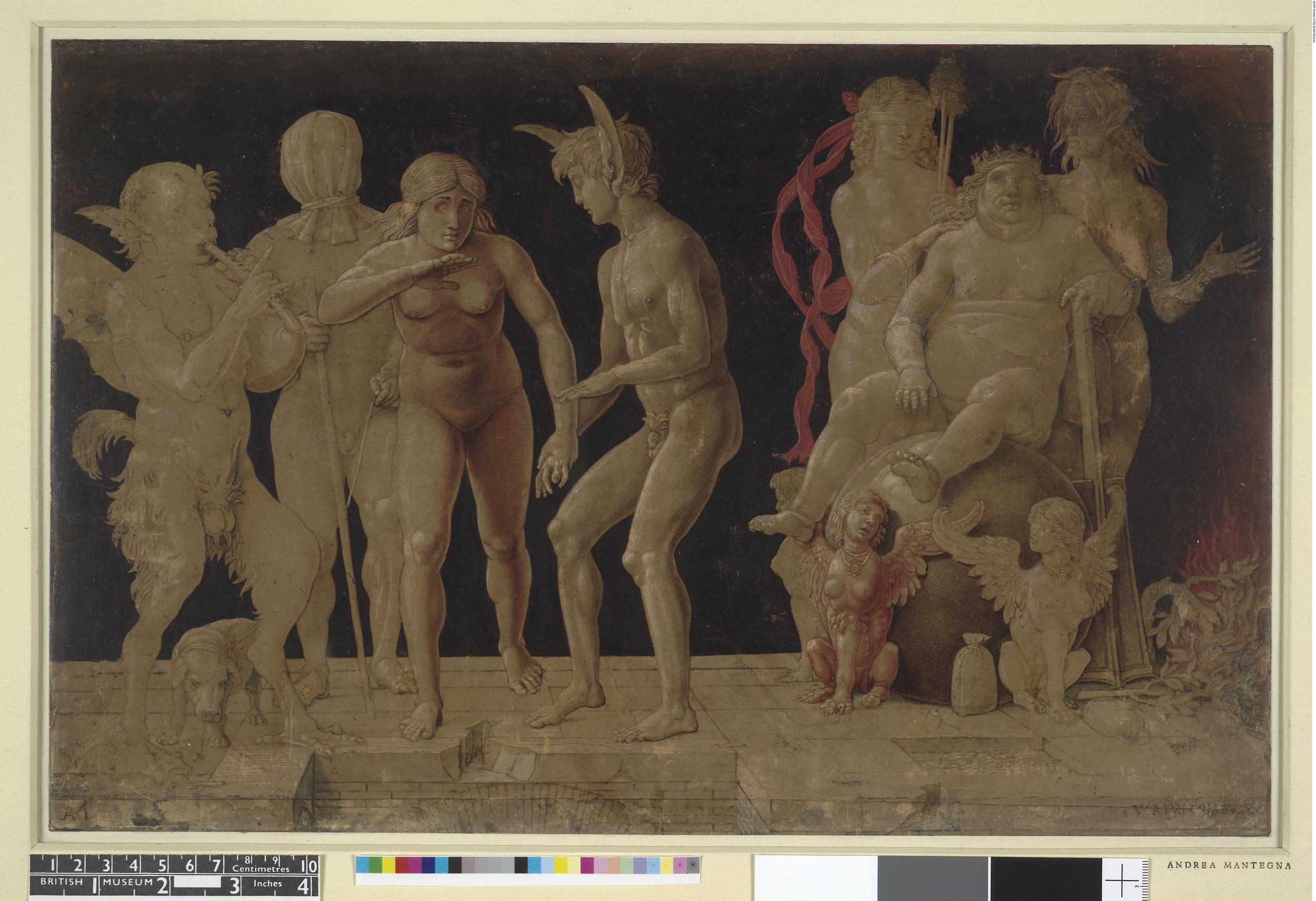
Allegory of the Fall of Ignorant Humanity
Andrea Mantegna
The form of Mithraism practiced by the Cilician pirates, with their skull and crossbones banner, likely accorded a particularly significant role to Anahita. The initiation rites that they introduced into the Roman Empire through the port cities of the Mediterranean certainly incorporated an embodiment of the divine feminine. The symbol for the second grade of initiation is the crescent diadem of the goddess together with a torch and an oil lamp to guide the way to the bridal chamber117. The astrological archetype associated with this grade of initiation is the planet Venus or Aphrodite, which is referred to as Lucifer in Latin when it rises as the morning star. Mithra was the bringer of dawn. Here one must recall that from the most ancient times until the present day, the Iranian name Mitra is predominately used for females and, according to Herodotus, the ancient Persians used to translate the name of the Greek goddess Aphrodite as Mitra118. So the god Mithra is also the goddess of Love.
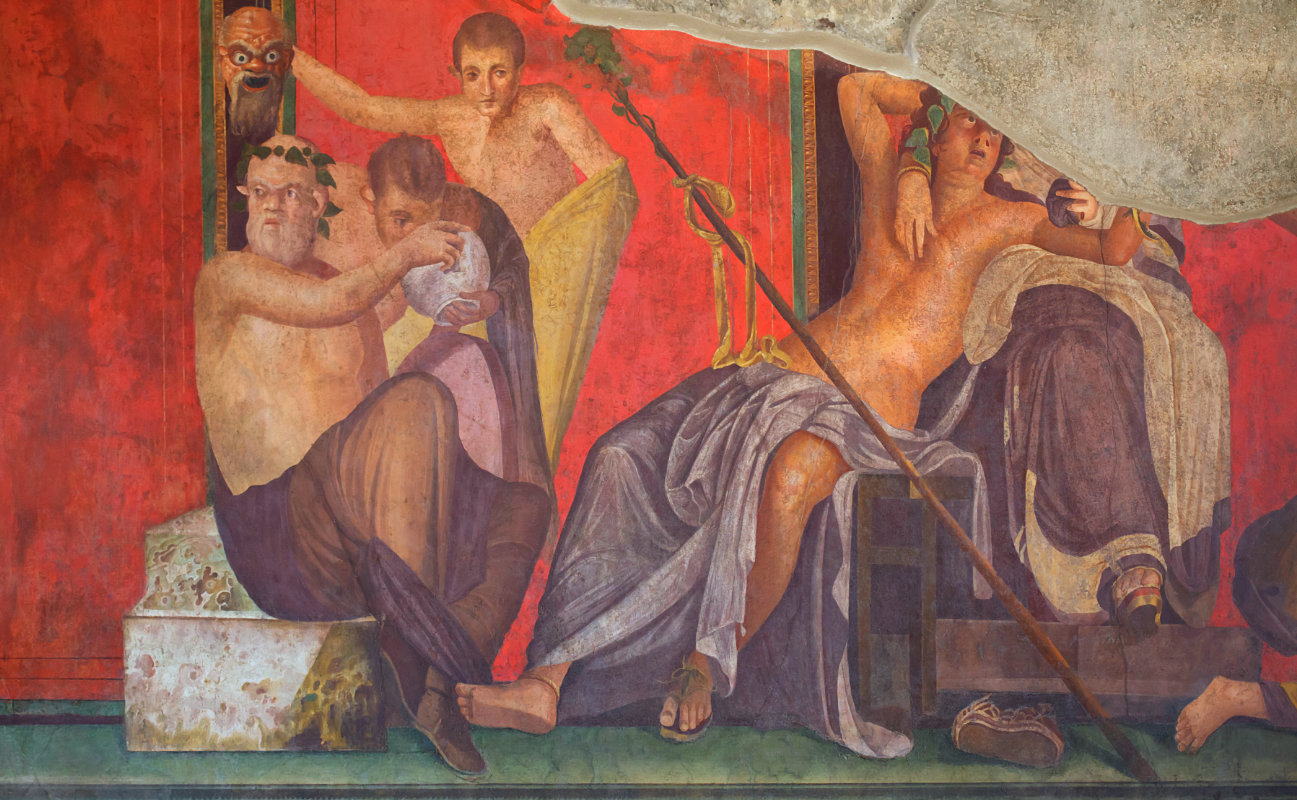
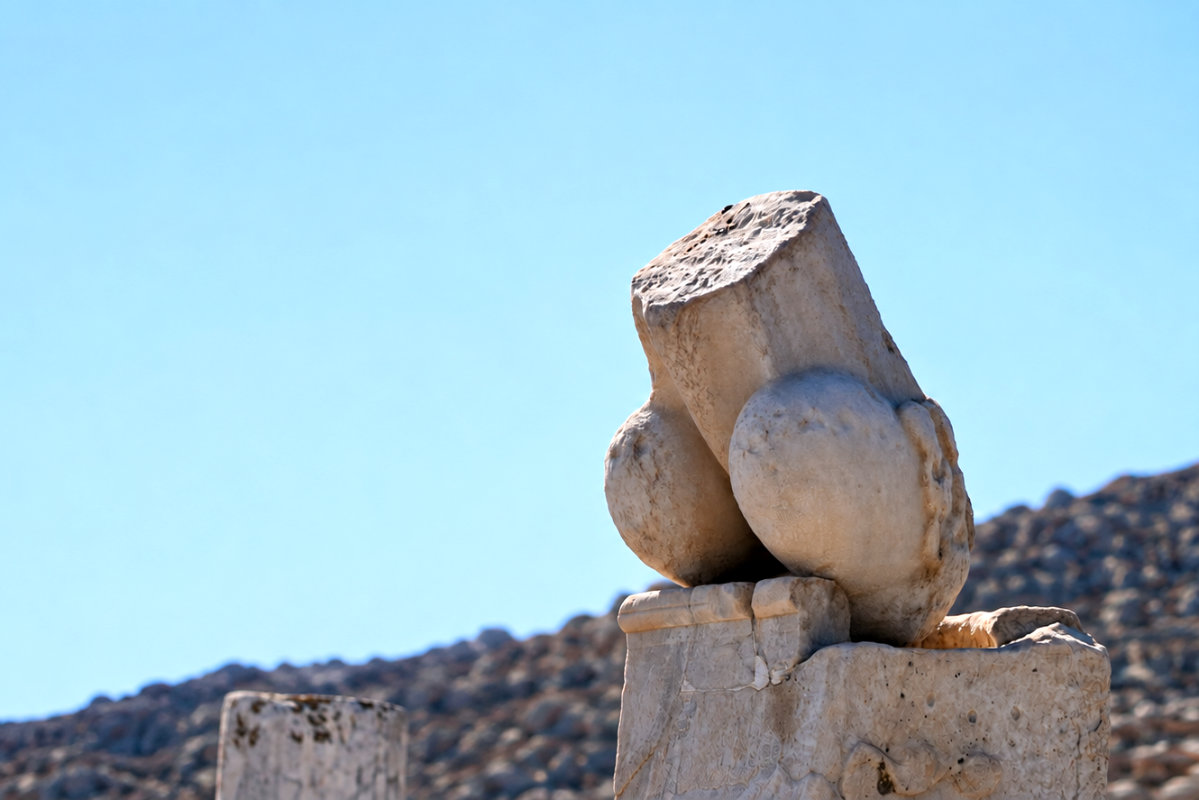
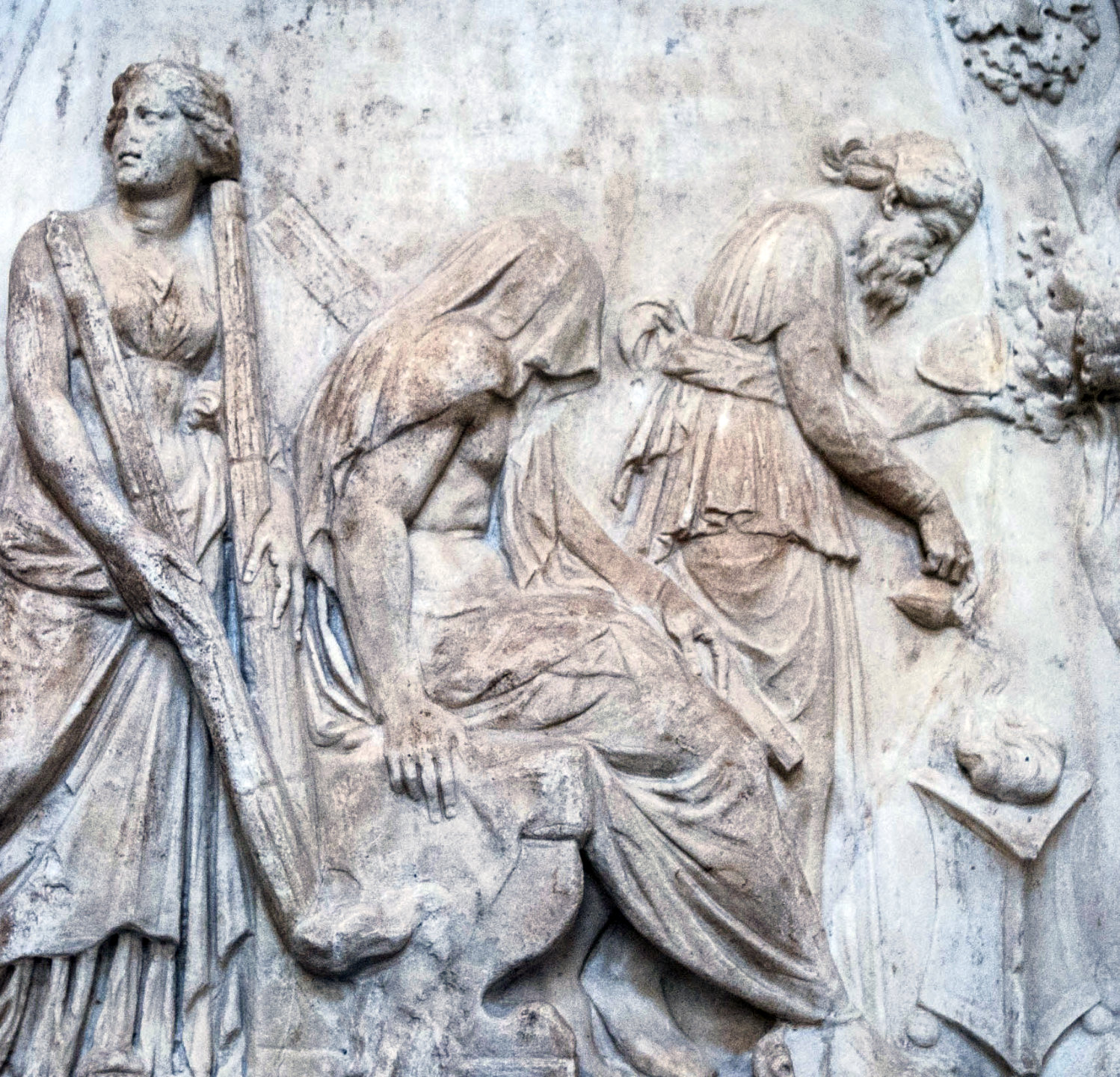
At this stage, the initiate was forced to become a transvestite. He was made to dress in female attire and wear a bridal veil that hid his face, so that the grade was sometimes also called Kryptos, “the Occult, or Hidden.”119 At the end of the ritual, the neophyte’s veil was totally removed.120 The initiatory rite involved his being married to the Father, in the course of which it was expected that he “pours out the cup of his heart” upon a statue of Mithra.121 Part of this mystical marriage of the bridegroom to the Father included kissing him on the mouth, the navel, the lower spine (or even the anus), as well as on the phallus.122 The marriage culminated with the bridegroom being sodomized.123
Orthodox Zoroastrians consider sodomy to be the worst of all vices.124 Yet traces remain in Middle Persian scriptures of a doctrine according to which the planets are very powerful demons that Ahriman brings into being by sodomizing himself.125 It was believed that:
All welfare and adversity that come to man and other creatures, come through the Seven and the Twelve. The twelve Signs of the Zodiac, as the Religion says, are the twelve commanders on the side of Ohrmazd; and the seven planets are said to be the seven commanders on the side of Ahriman. And the seven planets oppress all creation and deliver it over to death and all manner of evil; for the twelve Signs of the Zodiac and the seven planets rule the fate of the world and direct it.126
The Minouyé Kherad quite frankly admits that, in conjunction with the planets, the constellations determine the fate of the world.127 The planets intercept the beneficence bestowed by the constellations and use these stellar influences for their own demonic purposes.128 The planets accompanied Ahriman in his attack on the creation. Chapter 4 of Shikand Gomâni Vazâr and Chapter 5 of the Greater Bundahishn both describe the countermeasures taken by the forces of light on this occasion.129
Various planets are described as attacking various stellar constellations, for example, Saturn, the commander-in-chief of the planetary forces attacks the Pole Star, who is the supreme commander of the Zodiac.130 The “war in heaven” was a mythical explanation for the irregular motion of the planets, which, having been bound by the forces of light, are pulled back once they reach the end of their rope.131 Despite being bound, the planets are the “Rulers of the World” deputized by Ahriman.132 The heavenly sphere is divided into seven grades or seven heavens, with the uppermost ruled by Saturn (Kayvân).133 According to the Bundahishn, the two most powerful planets, Saturn (Kayvân) and Mars (Bahrâm), are triumphant over their adversaries in “the astral battle.”134 In other words, as in the most pessimistic types of Gnosticism, this world is predominately governed by the forces of evil.135 In this context, the sodomy endured by the Mithraic initiate of the second grade can be seen as a symbolic recognition of the Ahrimanic power of the planetary bodies, with a view to overcoming their influences.
Such a transcendence would mean rising above the earthly plane itself, and this brings us to the sixth grade of initiation in Mithraism, which is known as Heliodromus. In Greek Dromos means astronomical orbit, so Heliodromus is the charioteer in the orbit of the Sun. His symbols are a solar whip, a crown with seven rays standing for the seven grades of initiation, and a torch.136 These last two implements offer a clue to the hidden Mithraic symbolism of the Statue of Liberty, which was designed by Freemason Bartholdi, with the assistance of his fellow Masonic brother Gustav Eiffel. They were initiates of the same lodge, and clearly familiar with Mithraic symbolism.137 The crescent diadem of Nymphus looks like the lower part of the crown of the Statue of Liberty in New York with the windows carved into it, and the oil lamp carried by the initiate of this grade is like that which originally lit the fire in the statue’s torch. The cornerstone of the colossal statue’s pedestal was lain by the Masonic Grand Master of New York in 1884.138 She is a synthesis of Mithra as Nymphus and as Heliodromus. The “liberty cap,” which became a symbol of freed slaves in the Roman Empire, and of liberty during the French and American revolutions, is originally the Phrygian cap of the Mithraists.139 In Lady Liberty, Mithra’s Liberty cap has been replaced by the crescent diadem and solar rays.
In the guise of Sol, or the Sun, the Heliodromus initiate would participate in a banquet with the Father, sitting on the hide of a slaughtered bull.140 The wine consumed at this banquet was not ordinary wine. It was that wine which, according to Iranian mythology, is the blood of the giants who attempted to scale and storm heaven.141 This wine is still produced by Kurdish tribes in the area of Kermanshah today, where both the Yezidis and the Ahl-e-Haq preserve Mithraic traditions.142 The women of the tribe gather mushrooms that are referred to as mehrgiah or “Mithra’s vegetation.” As one informant, a Kurd named Siamak, reports, “This is not like normal wine… You drink a little bit and you feel like you can fly.”143 The flight is that of the charioteer who ascends above the Earth and into the orbit of the Sun. Certain Roman accounts suggest that this actually produced an out of body experience or “astral travel,” which allowed those who experienced it to come back and describe the Earth as if from space.144
The fiery fall of Phaëton, the son of the Sun, in his father’s solar chariot, sets the Earth ablaze with droplets of solar fire of red and amber color, in other words, the psychedelic Amanita muscaria mushrooms.145 These are the mushrooms that, after being dried and ground, are used to lace or spike the wine of the Mithraic Eucharist. Mithra is identified as “Phaëton in Persia” by the fifth-century poet Nonnos.146 After Phaëton’s death, his lover, Cycnus, underwent metamorphosis into a swan whose song lamenting the loss of his beloved is the origin of the term “swan song.”147 The initiate of the sixth grade sings a swan song for the entire world.
One thing relevant here is the difference between the initiate as Sol, at this stage, and Sol Invictus, which is Mithra in all his glory as The Father, namely Perseus. The Romans used the Persian epithet Nabarze or “victorious” for Mithra to express the same idea that is conveyed by the more common Sol Invictus.148 The military salute has its origin in the Mithraic symbolism of shielding one’s eyes from the brilliance of Mithra, the general and Invincible Sun.149 Sol Invictus or “Unconquerable Sun” is not the sun in the sky that passes through the twelve zodiacal constellations in the 26,000 year cycle of precession. It is an invisible Sun, a light that shines even in the darkness of night as the power over stellar fate and fatality. This is significant because the grade of solar charioteer also involves the perishability of this world, of everything under the conquerable Sun that rises and sets.
After the banquet the initiate in the guise of Sol, naked except for a cape covered in stars and the seven planets, would lead the Father into his solar chariot, whip in hand ready to crack it on the four horses of the Apocalypse — another symbol that Christians misappropriated from Mithraism.150 He carries a torch to set the world on fire.151 This conflagration, referred to as the Frashgard in Middle Persian texts, takes place at the end of the Great Year culminating the cycle of world ages.152 So in esoteric symbolism, the Statue of Liberty is the torch-bearing female version of Mithra, ready to set fire to the entire earthly realm that is divided into various sovereign territories. This is significant in terms of Lady Liberty being a watcher over the harbor, since the waters of the world are stateless and pirates are the true kings of the seas. Julius Caesar learned this first hand when he was captured by the Cilician pirates and only released for a very large ransom.
References
- Carl A. P. Ruck, Jose Alfredo González Celdrán & Mark Alwin Hoffman (2011) Mushrooms, Myth & Mithras. The Drug Cult That Civilized Europe, pp. 127, 130 ↑
- Ibid., p. 127 ↑
- Ibid., p. 126 ↑
- Ibid., p. 129 ↑
- Ibid., p. 206 ↑
- Ibid., p. 128 ↑
- Robert Charles Zaehner (1955) Zurvan: A Zoroastrian Dilemma, pp. 157–158 ↑
- Ibid., pp. 157, 160 ↑
- Ibid., p. 158 ↑
- Ibid., p. 160 ↑
- Ibid. ↑
- Ibid., p. 159 ↑
- Ibid., p. 162 ↑
- Carl A. P. Ruck, Jose Alfredo González Celdrán & Mark Alwin Hoffman (2011) Mushrooms, Myth & Mithras. The Drug Cult That Civilized Europe, p. 138 ↑
- Ibid., p. 220 ↑
- Ibid., p. 221 ↑
- Payam Nabarz (2005) The Mysteries of Mithras. The Pagan Belief That Shaped the Christian World, pp. 54–55 ↑
- Carl A. P. Ruck, Jose Alfredo González Celdrán & Mark Alwin Hoffman (2011) Mushrooms, Myth & Mithras. The Drug Cult That Civilized Europe, p. 140 ↑
- Ibid., p. 142 ↑
- Ibid., pp. 235–236 ↑
- Ibid., p. 237 ↑
- Ibid., p. 182 ↑
- Ibid., p. 136 ↑
- Ibid. ↑
- Ibid., p. 137 ↑
- Franz Cumont (1913) Les Mystères de Mithra ↑
- Payam Nabarz (2005) The Mysteries of Mithras. The Pagan Belief That Shaped the Christian World, p. 26 ↑
- Carl A. P. Ruck, Jose Alfredo González Celdrán & Mark Alwin Hoffman (2011) Mushrooms, Myth & Mithras. The Drug Cult That Civilized Europe, p. 174 ↑
- Ibid., pp. 137–138 ↑
- Ibid., p. 135 ↑