
Biography
of Cupitius
- Cupitius is attested as a member of a Mithraic community (syndexios).
- Attested at Augusta Treverorum, Belgica, Gallia in 280 – 315 (TNMM 419).
TNMP 84
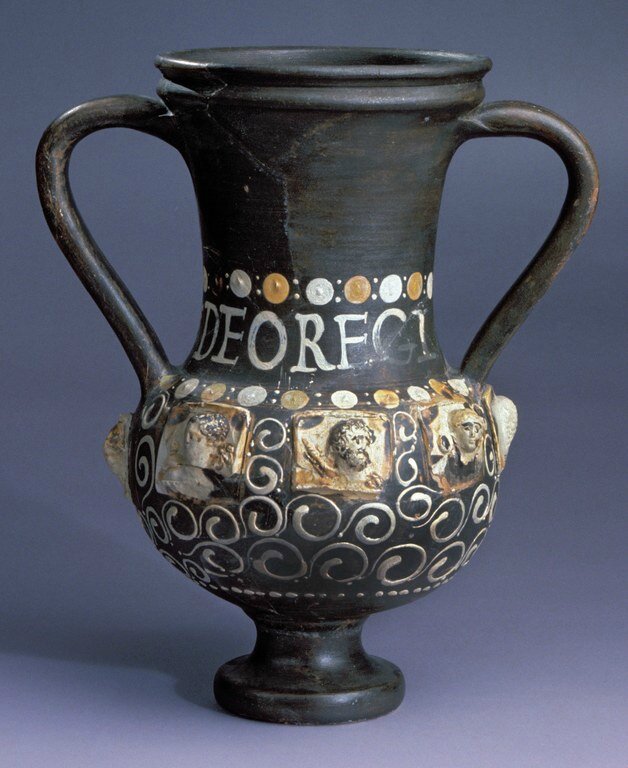
Cupitius dedicated a large ceramic krater to Mithras at Augusta Treverorum, probably in the late 3rd or early 4th century CE. His dedication, Deo [r]egi Cupiti[…] / d(ono) d(edit), identifies Mithras as “god and king” and records the vessel as his gift (TNMM 419).
His name is only partially preserved. Schwinden (1987) interprets Cupiti[…] as Cupitius or a similar name derived from Cupitus. Names of this family were particularly common in regions of Celtic settlement and are attested several times in the area around Mainz. The final d.d., for dono dedit, confirms that Cupiti[…] is the name of the dedicator rather than an epithet belonging to the preceding deus rex.
The identification of this “god and king” as Mithras is supported by other inscribed cult vessels from Trier, including examples dedicated to Deus invictus and Deus rex invictus. Cupitius’ krater, decorated with the seven planetary or weekday gods, was found in 1933 in the pottery district at Pacelliufer rather than in a mithraeum. Nothing further is known of Cupitius’ status, occupation or position within the Mithraic cult.
References
- Darin Lehoux (2016) Time and Cosmos in Greco-Roman Antiquity.
- Lothar Schwinden (1987) Zu Mithrasdenkmälern und Mithraskultgefäßen in Trier.
Attestations
Krater with weekday gods of Trier
TNMM 419
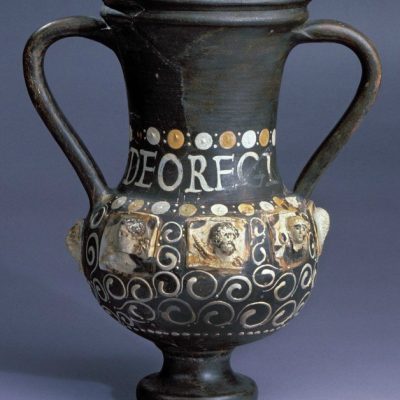
The vase bears an inscription to the god but also 'king' Mithras.
