Your search Bad Ischl im Salzkammergut gave 2084 results.

Mithraeum discovered towards the end of the 16th century in a vineyard of Horazio Muti opposite S. Vitale, between the Quirinal and Viminal hills, known from Vacca's report of a sealed room with many terracotta lamp-holders.
A small hollow edicola of simple square structure near altar K, with an opening for lamp offerings, from the Mitreo del Palazzo Imperiale at Ostia.
Second limestone base from the Forum Vetus at Leptis Magna bearing the inscription of Aristius Antiochus, with fragments of a torchbearer figure in Eastern attire.
Limestone head with Phrygian cap, possibly depicting Mithras, found in Egypt (possibly Alexandria), now in Tübingen, 2nd–3rd century A.D.
Limestone statue of a standing lion with mouth half-open, legs and tail lost, from the Mithraeum near Memphis, Egypt.
Upper part of a limestone torchbearer statue in tunic and hanging cloak, arms and lower legs lost, from the Mithraeum near Memphis, Egypt.
Limestone statuette of a standing torchbearer, torch and right arm lost, from the Mithraeum near Memphis, Egypt.
Fragment of a limestone statuette of a torchbearer in Eastern attire, head and lower legs lost, not cross-legged, from the Mithraeum near Memphis, Egypt.
Limestone statue of a figure in Eastern attire and Phrygian cap, probably a Cautes torchbearer, from the Mithraeum near Memphis, Egypt.
Engraved inscription naming Maximus as magus, from column 1 of the Mithraeum of Dura-Europos, Syria.
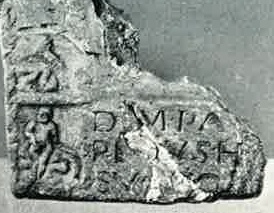
Double-sided white sandstone relief from Mithraeum I at Stockstadt, with Mithraic imagery on both faces
Late Roman funerary inscription from Antium commemorating the senator, governor of Numidia and Mithraic pater Alfenius Ceionius Iulianus Kamenius.
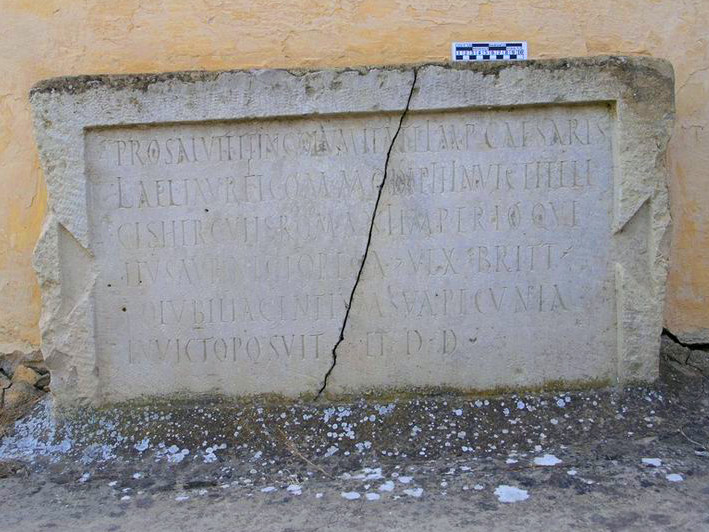
One of the two inscriptions by Aurelius Nectoreca, a follower of Mithras, found in Meknès, Morocco.
Limestone altar dedicated to Sol Invictus Mithras by the governor and military commander Marcus Valerius Maximianus.
Lower part of a sandstone altar from Svichtov, probably transported from Novae in Moesia Inferior, dedicated to Invicto by Caius Iulius Maximus, praefectus castrorum of Legio I Italica.
Inscription from Sarmizegetusa, Dacia, dedicated to Soli invicto by Lucius Domitius Primanus.
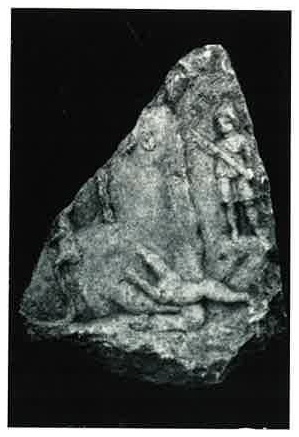
Foremost part of a white marble tauroctony from the Mithraeum at Sarmizegetusa, Dacia, showing the badly weathered bull-slaying with cross-legged Cautes raising the torch with both hands.
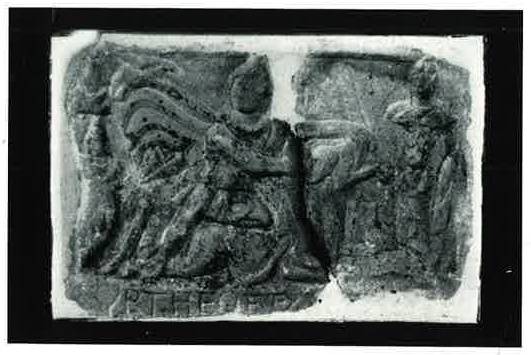
Yellowish marble tauroctony in two fragments from the Mithraeum at Sarmizegetusa, Dacia, executed in a primitive style with the bull represented obliquely.
Inscription from the Mithraeum at Sarmizegetusa, Dacia, dedicated ex voto by Cassius Maximus, augur of the Colonia Sarmizegetusa, and Marcus Ulpius Gaius.
Marble column from the Mithraeum at Sarmizegetusa, Dacia, dedicated ex viso by Flavius Trofimus.
