Your search for Sidi Ali Belkacem (سيدي علي بلقاسم) gave 40 results.

Thuburnica was an ancient Roman-Berber city in the Maghreb.

Two small altars dedicated to Sol and Luna by the consul Q. Aradius Rufinus, found at Sidi Adi bel-Kassem near Thuburnica, probably dated 304-321 A.D.
Altar serving as a column base, dedicated to Deus Invictus by M. Messius Messor, prefect of a cohort, found in the house of the sheik near Lambaesis at Sidi Okba.



Alesia became famous as the site of Caesar’s decisive siege during the Gallic Wars.

Five fragments of a red terra-sigillata vessel showing Cautopates with his torch pointing downwards, in Eastern attire and cross-legged, with the hoof of the bull's hindleg before him, found at Alesia (Mont-Auxois) in Lugdunensis.
A red terra-sigillata cup bearing a relief tauroctony of Mithras, with Cautes and Cautopates cross-legged on either side, found at Alesia (Mont-Auxois) in Lugdunensis and now kept at Saint-Germain-en-Laye.
Group of Mithraic objects now preserved in the museum of the Société des Sciences de Semur at Alésia.
Inscription on a clepsydra dedicated to Sol Invictus Augustus by C. Amulius Pultarius, found on the site of the Mosque Sidi Biri Narze at Cirta.
This fragmentary inscription from Zuccabar, reused in the wall of the Sidi Abd-el-Kader mosque at Affreville, preserves a dedication to Sol Invictus.
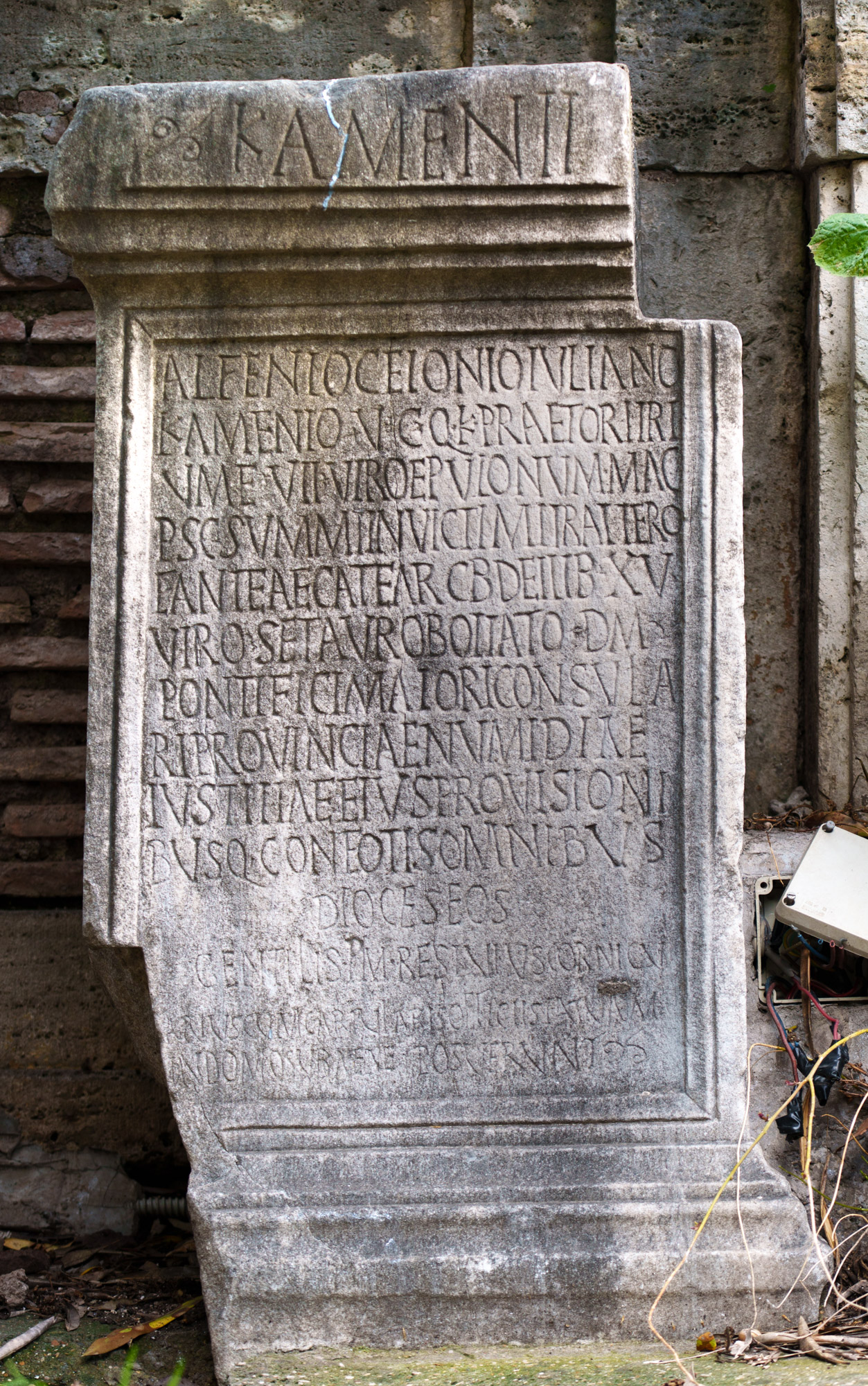
Honorific marble statue base dedicated to the senator and Mithraic pater Alfenius Ceionius Iulianus Kamenius by members of his provincial administration.
