Tractatus
Alexander Romance
Late antique legendary biography of Alexander the Great (c. AD 300), where history, myth, and imperial ideology merge around figures of divine kingship and solar power.
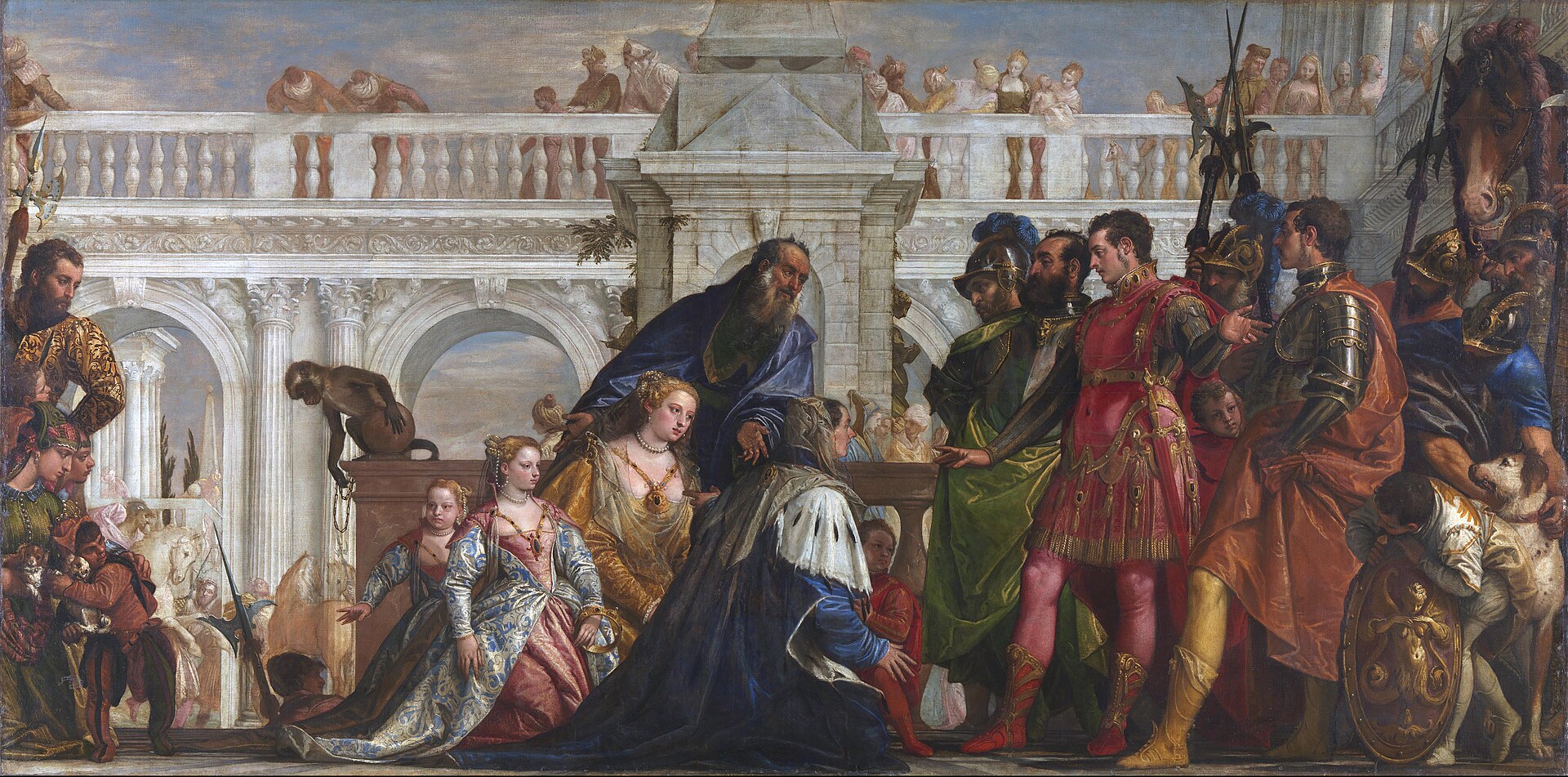
Family of persian king Darius before Alexander The Great and his friend Hephaestion after the Battle of Issus.
National Gallery, London.
Attributed to Pseudo-Callisthenes, the work is commonly known as the Alexander Romance. It also circulated under the title Historia Alexandri Magni and, in the Latin tradition, through Julius Valerius’ Res gestae Alexandri Macedonis, preserving episodes that link Persian kingship with Mithra and solar divinity.
I, Darius, king of kings and of the race of the gods, consort of Mithra on his throne and co-partner with the sun, in my own right divine do give these injunctions and commands to thee my servant Alexander.
Alexander the king, the son of king Philip and Olympias his mother, to the great king of the Persians, king of kings and consort of the sun-god, off-spring of the gods and co-partner with the sun, greeting. It is unworthy that Darius, so great a king of the Persians, exalted with so great power, consort of the gods and co-partner with the sun, should be reduced to mean servitude to a mere man Alexander.
Alexander then seeing the great pomp of Darius was moved almost to worship him as Mithra the divine, as though clothed in barbaric splendour he had come down from heaven,—such was his splendid array. Darius was seated upon a lofty throne, with a crown of most precious stones, wearing a robe of Babylonian silk inwoven with golden thread.
(Syriac) And when Darius saw Alexander he did obeisance and worshipped Alexander, for he believed that he was Mihr the god, and that he had come down to bring aid to the Persians. For his raiment was like that of the gods, and the crown which rested upon his head shone with rays of light and the robe which he wore was woven with fine gold.
The Persians contended with the Macedonians wishing to carry off Alexander and to proclaim him as Mithra. But the Macedonians resisted, wishing to carry him back to Macedonia.
English translations by A. S. Geden (1925)
