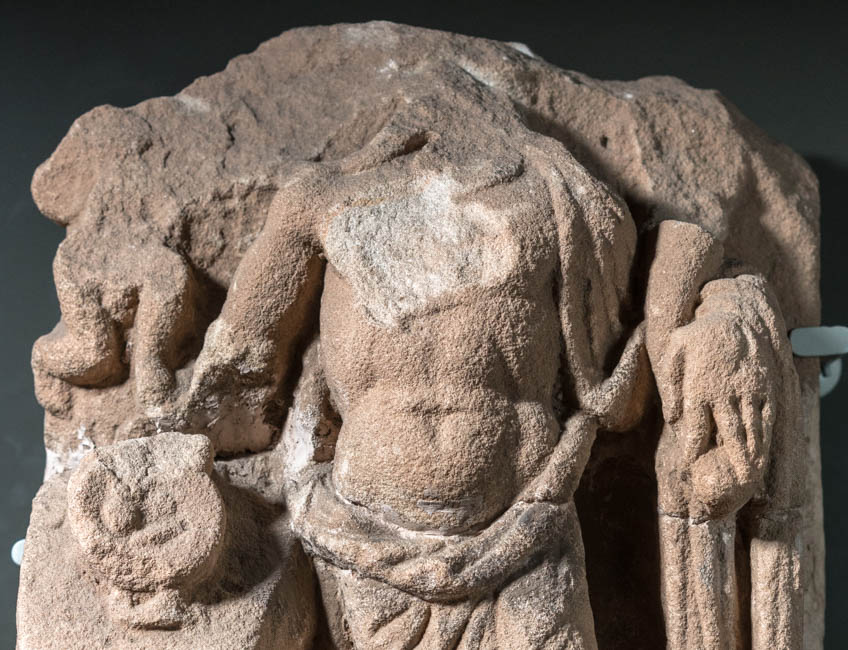
Two-sided relief of Dieburg
TNMM 231 ↔ CIMRM 1247
A relief in red sandstone (H. 0.902 Br. 0.855 D. 0.09). All finds from this Mithraeum are at Dieburg, Kreismuseum, Marktplatz 1. Inv. No. 220/52.
A. The front: The relief revolves on a pivot
The front is divided by horizontal and vertical rims into eleven panels. In its centre a representation of Mithras in a short tunic and in a flying cloak as a horseman. The god whose head is damaged shoots an arrow from his bow. Before the horse a tree. On either side a torchbearer in Oriental dress and cross-legged standing upon a krater. The l. one lifts a torch with both hands. The r. one lifts a torch with his l. h. and holds a torch downwards with his r. h. Next to the r. torchbearer an animal with long ears (probably a hare) is represented. Mithras as a horseman is accompanied by three large dogs.
Around this main scene there are various other representations:
- Two capricorns with long horns standing the one above the other (I do not agree with the interpretation of Behn who thinks that the animals are horses).
- Naked man in beard sitting on a rock. He supports his head with his l.h. and he holds a knife in his r.h. (according to me it is Saturnus and I cannot agree with Behn and Cumont who interpreted this figure as Ahriman nor with Kutsch in Germania XIV, 1930, 148, who interprets him as Herakles).
- Mithras being born from the rock with a torch in his l.h. and a knife in his upraised r.h.
- Naked Mithras in Phrygian cap walking to the r. with a knife in his r.h. (Cumont in JS, 123 is of the opinion that we have to do with a representation of the water-miracle. I think it is a representation of Mithras-Perses).
- Mithras climbing a tree. The hindmost part is lost.
- Mithras in Oriental dress standing with his l. foot on a rock, menacingly picks up a rock with his r.h., as if on the point of throwing it at a temple-like building in which the bull lies. In the pediment of this building a goose sits upon a stone and on either side of it a bust is represented.
- Mithras taurophorus walking to the r.
- Mithras dragged away by the bull.
- Mithras carries the bull to the r.
- A tree with three branches ending in heads in Phrygian caps.
- Mithras and Sol reclining behind a table covered with the bull’s skin. They are drinking each other’s health from a rhyton. Mithras is in Phrygian cap, Sol has a nimbus.
- Naked Sol standing in a quadriga, Mithras is ascending. Sol has a nimbus and holds a whip in his upraised r.h.
- Underneath the central panel is an inscription on the borders: Behn, M. Dieburg 22ff; Finke in BRGK XVII, 1927, 60f No. 187. L.H. 0.01-0.03. D(eo) i(nvicto) M(ithrae) / Silves/trius / Silvi/nius et Silvestrius Pe[rpetus et A]urelius Nepos / v(otum) s(olverunt) l(ibentes) l(aeti) m(erito).
Around scene 11: Silvinus artis quadratariae Aureli[us ..... ] d(ono) d(ederunt).
Around scene 2: Perpetus frater artis sutor(iae?).
The formula v.s.l.l.m. is also written around scene 2 but it belongs to the main dedication. Silvestrius Silvinus: the name of this artist occurs also on a base of a statue with Diana from Dieburg (CIL XIII 6434). He is a Biturex.
The identification which was proposed by Behn (cf. Schröder in FuF 1929, 124) that Mithras as a horseman should be equivalent to Wodan has already been contradicted by Clemeri (o.c., 221). The hypothesis is definitely contradicted by the finds at Dura-Europos (Mon. No. 52). The representation is not only found in Germany (Neuenheim Mon. No. 1289, Osterburken Mon. No. 1292,5f and Rückingen Mon. No. 1137) but also in the East.
B. Reverse
The whole scene is represented inside a circular border in which an engraved inscription. The only figures outside this border are the busts of the four wind-gods; the one in the r. upper corner is lost.
The front of a temple with four Corinthian columns. Between these columns garlands are hanging. In the centre of the triangular pediment is a medallion with a head (Sol?).
- In the front of this building a naked person (Helios-Sol) descends from a throne. His l. foot on a footstool; a cloth covers his r. leg and his l.h. in which he holds a staff or sceptre. His r.h. is lost; the head is damaged.
- Standing youth dressed ouly in a long shoulder-cape (Phaeton-Mithras). He rests his l.h. on the throne and he raises up his r.h.
- On Helios’ left a standing woman only partly dressed in a mantle (Summer). She leans against the throne and in her l.h. she holds an oblong object (corn-ear).
Behind the central part three standing women are represented from l. to r.: - Standing woman the upper part of whose body is not covered, holds a plate with fruit in her outstretched l.h. (Autumn). She lifts her r.h. over her head. Both hands are damaged.
- Youthful woman, the upper part of whose body is undressed holds her r.h. above Sol’s head (Spring).
- Standing older woman dressed in a mantle holds a long thin object (reed?) in her l.h. (Winter).
- On the four sides of the throne naked youths dressed in shoulder-capes. Each of them leads a horse and holds a twisted club in his l.h.
- Three figures are represented in the foreground. In the centre a bust of a man in beard and above him an arched velum (Caelus). On his right a reclining woman the upper part of whose body is undressed. She lifts up her r.h. and she holds in her l.h. a cornucopia (Tellus). To the l. of Caelus a reclining man in beard who wears a ribbon in his hair. The lower part of his body is dressed in a mantle. He holds a jug in his r.h. (Oceanus).
In the figures of Caelus, Tellus and Oceanus the elements of air, earth and water are symbolized. The element of fire is represented in the main scene which is unique in Mithraic monuments and which refers to the end of the world. According to Cumont (Cf. Les Mages hell., I, 92; II 147 No. 4; Rel. Or4., 274 No. 14; Symb. fun., 75 No. 1) Phaeton, who implores Helios to guide the quadriga, is a symbol of the Platonic and Stoic ekpuroosis. The Mithraists were of the opinion that Mithras himself was the author of the World-conflagration and so they identified Mithras with Phaeton.
Inscription on the border.
L.H. 0.04.
Silvestrius Silvinu[s] et Silvestrius Perpetus et Silvinius Aurelius d(eo) S(oli) i(nvicto) M(ithrae).
Main inscription
Perpetus fra/te[r] artis sutor[iae]. / Silvinus ar/tis quadratari/ae Aureli[us ---] d[ono] d[ederunt].
[Side B:] D[eo] S[oli] i[nvicto] M[ithrae] Silvestrius Sil[v]inu[s] et Silvestrius Perpetus et Silvinius Aurelius.
[Side B:] To the invincible god Mithras, Silvestrius Silvinus, Silvestrius Perpetus and [Silvinus?] Aurelius, their nephew, fulfilled their vow willingly, gladly and deservedly. Perpetus, brother, a cobbler by trade, and Silvinus, a sculptor by trade, Aurelius [---] gave this as a gift.
References
A special bibliography about the reverse of the relief: Snijder in Mnemosyne 1927 40lff; Cumont in RHR CIV 1931 29ff; RHR CV 1932 102f; cf. Radet in REA 1932 123f; Rose in RHR CV 1932 98ff; Wüst in ARW 1935 219ff; Albizzati in Athenaeum 1937 193ff and fig.; Schoppa Pl. 89. Behn M. Dieburg 8ff and Pls. I-II; Gnomon l.c. and figs. 1-2; Angelos l.c. figs. 8-9; Umschau l.c. figs. 1-2; Leipoldt figs. 23-24; Esp. Rec. Germ. 163ff and fig.; Koepp Germ. Rom. Pl. XXXVI; Buday in Dolgozatok VI 13ff and fig.; Clemen in ARW XXXIV 1937 217ff. See figs. 323-324.
- Vermaseren, Maarten Jozef (1956) Corpus Inscriptionum et Monumentorum Religionis Mithriacae