This site uses cookies to offer you a better browsing experience.
Find out more on how we use cookies in our privacy policy.

 
Support The New Mithraeum The New Mithraeum is an independent, non-profit project dedicated to Mithraic studies, ancient religions and classical culture. Developed and maintained independently since 2007, the site exists without advertising, paywalls or institutional funding. If you have found value in its articles, interviews, photographs or database, please consider supporting the project with a contribution. Every contribution helps keep The New Mithraeum open, free and alive. Thank you.
Support us →
Monumentum

Mitreo dell’Esquilino

In a house from the time of Constantine, a Lararium was found with a statue of Isis-Fortuna. The Mithraeum was a door next to it, on a lower room.
  • Bull. della comm. arch. comm., 1885, p. 27 et pl. IV-V; cf. Lanciani, Ancient Rome, 1890, p. 192. Fig. 25. [TMFMM]

    Bull. della comm. arch. comm., 1885, p. 27 et pl. IV-V; cf. Lanciani, Ancient Rome, 1890, p. 192. Fig. 25. [TMFMM]
    Franz Cumont. Cf. caption

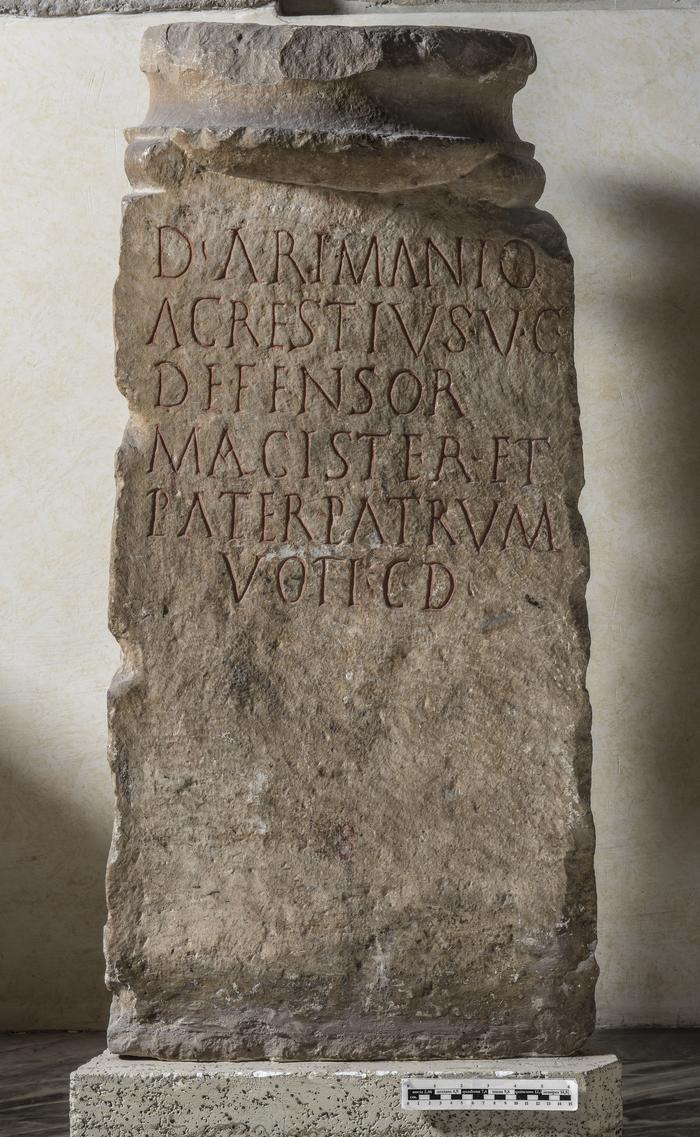
  • Altar to Arimanius of the Esquilino.

    Altar to Arimanius of the Esquilino.
    Lupa.at

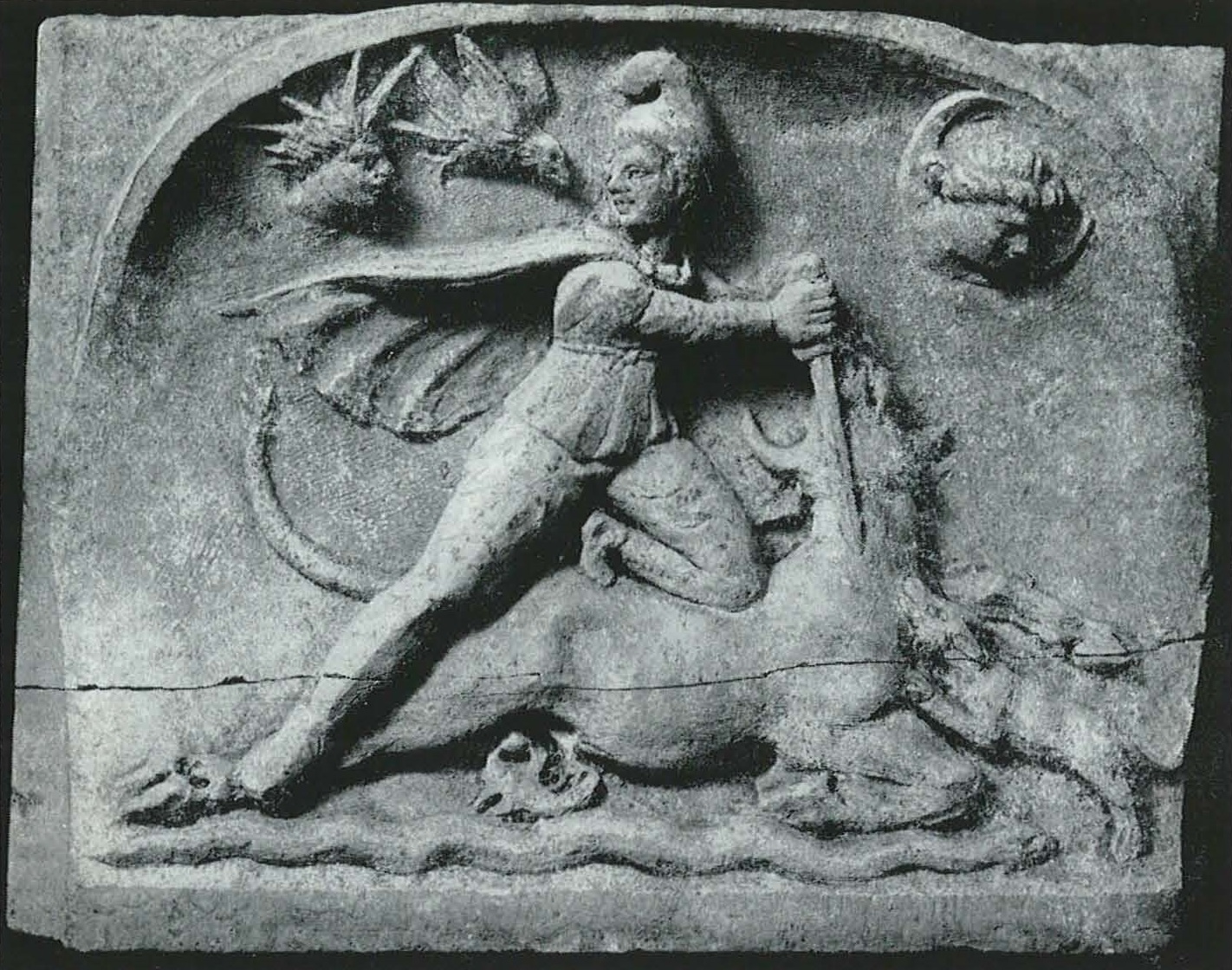
  • Tauroctony relief from the Esquillino.

    Tauroctony relief from the Esquillino.
    CIMRM

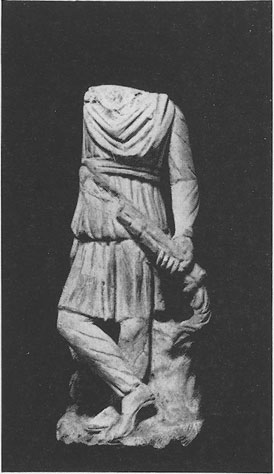
  • Cautopates from Rome.

    Cautopates from Rome.
    CIMRM

 
The New Mithraeum
9 Jun 2009
Updated on May 2026

TNMM 83 ↔ CIMRM 356

On the Esquiline (Via S. Giovanni Lanza 128) a Mithraeum was discovered near the Church of S. Martino ai Monti in 1883.

In a house from the time of Constantine or a little earlier, a Lararium was found with a statue of Isis-Fortuna and smaller statuettes of Sarapis, Jupiter, Hekate, Venus, Mars, Hercules and others. A door next to it opens on a lower room, which served as a Mithraeum. Via two flights of seven and nine steps, separated by a landing, one descends into it. On either side of this landing there is a niche in the wall, in which the two statues of Cautopates (l). In the r. niche traces of red-paint.

The sanctuary itself consists of a small, arched room (L. 3.70 Br. 2.43). In one of the side-walls a marble slab has been fixed (L. 1.23 Br. 0.36), which is supported by two brackets, which are decorated by leaf-work. On this slab we see a marble Mithrasrelief. Moreover there were some small vases (diam. 0.10) and the remnants of seven torches of fair-wood, which were covered with tar. Underneath the slab on the floor stood a square column with an upturned Ionian capital. The whole probably served as an altar.

In the wall several small niches have been hewn out. Four of them, two arched and two square ones, are on the left between the entrance and the cult-niche, two more below the marble slab and two to the left of it, and finally one more in the opposite wall. They probably contained lamps.


This mithraeum on the Esquiline hill, associated with a garden lararium and domus, is important for understanding the 4th-c. cult of Mithras. It is a problematic sanctuary for several reasons: its layout does not conform to typical mithraea in every respect, its owner cannot be identified, and it is difficult to date precisely. The subterranean sanctuary accessed by two flights of stairs was uncharacteristically small and nearly square (l. 3.7 m x w. 2.43 m) and lacked sufficient space for the requisite kline (dining couches), but statues of Cautes and Cautopates in niches at the landing on the stairwell, a tauroctony relief resting on two brackets on the left wall of the sanctuary, and the 4 niches for the lamps recovered during the excavation confirm its identity. Clauss firmly states what Vermaseren only tentatively suggested: that the owner of this domus and mithraeum was one Flavius Septimius Zosimus, who stated in a dedicatory inscription that he was a vir perfectissimus and sacerdos of Bronto and Hecate, and that he built a Mithraic cave (speleum). I would emphasize that this dedication found its way to the church of San Martino ai Monti and that the exact provenience and the circumstances of its discovery are unknown. However tempting it may be to associate this individual with the owner of the mithraeum, lararium, and domus, we cannot do so securely.

Dating the mithraeum, the lararium, and the associated domus with any precision has also proven difficult. In his analysis of the domus in late-antique Rome, Frederico Guidobaldi considered the excavation reports carefully and has confirmed the “Constantinian” date originally suggested by the excavators, although he noted that the domus, lararium, and mithraeum were all installed in earlier structures which could date any time from the late 1st c. B.C. through the 2nd c. A.D. Most other indicators are too general to be helpful. Garden lararia were common enough that the presence of one here cannot help to determine a date. The arrangement of lararium and mithraeum recalls the garden lararium and biclinium at the Domus Fulminata at Ostia, but even if we posit a biclinium at the Via Giovanni Lanza lararium, a handy substitution for the kline lacking from the mithraeum, the Domus Fluminata is generally dated to the 1st and 2nd c. Neither is the presence of a mithraeum on the grounds of domus a good indicator because mithraea in domus and insulae are documented in the middle of the 2nd c. in Ostia and during the Severan period in Rome. What is most useful for supporting a “Constantinian” date is the presence of a mithraeum in a particularly well-appointed domus containing certain architectural features which might indicate a 4th-c. date, as here, and the remarkable variety of deities in the lararium. Taken as a whole the group of 17 figures contained a life-size statue of Egyptian Isis, and statuettes of Serapis, Horus, and Mithras among the more traditional Jupiter, Diana, Venus, Mars, Hercules, Dionysus (represented by a bacchant), two lares, and a genius (of what Visconti declined to say). Now of all these deities, Mithras’ arrival was by far the most recent in Rome, and even it can be reasonably dated around A.D. 90. Inscriptions dedicated by senators in the 4th c. to Magna Mater in the Vatican Phrygianum, however, mention not only Magna Mater and Attis Menotyrannus, but also Mithras, Hecate, Liber, and Isis. These are not merely joint dedications, as we shall see presently, but a list of priesthoods in each of these cults. The variety of this list immediately calls to mind the group of statues from the Via Giovanni Lanza lararium.

CIMRM II 356

Via Giovanni Lanza.

References

C. L. Visconti in BCM XIII 1885 27ff and PIs IV-V; Lanciani-Borsari in NSc 188567 154; Lanciani Rome 191 fig.; MMM II 199f No. 15 and fig. 25; Jordan Top. Rom. I (3) 316f.

Related monuments

Altar to Arimanius of the Esquilino

This altar mentioning the god Arimanius was found in 1655 at Porta San Giovanni, on the Esquilino.

Tauroctony from the Mitreo dell’Esquilino

This simple relief of Mithras killing the bull without his companions Cautes and Cautopates was found in the so-called Mithraeum of the Esquilino, Rome.

Altar by Septimius Zosimus from Roma

This altar dedicated to Sol Invictus Mithras by a certain Septimius Zosimus was found in the Basilica of San Martino ai Monti in Rome.

Marble statue of Cautopates from Rome

White marble statue of Cautopates found in Rome.


Marble statue of Cautopates with owl from Rome

White marble statue of Cautopates with crossed legs, accompanied by an owl beside a tree trunk.

 
Back to Top