Hekate: magic, mystery and the liminal world
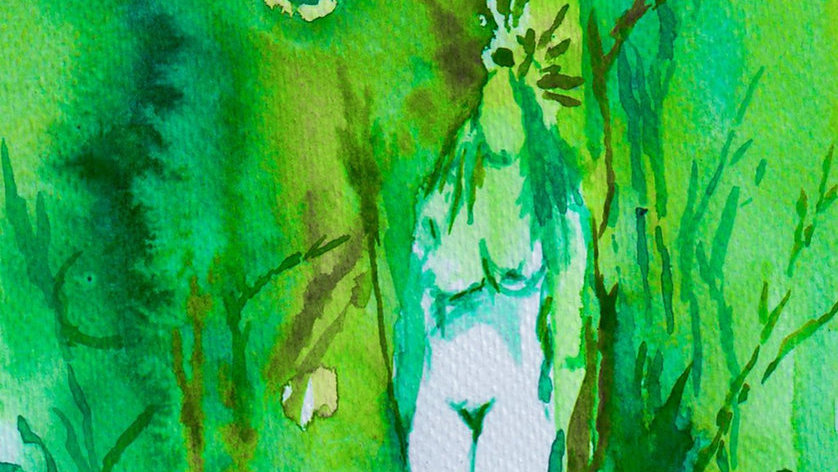
Cover illustration for The Rites of Hekate
Nat Clegg
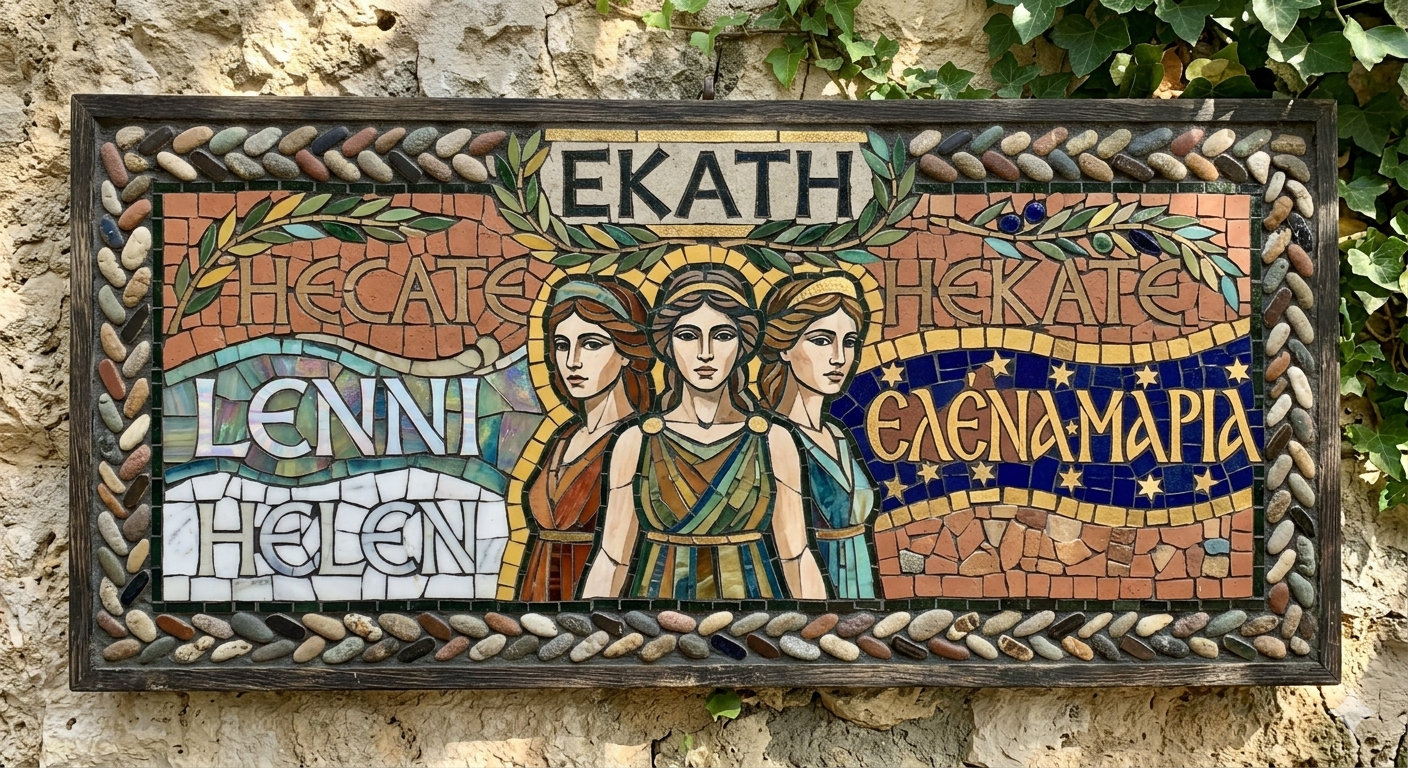
Lenni George is a British-Greek Cypriot researcher and herbalist whose work engages with ancient sources and their later reception. Over more than three decades, she has developed a sustained interest in botanical traditions and in sources such as the Greek Magical Papyri, particularly in relation to the figure of Hekate.
Together with Nat Clegg, she runs the House of Zophiel, organising workshops and events on esotericism, creativity and symbolism. She holds a PhD from Birmingham City University and has an extensive international background in training and capacity development, working across public institutions, universities and international organisations. This dual perspective informs her recent book, The Rites of Hekate: From the Dirt to the Divine, which explores the relationship between historical material and contemporary engagement.
Where does Hekate actually come from, and what are the earliest sources we have mentioning her?
The question of the origin of Hekate is genuinely complex, and in many ways I think that is also a clue to her nature. The earliest substantial Greek source is Hesiod’s Theogony, written around 700 BCE. In it, which is basically a family tree of the gods, Hekate appears not as a peripheral figure but as a goddess of extraordinary scope. Hesiod describes Zeus as having honoured Hekate above all others, and in doing so she is granted a share in the earth, the sea and the sky. That breadth of dominion is unusual even in the Greek pantheon, where most deities have clearly bounded domains — think of Hades or Poseidon — but she is given dominion across all three. She is also understood to be a Titan, a Titaness, daughter of Perses and Asteria, which places her outside and predating the Olympian family. Interestingly, looking at the friezes at Lagina in southwest Turkey, one suggests that Hekate actually witnessed the birth of Zeus, and as we know, she fought alongside the Olympians against the Titans.
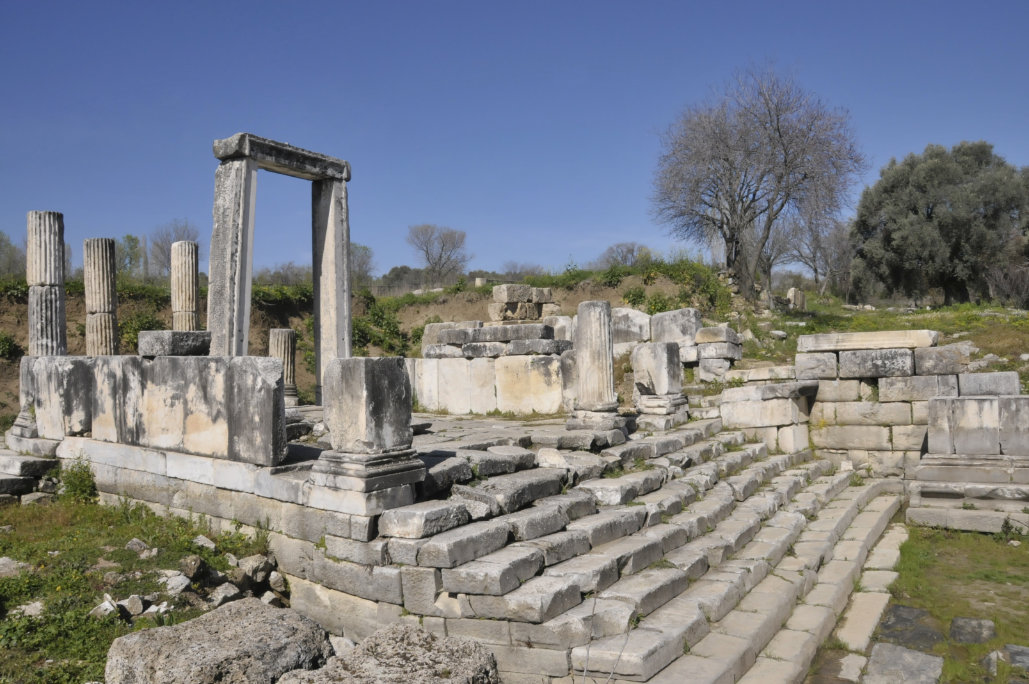
Hekate’s temple of Lagina, Turkey.
CTHOE
So her starting point in Greek terms goes back to that work of 700 BCE. But there are clearly arguments that she predates the Greek pantheon altogether. The temple at Lagina in southwest Turkey is dedicated to Hekate, and that is one of the strongest examples of Hekate worship outside of the Greek world, in Caria. So there is a case that she comes from Asia Minor. There is also another argument that comes up through names in the Greek Magical Papyri, also known as PGM, where she is referenced as “Perseia,” and it is not entirely clear whether that is a reference to her as daughter of Perses the Titan, or a reference to a Persian origin. So her origins are left genuinely unclear. And on top of that, we have the Chaldean Oracles, where Hekate is understood as the cosmic world soul, which gives a whole different starting point for where she came from.
The Eleusinian Mysteries were one of the most important religious institutions of the ancient world. Hekate is not always at the centre of that story, but she plays a crucial role. Could you tell us more about her function in the myth of Demeter and Persephone, and within the Mysteries?
Absolutely. And as you say, she is not in a central role in terms of the relationship between Demeter and Persephone, but she is really central to the movement of the story. In the Homeric Hymn to Demeter, we learn that Hekate hears Persephone’s cries at the moment of abduction. Hekate does not intervene, that is not her function, but she witnesses, and from witnessing she goes to Demeter and tells her what she has heard. And then she is the one who takes up her torches and accompanies Demeter in the search. I think this is quite an important detail that tends to get overlooked. She is not the rescuer, but she is the one who stands at the threshold of the event, and she is the one who provides the light by which others can navigate.
In the Eleusinian Mysteries themselves, the initiates were called the epoptai, which really meant “those who have seen,” and Hekate’s torch-bearing role is structurally essential to that seeing. Her role is about illumination, about bringing the light and enabling people to see. The mysteries themselves enact the myth of loss and return: Persephone is taken, Demeter is devastated and makes the world barren. I love that idea of the tiger mum: give me back my daughter or I will leave this planet barren. And then it is about the retrieval and the reunion, and what the initiates received through the enactment was experiential knowledge of what lies beyond death, not just symbolic reassurance.
Hekate’s function in all of this is really to illuminate the threshold. She is the one who makes it possible to stand at the boundary and see clearly: what has been destroyed, and what comes after. And it is also quite significant that after Persephone’s return, it is Hekate who becomes her companion in the underworld — not her enemies, and not Demeter. I think that is where we start to register the psychopomp function that Hekate carries, and perhaps where that function found its true home.
We are fairly certain that participants in the Eleusinian Mysteries consumed a special drink called kykeon, which almost certainly included ergot, a fungus that causes altered states of consciousness. In your book, you also inventory many other toxic plants and compounds associated with Hekate. What role would drugs play in the cult of Hekate?
Hekate’s association with the dark botanicals is old and consistent. I think it was Diodorus Siculus who talks about Hekate’s experimentation with aconite. There is a lovely story that she found the plant and experimented with it to understand its degree of poison. When visitors came to Colchis, she would prepare meals for them with different amounts of aconite to test its potency. So: aconite, belladonna, hemlock, mandrake, they all belong to Hekate’s garden, and certainly her connection with Medea, who was a pharmakis, a worker of plant medicines and magic. The word pharmakon itself is an ancient Greek word that covers what we would now separate into medicine, poison, and magic. For me, that is a very seductive and potent area of study, because many of the things we identify as poisons can also provide a cure. You can flip between the kill and the cure with many of the botanicals in Hekate’s garden, and Hekate presided over all three.
As goddess of thresholds, altered states of consciousness are really a kind of threshold technology, moving the practitioner from one mode of perception to another. The ritual use of plants was not recreational and not without its dangers. It required expertise, the knowledge of the pharmakis, and that is why it is so embedded in ritual structure rather than used freely. What you are trying to do with those substances is change the perceptual frame, and you need a container for that. I think Hekate, as keeper of the thresholds, is part of that container in her own right. That is really where a lot of my interest in working with Hekate started: trying to understand this relationship between medicine, magic, and poison.
As we move into the Hellenistic and Roman periods, her figure seems to expand and transform. How does Hekate evolve in Roman religion as Trivia?
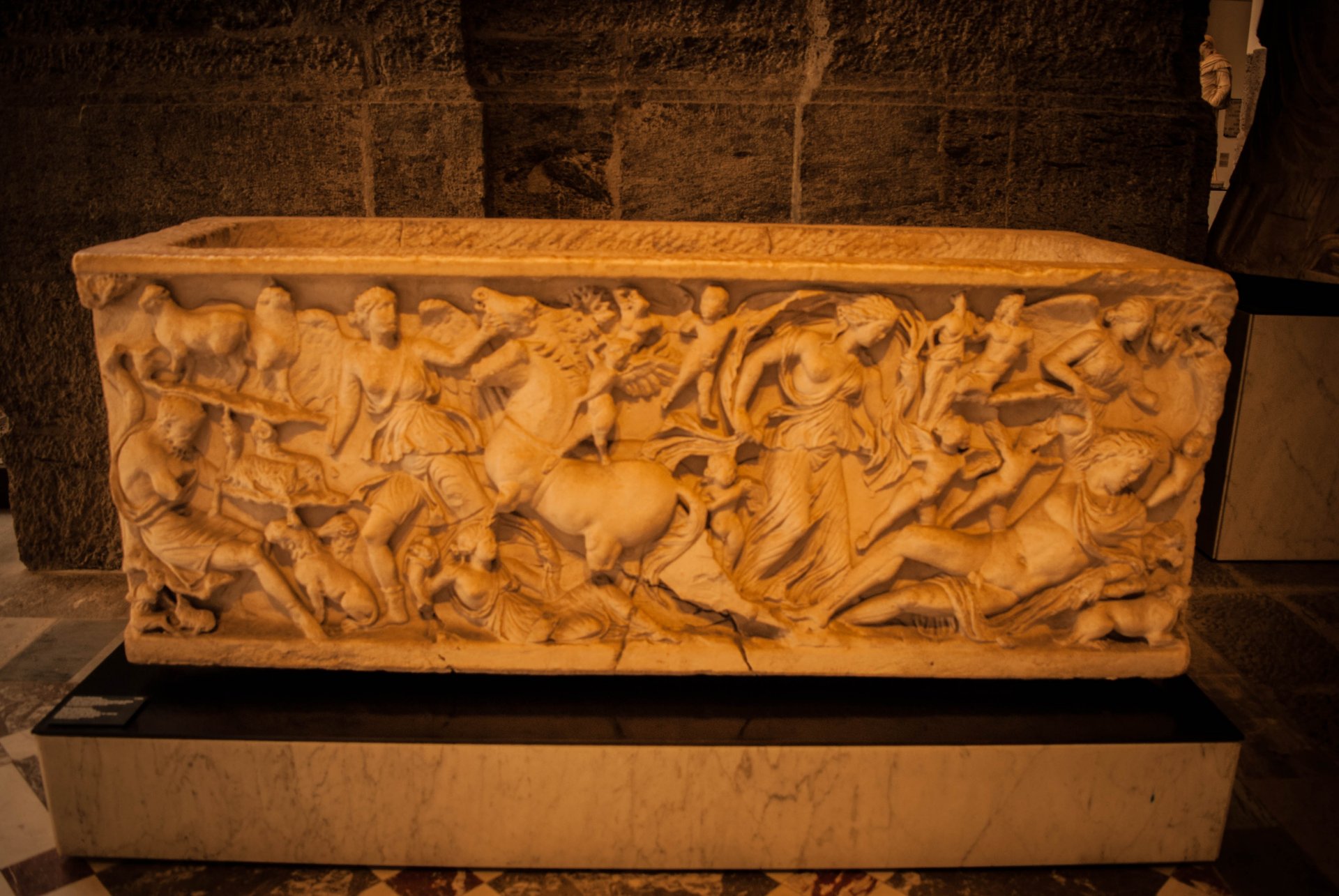
What is always interesting about the Romans is their willingness to absorb deities rather than quell or crush them. And if you think about the name Trivia, it is a Latin rendering of Hekate’s Greek crossroads function. Tri via: three ways, the three-road crossroads. So it tells you that the Romans recognised her domain immediately and had no difficulty assimilating her. She became very closely associated with Diana and Luna, producing the triple goddess formulation that Virgil used in the Aeneid: Luna in the sky, Diana on the earth, and Hekate in the underworld. That is a bit of a tidying-up operation, I think. The Romans tended to like their theological taxonomy reasonably clean, and mapping her across three domains and three familiar figures gave a structural legibility that was perhaps not so clear in the earlier Greek material.
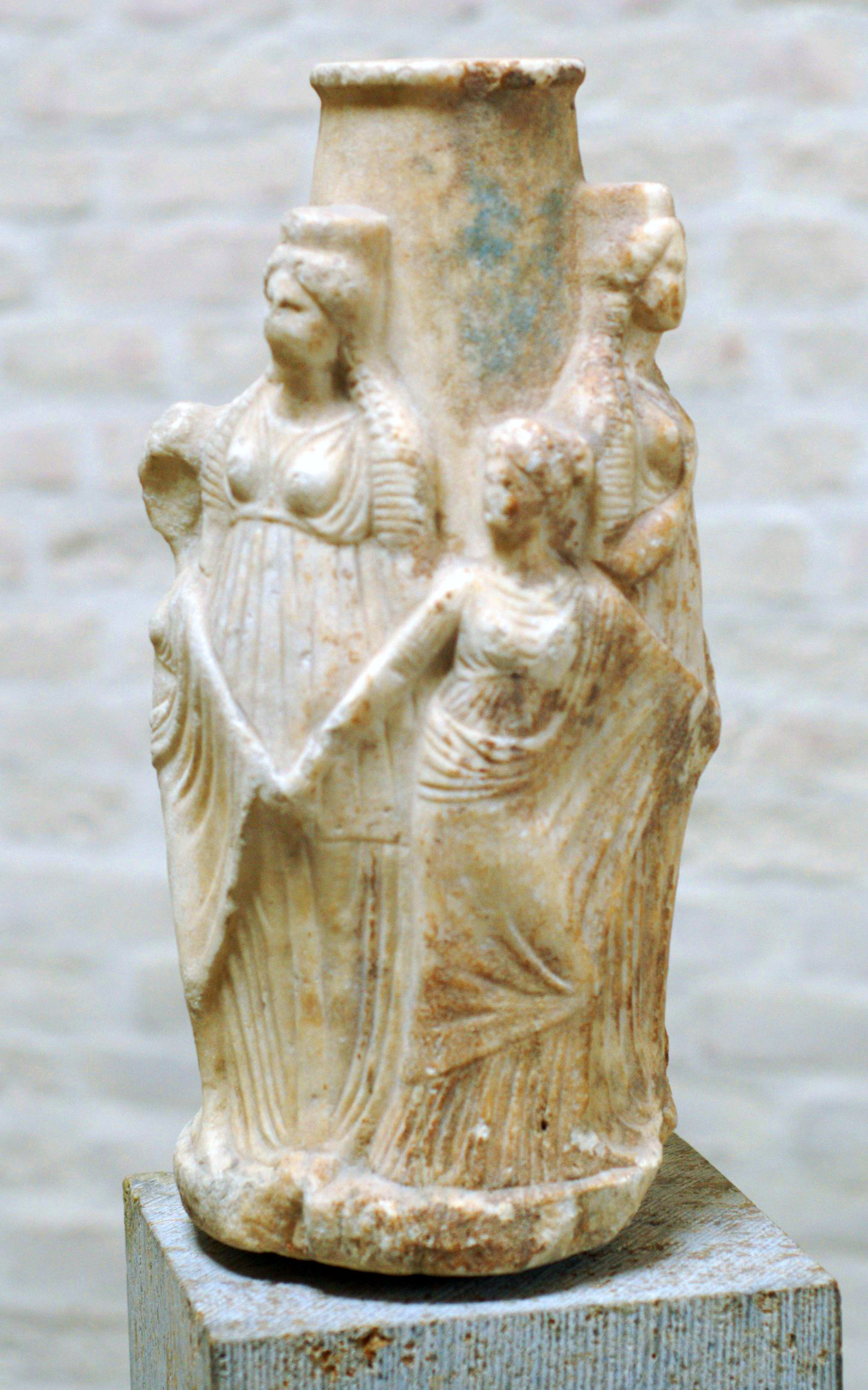
Hekateion from Attica, ca. 3rd century BC.
Bibi Saint-Pol
What is interesting is what gets amplified and what gets compressed. Her role in magic, particularly in the context of necromancy and the kathartic ritual, becomes much more pronounced in the Roman literary tradition. Horace, Virgil, Lucan: she appears in their work primarily in those darker registers. The philosophical depth she carries in Hesiod, the sense of vast honour and sovereignty, tends to recede in the Roman versions of Hekate or Trivia. She is not diminished exactly, but she is more narrowly defined. And this had already begun in the Hellenistic period, with the triple form, the three-faced or three-bodied image, becoming the dominant visual representation. We see the Hekataion: the triple-form pillar or statue placed at crossroads or in doorways, spread across both the Greek and Roman world. The first triple-form statue was created in Athens, around 430 BCE, so it is actually very early, but it was taken on much more strongly in the Roman context.
Since the Hellenistic period, Hekate becomes a central figure in magical practice, and even more in the context of the Greek Magical Papyri. What makes these texts so important for understanding her cult, and how do they reflect the merging of Greek, Egyptian, and Roman traditions?
The PGM, as we call them, are really fascinating. They date roughly from the second century BCE to the fifth century CE and they are extraordinary because they are not theological treatises. They are actual working documents: collections from different places, with a great deal of mingling from Egyptian, Greek, Roman, and Coptic traditions. Because they are working documents, they record actual ritual procedures: what to say, what to do, how to construct an amulet, how to invoke a deity. They are very rich in telling us about the use and practice of magic in those periods, though there is also significant potential for misinterpretation.
Hekate appears throughout the PGM. She is directly mentioned eighteen times, but appears in all her different names and forms many more times than that, whether that is Hekate being called with her horde to assist with a love spell, or invoked for protection. She is clearly central to many of the rites and rituals described there. You also see that relationship between the syncretic Hellenistic, Roman, and Egyptian world, absorbing aspects of Isis, Selene, Persephone, and placing names alongside Egyptian divine names. I do not think that is confusion or carelessness. It is consistent with the logic of a world in which deities are understood to have multiple names and multiple faces, and where it was the practitioner’s job to know how to address the right aspect for the right purpose. The papyri demonstrate a continuous, living, technically sophisticated practice associated with Hekate, one not confined to any single ethnic or cultural tradition. And that breadth is itself part of her nature: always operating outside the boundaries of any single sanctioned religious structure.
In later sources like the Chaldean Oracles, Hekate seems to take on a much more elevated, almost metaphysical role. Proclus calls her “life-giving” and “intellectually luminous”, and Damascius describes her as a bridge between the material and divine worlds. Could you tell us more about her role as a psychopomp, perhaps in connection with these later philosophical interpretations like the Chaldean Oracles or Porphyry’s Cave of the Nymphs?
The connection is deeper even than it might initially appear. The Chaldean Oracles were probably composed in the second century CE and attributed to Julian the Theurgist, though there are arguments it may have been Julian the Chaldean, his father, which does not help us much given that both were called Julian and both were magical practitioners. They present Hekate as the world soul, the cosmic world soul. She is the intermediary between the principle of the transcendent father and the material world. Hekate is the buffer between pure thought and matter, and literally births everything that is material. Proclus, working within the Neoplatonic tradition in the fifth century, describes her as “life-giving and intellectually luminous,” and this is not really a departure from her earlier character but an elaboration of it, of a deity that stands between, that mediates. The Neoplatonists, working with the fragments from the Oracles, really helped develop this thinking.
In Porphyry’s Cave of the Nymphs, third century, if I am right, there is an allegorical reading of a passage from Homer’s Odyssey. In the Odyssey, the cave has two entrances: one for the descent of souls into incarnation, and one for the ascent of souls out of it. It becomes a map for the soul’s journey through materiality and back towards the divine. That fits perfectly well with Hekate’s torch-bearing liminal function. And in the Neoplatonic reading, she does not merely escort souls — she governs the entire movement of the soul. That is why Damascius can describe her as the bond between the material and divine realms. And the psychopomp function, in that sense, is not a subsidiary feature. It is key to her theological significance. It is where the light makes navigation possible across boundaries that would otherwise be impassable.
We do not have many references to Hekate in Mithraic contexts, but a beautiful Hekataion was found in Sidon alongside a group of Mithraic monuments now preserved in the Louvre. Vermaseren also notes a few smaller references in places like Rome, Trier, and Stockstadt. There is also an inscription dedicated to Mithras from Zosimus, who identifies himself as a priest of Hekate. How would you interpret her presence in a Mithraic context?
I think it is really interesting, and on first appearance it seems like a contradiction. On one side you have the heroic, active, conquering cosmic warrior of Mithras; on the other, the ambiguous governess, the queen of the chthonic, the dark side. But if you look beyond that, you see that both are about light in darkness, whether that is the solar-born god or the torch-bearer carrying the light through. You have the sun and the moon, which may seem like opposites but are both related to that idea of showing the way, illuminating the path.
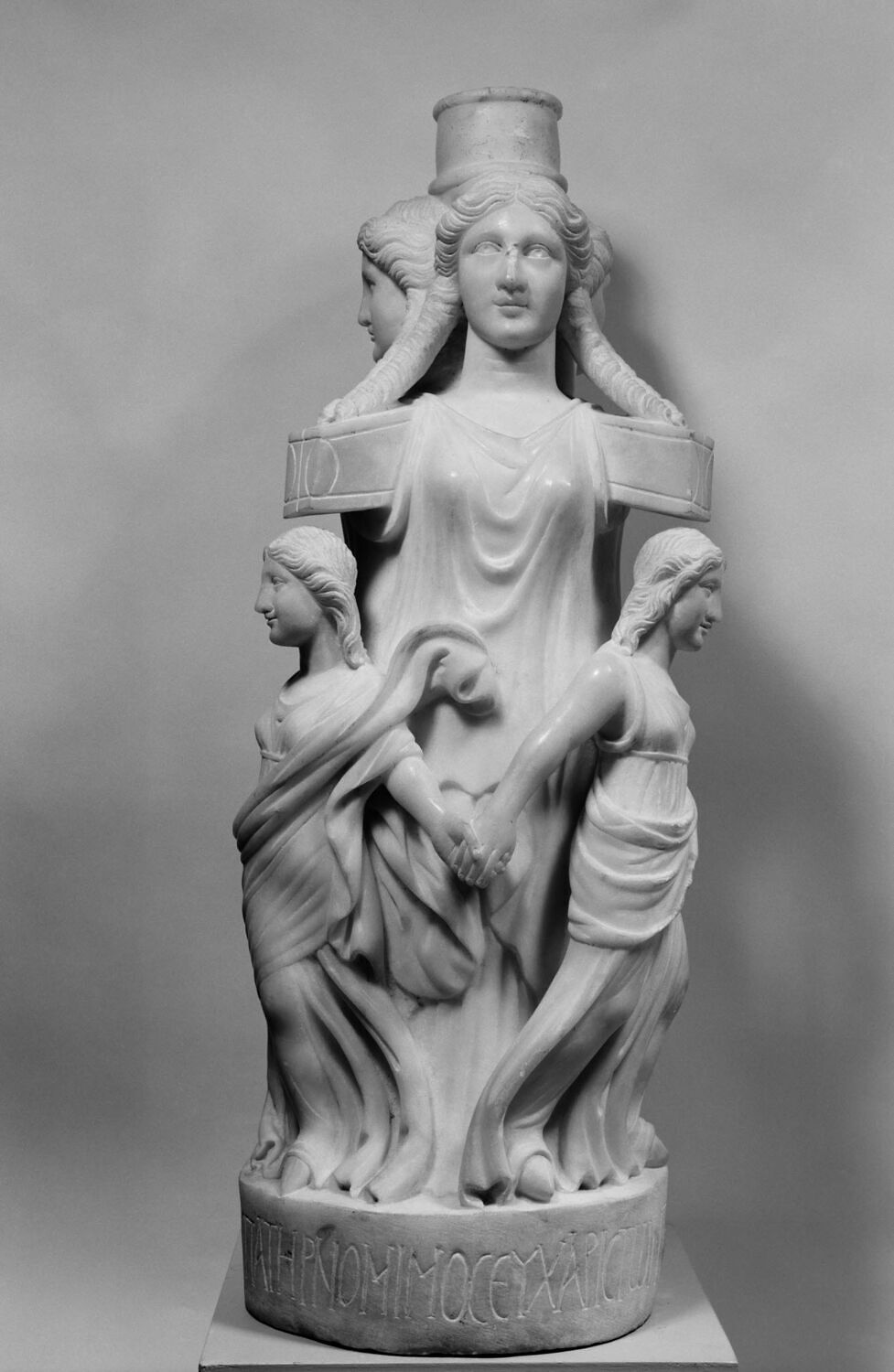
Hekataion de Sidon.
© Musée du Louvre / Maurice et Pierre Chuzeville
And there is that key thing about operating across sets of thresholds. With Mithras, the killing of the bull, the passage of the soul through the planetary spheres, the movement between darkness and light, the initiate in the Mithraic mysteries understood themselves to be making a journey through a series of grades or levels. Hekate is the deity of the thresholds, the guide of souls between realms. She is not decorative in that context, she is quite structural. She recognises that journeys need to be made, whether allegorical or cosmic, and she helps with the passage through them. And in the later tradition, Hekate as world soul, as described in the Chaldean Oracles, would have been available to whoever commissioned or used the Sidon monuments. Her cosmological authority would have been well understood, and I think it would have sat very naturally alongside the cult of Mithras.
You write about how powerful goddesses could become feared or diminished under patriarchal systems. Do you think Hekate can be understood as a figure of female agency in antiquity, or is that mainly a modern way of reading her?
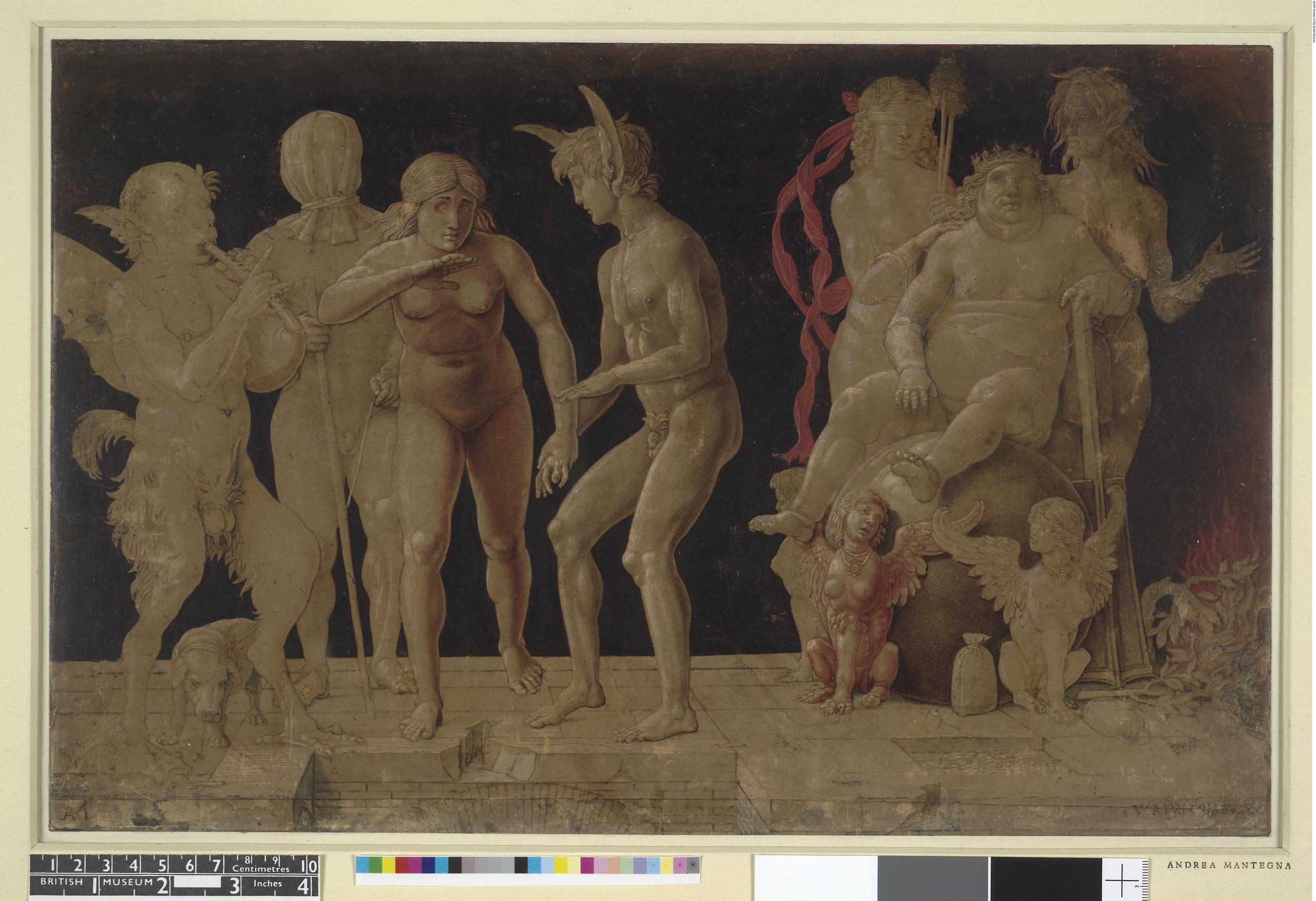
I think both are true, and it is worth taking a moment to reflect on that rather than resolve it too quickly. The historical record is clear that Hekate’s independence from patriarchal religious authority is structural rather than incidental. She was not one of the goddesses defined by her relationship with male figures. She was not a wife, as Hera was; not a daughter, as Athena was. She did not represent femininity in the way Aphrodite did. She held dominion across all three realms independently, unbeholden to a male consort or protector. She was not tamed into domesticity. She was not subordinated into a supporting role. And that is not a modern reading, it is what the ancient sources describe, including Hesiod, who I would not describe as a feminist writer in any contemporary sense.
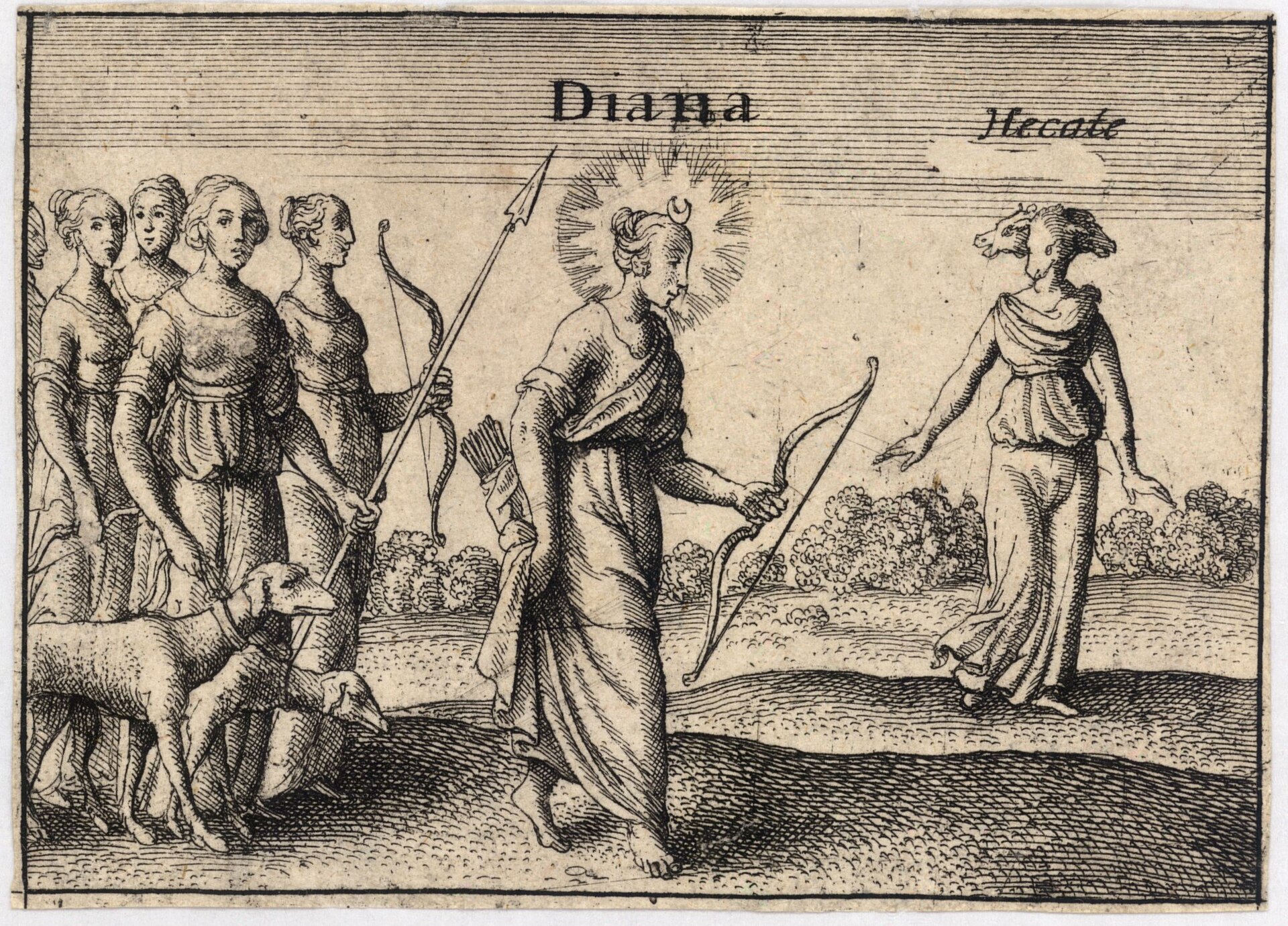
The Greek gods. Diana and Hekate
University of Toronto
But the demonisation is equally historical. The goddesses that resist patriarchal structures tend to get diminished, narrowed, or made monstrous when cultural conditions demand it. The process by which Hekate was removed from the broad sovereignty described in Hesiod and recast in later traditions as a malevolent night-wanderer is a real historical process that challenged what female deities could and should be. I am currently writing an article called “Made Monstrous,” reflecting on what happens to women or female deities who exist outside the definitions of essentially patriarchal societies, not just Hekate, but figures from her horde as well. Take Mormo: she is described a bit like the bogeyman, the demoness who would come and terrorise children in the night. But Mormo was not born a demoness. She was a figure who lost her own children and became demonised. And I think that is very revealing in terms of how women who do not fit comfortably inside the patriarchy can come to be demonised.
In terms of agency, and you used that word, the newest wave of engagement with Hekate, over perhaps the last seventy years, has been about reclaiming something. Particularly women who understand it as an opportunity to reclaim agency and power that has been sidelined or diminished in historical contexts. It is no surprise that there is a contemporary growth in her following, and that it has accelerated in times when women have more freedom to claim their own authority. And I do not think it is a coincidence that the goddess was demonised precisely for refusing to be beholden, and then further diminished through Christian traditions, where she did not fit inside the archetypes seen as desirable for women.
In your book, you make a really interesting distinction between invocation and evocation. Could you explain how these two approaches differ in practice, and what they tell us about how ancient people interacted with the divine?
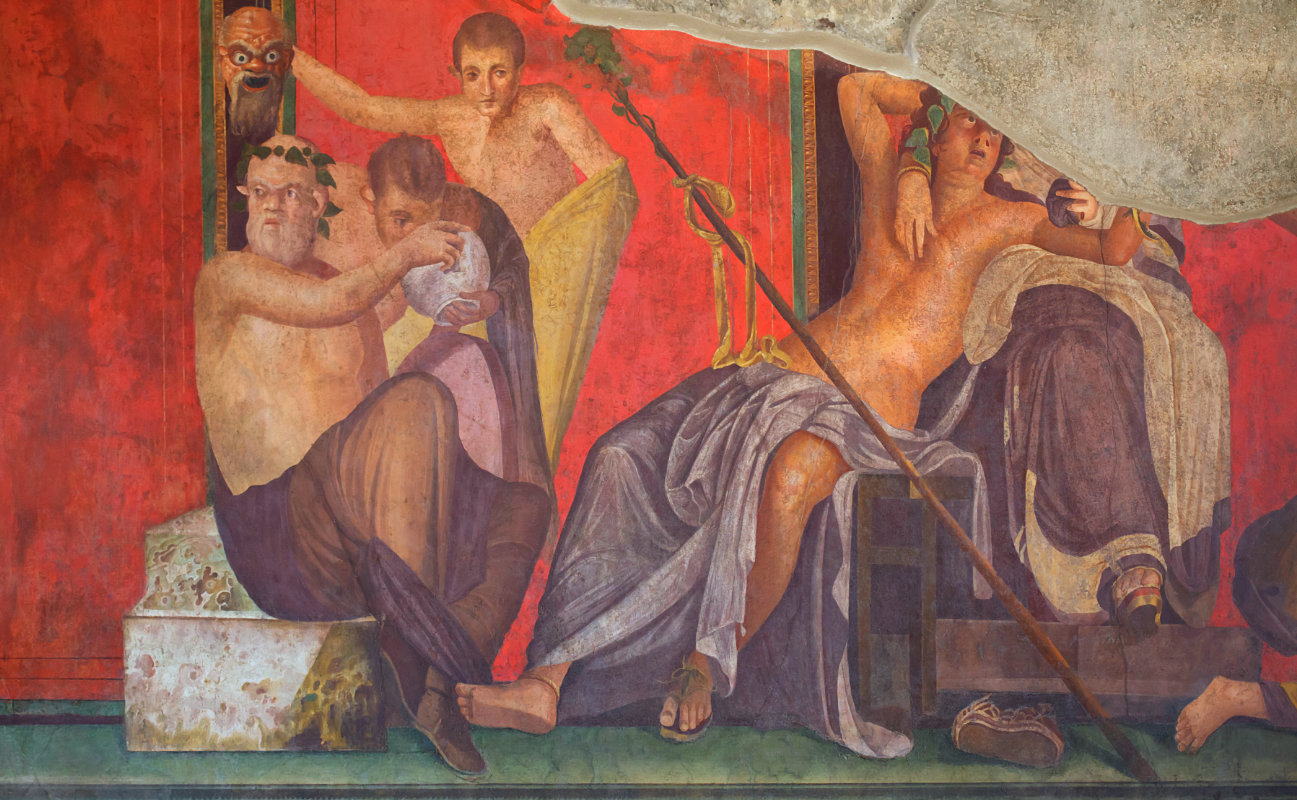
I am delighted to, because the distinction is important but tends to get collapsed in popular treatments, with the two terms used interchangeably, without understanding that they describe two very different functions. Invocation is an internal operation: you are calling a deity into yourself, into your own consciousness and body, working with a kind of alignment or identification. A really good example is the work of the Theosophists at the turn of the twentieth century, being invited to invoke the deity within you, to become the channel or vessel for that communication.
A kind of possession, in some sense?
Yes, a range is involved there, but certainly possession, channelling, oracle work. That is all internal. Evocation, on the other hand, is the external operation: you are calling a deity to appear before you. There is a distinct presence, a distinct energy, and there is a clear boundary between the practitioner and the deity. Both carry different kinds of risk. In ancient magical tradition, and certainly in the PGM, both invocation and evocation appear and are treated as distinct procedures requiring very different preparations, spaces, and protective protocols. Evocation in particular requires careful containment — a triangle, a boundary, the naming of what you are summoning — because you are working with a power you are not absorbing but engaging. The ancient practitioner took the distinction very seriously because it mattered in practice, not just in theory.
This also tells us something about how ancient people understood the divine. They did not flatten deities into abstractions. A deity was a real presence with genuine agency, and the question of how you meet that presence — whether you open yourself to it or place it before you — was a technical and theological question, taken quite seriously. I think that care is somewhat absent from casual modern engagements with deity work. It is worth recovering: the protective work, the containment work, and equally the dismissal. How you close the working so the energy is not simply left hanging in the space, where it may become more problematic.
You mention that figures like the Madonna della Strada absorbed certain aspects of Hekate during the Middle Ages. How does Hekate survive into Christian contexts, and how does she end up reduced to a more, as you put it, “one-dimensional goddess of witchcraft”?
The first thing that started to happen with Christianisation is that public ceremonies and rituals became more private. With Hekate specifically, devotion that had been practised at crossroads or in temples started to move into the household, into the threshold space. The deipnon ritual, the Hekate supper, is an example: people would clean a space in their home and make an offering, but it became a private rather than a public act. And devotion continued through syncretism: Hekate being absorbed into more acceptable religious saints or venerated through figures like Mary. Mary as the intercessor, the presence of the threshold, the protector of travellers and the vulnerable. The Madonna della Strada, Our Lady of the Road, carries a very clear resonance with Hekate’s familiarity at the crossroads.
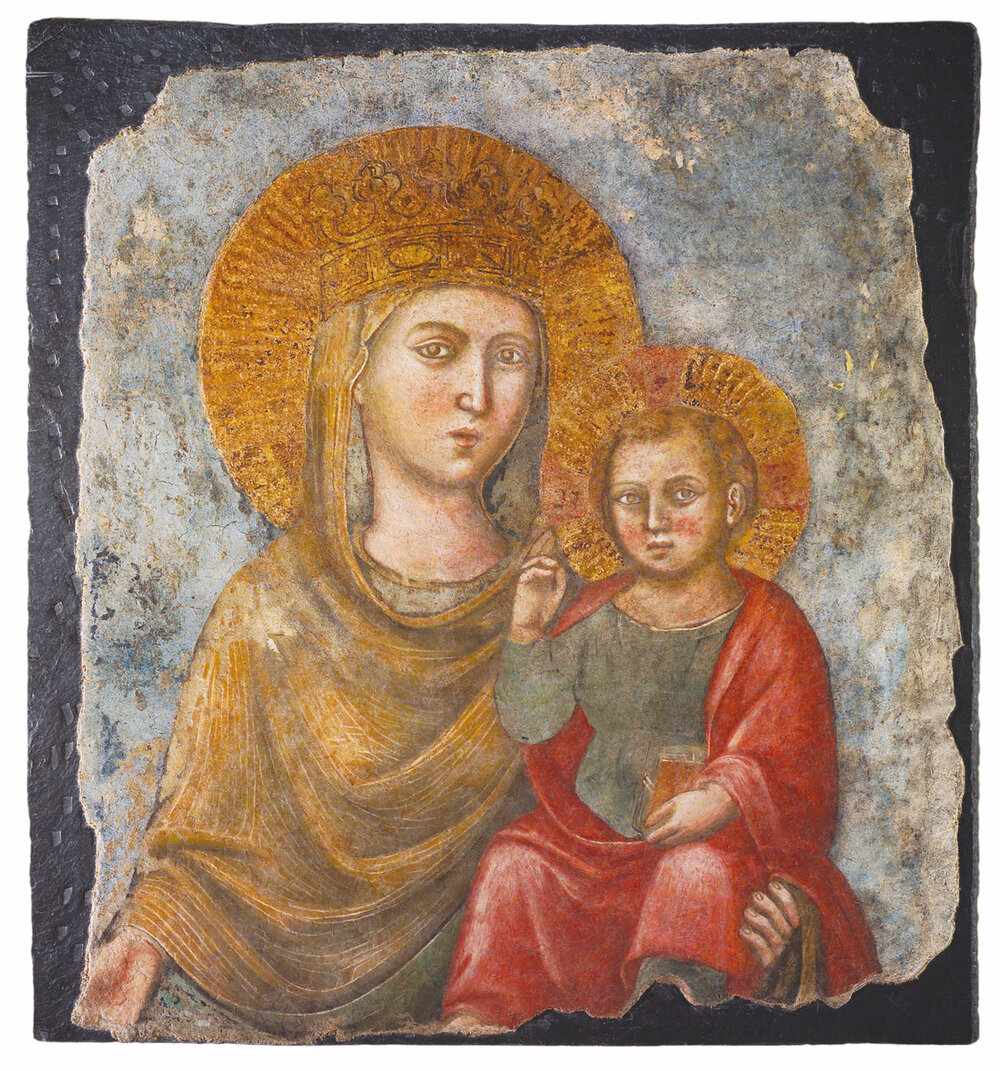
Madonna della Strada
Jean-Pol GRANDMONT
So what could be absorbed was absorbed, and what could not be absorbed was expelled and then demonised. The Canon Episcopi, a church document from around the tenth century, describes women who believed they rode out at night with Diana, explicitly named, and treated it as a diabolical delusion. By that point Diana and Hekate had become quite interchangeable in some popular traditions. Those aspects of Hekate that could not be absorbed into Christian liturgy emerged in the form of diabolism. The Queen of the Night became associated with the dangerous, the uncontrollable, with those aspects of feminine power that were not seen as acceptable. But it is probably worth noting that she never entirely disappeared, even in that diminished form. The tradition persisted underground, distorted, and its residue continued to be visible in the early modern witch trials.
Your book is also a very personal account of your encounter with Hekate, a genuinely experiential one. How did it happen, and how does it shape your understanding of her beyond the academic?
I suppose the starting point is that I am not sure you ever choose to work with Hekate. I think she starts by telling you that you are going to, and you can ignore that for a very long time before you realise that your own free will may not be quite as sovereign as you thought.
For me there were two entry points. The first was in my mid-twenties, when I did a past-life regression. The practitioner led me through a trance state, through a journey, to a door, and when the door opens, you are at the end of a life. So this voice said: when you go through the door, tell me what you can see. And I said: I cannot see anything. He said: look a bit harder. I said: no, there is nothing there. Nothing. He said: when you say nothing, what do you mean? I said: it is very dark grey. There is nothing.
And what we came to realise, as he took me through the end of that life and back to its beginning, is that at the end of that life I had been a beggar woman, probably thirteenth or fourteenth century, possibly France or possibly Britain. I cannot be sure, though the terrain felt recognisable. I was at the end of a life that was blind with cataracts, profoundly deaf, and I had fallen into a ditch and died. I was not the handmaid of Cleopatra. I was not Queen Anne. I was just a woman who fell in a ditch and died having led a miserable, short life.
That is one of the stories I tell at the beginning of the book. And I did not realise when I was writing it how significant it would turn out to be, because when I started thinking about Hekate’s horde, and who is included in it, it is precisely those people: those who died before their time, those who died violently, those who were left unburied. They are the people she brought into her company. And I think what we have never really acknowledged about Hekate is the compassion and the unconditional love required to gather those people, those bodies and spirits, into something. To give them what they never had: belonging. When people characterise Hekate as the evil queen of witches, there is a real misunderstanding there. Walking with Hekate carries within it an unconditional acceptance of the marginalised, those put at the edge of society, and they are brought into being part of something.
The second entry point was through transpersonal work. Creating the opportunity to speak with aspects of oneself in a trance state. I built what I call a transpersonal house, a sort of interior space I can go to in trance: a kind of Mind Palace direction, but not exactly that. And alongside it, a space I call the Vaulted Lab, a transpersonal laboratory full of the junk of the broken bits of my body, and where I could go specifically to work with things that were not functioning. It looks like an old alchemist’s lab, a furnace, an alembic, a mezzanine with an old wooden staircase coming down. And the first time I went into the lab, I saw who I immediately knew was Hekate, standing at the top of the staircase and beginning to descend. I went around the alembic to meet her at the furnace, and when I got there, she was not there. Instead, there was a short, rather grumpy, sandy-haired man in a waxed apron, who looked at me and laughed and said: the first lesson is, do not always assume that what you want to see is what is. His job was to take me down a peg. I thought I was going to be welcomed by the goddess into something, and instead I was received by a very surly character who has always posed difficulties to me.
That’s excellent advice, and very fitting for anyone drawn to esoteric practice. Speaking of which, in your book, you describe a movement from “the dirt to the divine”, structured across different axes. Can you explain it in a few words? How might someone today approach Hekate in a way that feels both meaningful and grounded?
The model I share in it came as part of the process of being asked to write it. I was trying to make sense of my own practice and find a way to communicate it. As you know me, you know that a part of my practice is very grounded in traditionalism, going back to understand what was actually meant, rather than taking a light or casual view of these things. My work began internally, with learning about myself. That is whether it is ancestral understanding — where I come from, what I believe in — or very literally putting my hands in the earth and growing things.
The model I propose has two axes. The first is from the internal to the external. The second is from the dirt to the divine. As we have talked about in this conversation, Hekate operates from the chthonic to the ouranic, from the dirt to the celestial, and you have to understand that whole spectrum of what she represents in order to walk that path. But you cannot do that without first understanding yourself and grounding your own practice. Why are you doing this? What is this about? What is your ego? What is your ancestry? That is the internal work. And then there is the external work — the tools, the rites, the rituals, and ultimately, if you are moving along both dimensions at once, it links to the divine: the high ceremonial, the external ceremonial. Many practitioners locate themselves in one of those quadrants but do not necessarily reflect on where they are coming from in their own journey. What are the roots that allow the tree to grow?
Lenni George and her companion Nat Clegg run The House of Zophiel, an esoteric and creative initiative dedicated to esotericism, creativity and symbolism. Through writings, workshops and events, their work explores the intersections between ancient sources, contemporary spirituality and artistic expression.
Visit their website for more information, including upcoming events and workshops.