Mithraeum at Santa Maria Capua Vetere. Revisited in February 2026
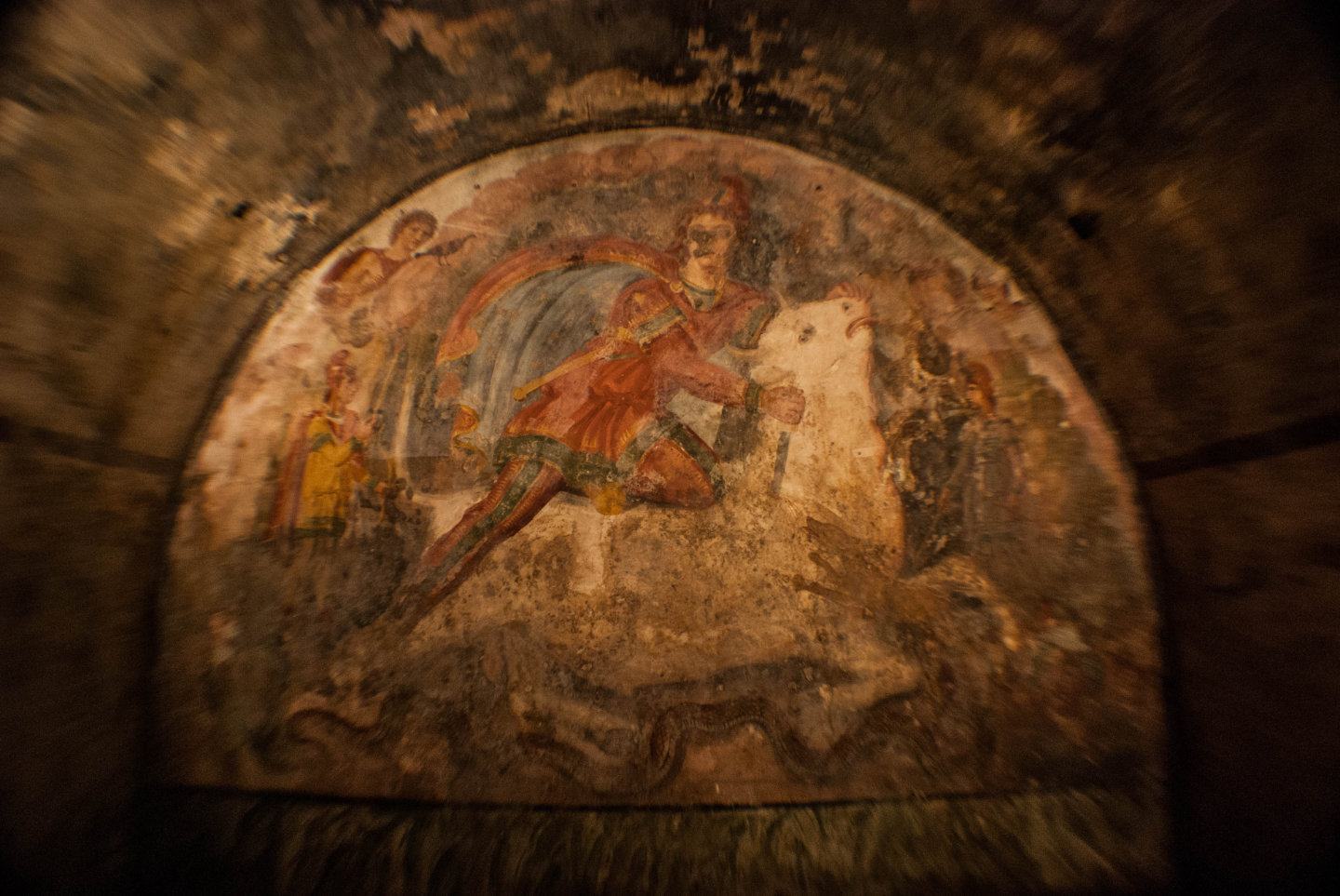
Mithraeum at S. Maria Capua Vetere.
Mateusz Zalewski-G.
As a citizen of Poland who has studied the mysteries of Mithras for several years, and as part of a much longer, decades-long immersion in ancient Mediterranean mystery traditions together with Neoplatonically framed theurgic praxis, I would like to introduce you to one of the most beautiful and best-preserved Mithraea near Capua. I will do so through a short description of a ritual that the respectful caretaker of the site tacitly allowed me to perform.
I prayed and received sacraments and reconsecration in secrecy while he was away, with full respect for the adyton. I believe that our connection to mysteries is established through the soul—through metempsychosis and transmigration—rather than through land or blood. I found my own path long ago.
Given the constraints of space and time, I will divide this article into two parts: historical and practical. I will not enumerate what has already been thoroughly discussed in the scholarly literature, as most readers here are surely familiar with the standard volumes and articles. Instead, I will focus on aspects that are more rarely addressed.
The Mithraeum was constructed in the first half of the second century CE within an existing cryptoporticus. The panel depicting the sacred meal was installed, and during the Antonine period the tauroctony of Mithras was added; Luna was painted, the vault was constructed, and the somewhat shorter figures of Cautes and Cautopates were painted on the walls. The figure of the Heliodromus (the sixth grade—six being a solar number, as indicated by the Pompeian “Sator Arepo” square; Moeller, 1973) also belongs to this phase. The enlargement of the podia occurred in the third century CE, together with the addition of initiation scenes.
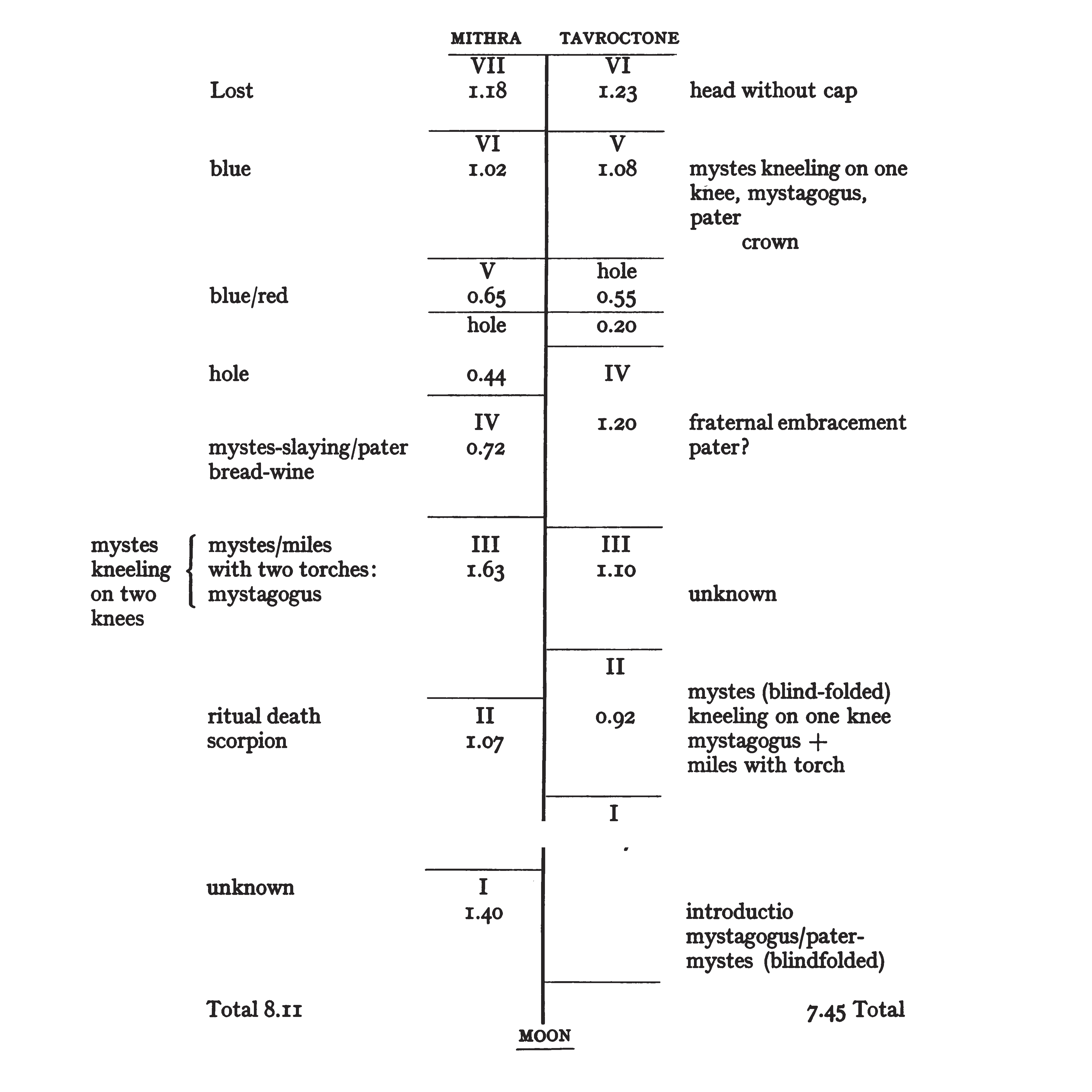
Vermaseren’s interpretation of Capua’s frescoes with scenes of initiation into the mysteries.
Vermaseren, 1971
The reconstructed historical initiation is based on fig. 5 in Vermaseren (p. 25). Along the ritual path, the initiate—now an aspiring mystes—was blindfolded and knelt on one knee as a gesture of reverence toward the sacred. He was then subjected to a ritual death, possibly involving a test with a scorpion, emphasizing trust in his brothers and honesty in initiation.
Afterwards, a mystes of the rank of Miles (associated with Mars), holding two torches symbolizing Cautes and Cautopates, knelt on both knees as if venerating the Dioscuri of Jupiter Dolichenus. Sabazian gestures (benedictio in Latin) may have been used to seal the initiate with the Crux Decussata of Kronos at the pneumatic or daimonic point between the eyebrows.
Only thereafter was the mystes “slain”—that is, he passed through a symbolic death. He then participated in an initiatory sharing of bread and wine and was introduced by the pater to the local community. He was most likely placed in a pit (perhaps symbolizing the Waters of Tantalus; the Capuan fresco depicts Oceanus in the lower left corner). Subsequently, he received sacred garments of blue and red and was led to accept the Crown from the pater.
His duty was to reject the crown as a temptation and place it upon his shoulder, uttering the words:
Atque perlata humeris tuli maxima divum.
(And I have borne the commands of the gods upon my shoulders.)
For Mithras himself is the true crown.
There are many accounts of people dying during initiations; the farther removed from the true mysteries, and the more distant in time, the bloodier such imaginings tend to become. Apart from the sacrilege attributed to Commodus—who reportedly slew an aspiring initiate—ritual slaughter was not the purpose of Mithraic initiation. It was not intended to kill a brother or sister. (Hyena, Lea, Mater, and other variations of female ranks are attested in some locations, while in others the cult appears to have been strictly male.)
Like the Sun and Saturn, the Kosmokrator and Orion, and Selene the Moon, the initiate walks the path of mystery. He reflects and absorbs teachings like the Moon, and then emits and creates greatness—aretē, intellectual discipline, and self-governance—through the symposium of planetary spheres, whose gods and goddesses instruct the young aspirant. This path is always overseen by the Selenic Moon, the Intellectual Sun, and Imperial Saturn.
As for the ritual through which I felt reconsecrated, I imagined and visualized a cosmic cave filled with stars and galaxies, moving through vast Aionic cycles. I then performed the X-shaped commendation of Kronos and prayed with the words:
Vale, Pater Noster Saturnos; vale, Kronos; Sol Invictus Mithras.
I contemplated the theological superstructures I have absorbed over many years and applied them within the brief time I had in that sacred space. As I emerged from the Mithraeum, I felt blessed and further committed to homoiōsis theōi—the work upon oneself—in order to participate in theion ergon, the work of the gods.
Should you ever visit this Mithraeum, you will find other magnificent wonders nearby: the amphitheater from which Spartacus began his rebellion, one of the most famous of the Republican period, and Hadrian’s triumphal arch, albeit now in disastrous condition. I would like to thank the Italian people for hosting an unwieldy and somewhat strange Pole upon their soil. I felt like a guest—and felt most welcome.
References


Comments
"...there is the soul we call divine, by which we are ourselves, and the other soul, the one that comes from the universe (our world). We derive our character, our actions, and our passions [Ego] from the lower soul... but thanks to our higher soul [Spirit], we can master our lower part and free ourselves from the order imposed by the world soul [Management] on the rest of the universe."
One of Plotinus’s most justly famous concepts concerns his theory of the different levels of self-awareness. The duality of the soul was conceived by Plato around 350 BC (but already explored by Homer in the previous century). This is a defining characteristic of Western philosophy. Plotinus, by discovering that one of the parts had to be divine, made metempsychosis impossible
While you are, strictly speaking, absolutely correct, it is worth recalling the sheer diversity of afterlife beliefs within the Graeco-Roman milieu. For instance, in Thracian Sabazian traditions, it is said that human souls were first formed from animal souls; furthermore, both metempsychosis and transmigration were entirely acceptable concepts within the classical world.
Let us also remember that the Divine spirit in this duality is understood as a daimon. These daimones belonged to varied classes: Sosipatra was a demi-goddess type of daimon, as were Plotinus, Apollonius of Tyana, the Socratic daimon, and the archangelic daimon of Julian the Theurgist.
Inasmuch as I agree with you in this context, I remain open to the possibility of dividing the soul into further subclasses: the eidola or skia (simulacra) representing the chthonic shadow-soul of the dead; the psyche; the transmigratory or inborn soul; and the daimon—the intellectual, immortal soul, or pneuma. By mastering the lower faculties (emotions, cognitions, impulses, and cravings), we may refine the soul into a daimon or pneuma, as if drawing from the Anima Mundi and condensing it into an immortal particle.
I maintain some reserve as to whether we all possess such a particle. Nevertheless, even the most base creatures possess a soul, and upon their passing, they leave a shadow behind. In this manner, nothing is lost in nature. The metamorphoses described by Ovid and Apuleius serve as my warranty that "nature loves to hide," and many secrets follow.
With the highest respect and warmest salutations,
Uždavinys, Algis. 2008. Philosophy as a Rite of Rebirth: From Ancient Egypt to Neoplatonism. Sedbury, Glos.: Prometheus Trust. — Relevant for its attempt to reconstruct the philosophical pathways underlying the foundations of rite and theurgy.
Ritner, Robert Kriech. 1993. The Mechanics of Ancient Egyptian Magical Practice. Fourth printing, with minor corrections. Chicago: Oriental Institute of the University of Chicago. — Valuable for providing ritual ideas that, with enough virtuosity and experimentation, may be imaginatively adapted within the “temple” of the inner or ethereal spheres.
Stahl, William Harris. 1990. Macrobius: Commentary on the Dream of Scipio.* New York, NY: Columbia University Press. — Relevant because it describes, albeit quasi-legendary, the rapture of a Roman knight to the celestial spheres and stars above.
Iamblichus; Clarke, Emma C. (trans.). 2003. Iamblichus: On the Mysteries. Atlanta, GA: Society of Biblical Literature. — Important for its clear elucidation of the theology of theurgists.
Apuleius. 2017. Apologia; Florida; De Deo Socratis. Edited by C. P. Jones. Loeb Classical Library. Cambridge, MA: Harvard University Press. — “On the God of Socrates,” a treatise on daemonology and theology.
Bittrich, Ursula; Bydén, Börje; Gertz, Sebastian Ramon Philipp; Sheppard, Anne D. R.; Tanaseanu-Döbler, Ilinca; Synesius. 2014. *On Prophecy, Dreams and Human Imagination: Synesius, De Insomniis. Edited by D. A. Russell and Heinz-Günther Nesselrath. — Discusses types of dreams and how to discern them (for example, distinguishing a personal dream from a vision sent from beyond).
Kupperman, Jeffrey S. 2014. Living Theurgy: A Course in Iamblichus’ Philosophy, Theology and Theurgy. London: Avalonia. — Another modern attempt to engage these mysteries, offering a practical conceptual toolkit.
Kind regards,
Matt.
Absolutely. As a cult varies according to its geographical context, I am convinced that local modalities were distinct, especially where they existed alongside other magical or theological frameworks. As a generalist in the study of mysteriosophies, however, I try to remain academically humble and avoid conflating traditions. Like a religious comparativist, I believe each lineage deserves its proper respect, scholarly engagement, and dignity.
When it comes to praxis, my position is simply that “what works, works.” The same applies to theurgy. The experiential aspect is too subjective and personal for me to present as explanatory doctrine. I would rather not frame private gnosis as argument, since it is unverifiable beyond honesty and reasoned commitment between the individual and the expanse of the Divine.
That said, records exist of individuals in antiquity who participated in multiple mystery schools. For this reason, I feel justified in pursuing the Divine wherever it may be encountered—not as a collector, but while granting each mystery school the profundity it commands.
Regarding the combinatorial character of late antiquity, I once found an exceptional study:
Kahlos, Maijastina. 2002. Vettius Agorius Praetextatus: A Senatorial Life in Between. Rome: Institutum Romanum Finlandiae.
For ancient ritual practice more broadly, Thesaurus Cultus et Rituum Antiquorum (ThesCRA) is indispensable, especially the material in Vol. II (“Consecration: Divination, prayer, veneration, hikesia, asylia, oath, malediction, profanation, and magical rituals”), Los Angeles: Getty Museum.
I am fortunate to have access to a copyright library (the National Library of Poland). I understand these sources can be difficult to obtain, so I would be glad to share my impressions or reports on the above works whenever requested.
Best wishes and kind regards,
Matt