Support The New MithraeumThe New Mithraeum is an independent, non-profit project dedicated to Mithraic studies, ancient religions and classical culture.Developed and maintained independently since 2007, the site exists without advertising, paywalls or institutional funding. If you have found value in its articles, interviews, photographs or database, please consider supporting the project with a contribution.Every contribution helps keep The New Mithraeum open, free and alive.Thank you.
BSc Econ in Political Science and Intelligence Studies, born in Warsaw, PL, Researcher of Cults and Mysteries, a practicing Heathen since the age of 12.
A theological experiment in Neo-Platonic realism, theology of arithmetic, and teleological metamorphoses of powers in the divine, terrestrial, and chthonic worlds across the cosmic symphony.
By reading Orphic theology together with Eleusinian ritual practice, the mysteries emerge as a structured mystagogy of transformation: a disciplined passage from forgetfulness (Lethe) to knowledge (aletheia), from mortality to participation in the divine.
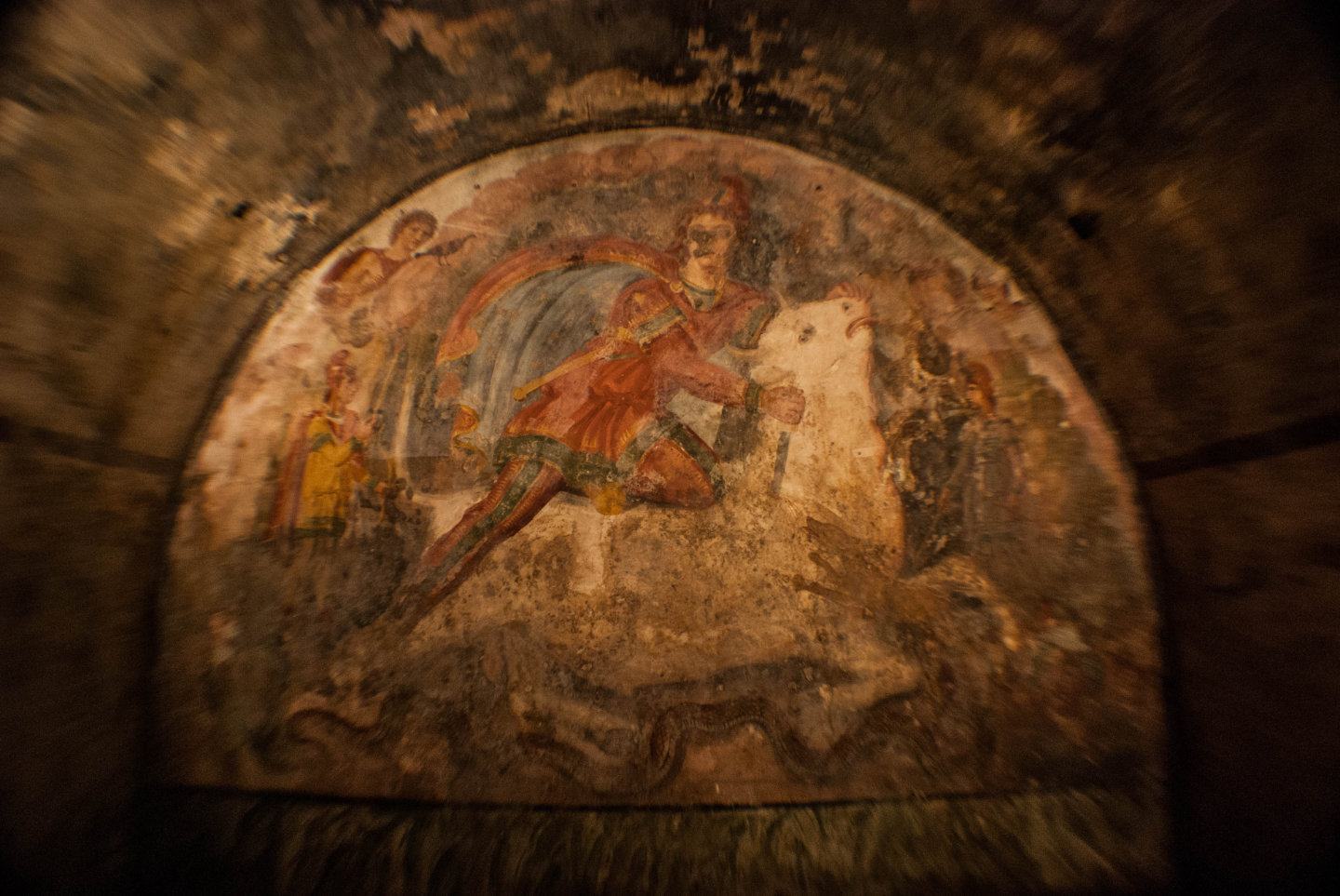
This article revisits the Mithraeum of S. Maria Capua Vetere, one of the most complete and artistically refined Mithraic sanctuaries in the Campanian region, situating it within its archaeological, iconographic, and ritual-historical contexts.
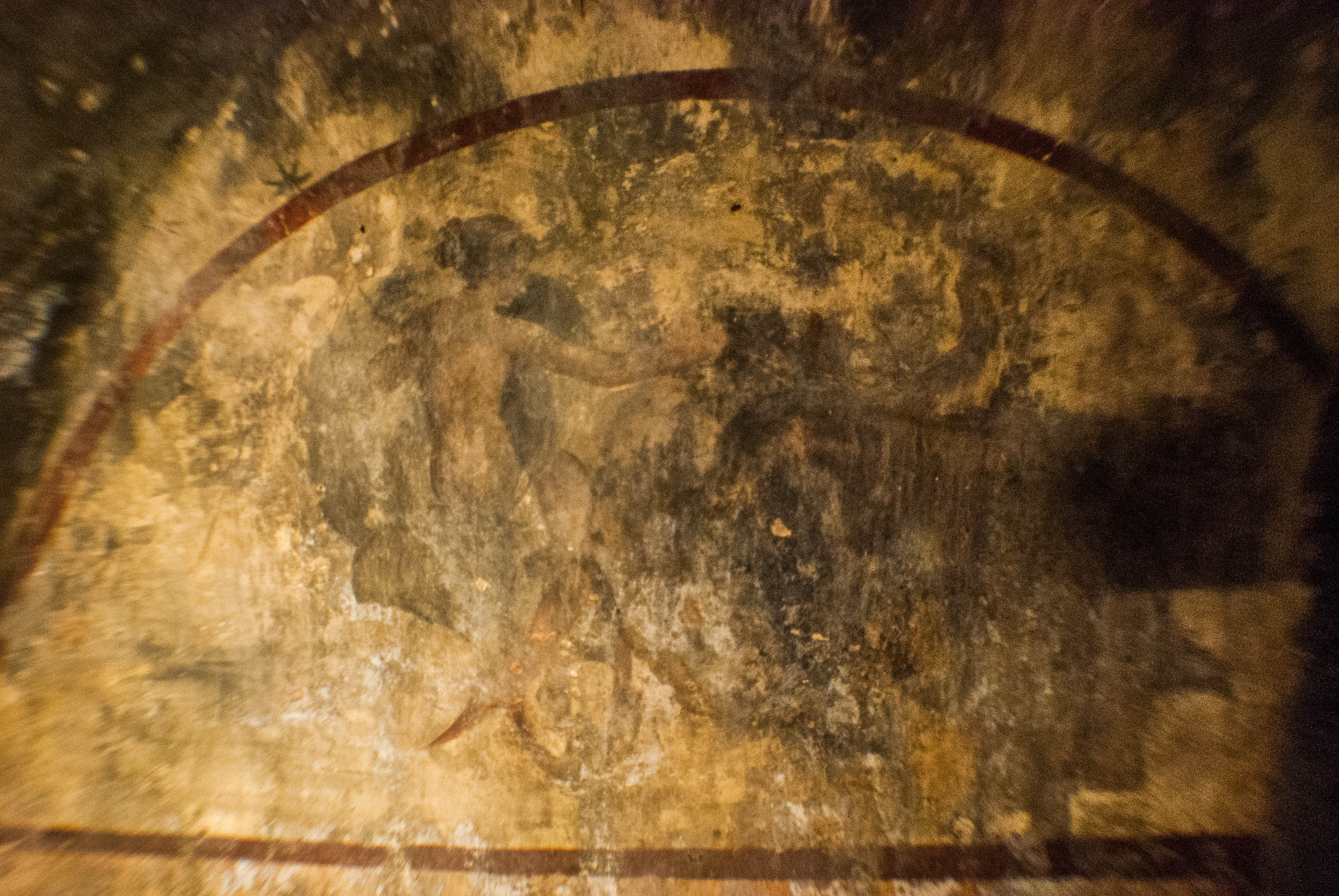
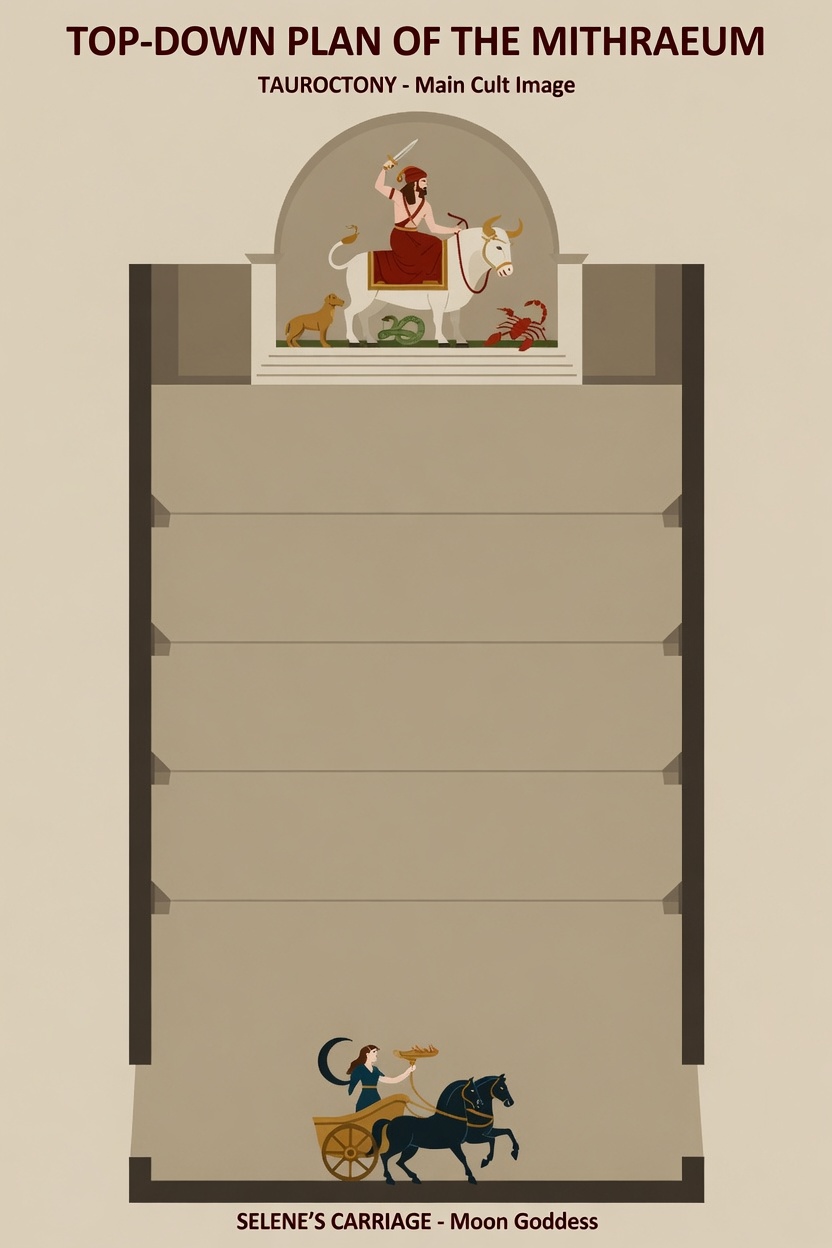
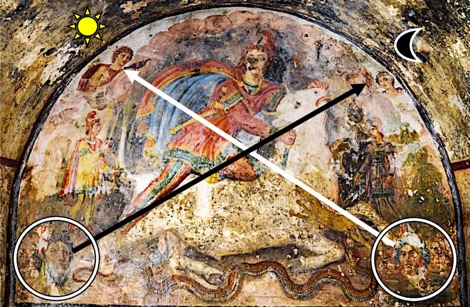
Dear Dominique, interesting observation. However, the placement of Selene (Luna) in this Mithraeum is positioned opposite the Tauroctony scene, evoking a symbolic sun-moon connection—much like the alchemical Lunar Queen (who reflects) and Solar King (who illuminates). It thus appears that all planetary and zodiacal works are carried out under their joint oversight. Thank you and best regards.
Dear Amicus: as early as the 3rd century AD, Plotinus wrote that the soul was divided into a lower and a higher part:
"...there is the soul we call divine, by which we are ourselves, and the other soul, the one that comes from the universe (our world). We derive our character, our actions, and our passions [Ego] from the lower soul... but thanks to our higher soul [Spirit], we can master our lower part and free ourselves from the order imposed by the world soul [Management] on the rest of the universe."
One of Plotinus’s most justly famous concepts concerns his theory of the different levels of self-awareness. The duality of the soul was conceived by Plato around 350 BC (but already explored by Homer in the previous century). This is a defining characteristic of Western philosophy. Plotinus, by discovering that one of the parts had to be divine, made metempsychosis impossible
Dear Dominique, interesting observation. However, the placement of Selene (Luna) in this Mithraeum is positioned opposite the Tauroctony scene, evoking a symbolic sun-moon connection—much like the alchemical Lunar Queen (who reflects) and Solar King (who illuminates). It thus appears that all planetary and zodiacal works are carried out under their joint oversight. Thank you and best regards.
While you are, strictly speaking, absolutely correct, it is worth recalling the sheer diversity of afterlife beliefs within the Graeco-Roman milieu. For instance, in Thracian Sabazian traditions, it is said that human souls were first formed from animal souls; furthermore, both metempsychosis and transmigration were entirely acceptable concepts within the classical world.
Let us also remember that the Divine spirit in this duality is understood as a daimon. These daimones belonged to varied classes: Sosipatra was a demi-goddess type of daimon, as were Plotinus, Apollonius of Tyana, the Socratic daimon, and the archangelic daimon of Julian the Theurgist.
Inasmuch as I agree with you in this context, I remain open to the possibility of dividing the soul into further subclasses: the eidola or skia (simulacra) representing the chthonic shadow-soul of the dead; the psyche; the transmigratory or inborn soul; and the daimon—the intellectual, immortal soul, or pneuma. By mastering the lower faculties (emotions, cognitions, impulses, and cravings), we may refine the soul into a daimon or pneuma, as if drawing from the Anima Mundi and condensing it into an immortal particle.
I maintain some reserve as to whether we all possess such a particle. Nevertheless, even the most base creatures possess a soul, and upon their passing, they leave a shadow behind. In this manner, nothing is lost in nature. The metamorphoses described by Ovid and Apuleius serve as my warranty that "nature loves to hide," and many secrets follow.
The Two Gates: Thank you very much for sharing this Dominique. Traditionally, Selene was associated with the Isle of the Blessed. My personal belief is that the soul, or daimon/hegemon, may be interpreted as an intelligencer of the spheres of the Solar System—for example, Mercury, Venus, the Moon, Mars, Jupiter, or Saturn. It does not necessarily require a biological birth; “myriads of spirits in other worlds await,” including the stellar ones. My personal belief, or interpretation, is based on communication with spirits of these spheres, some of whom were once human beings. Sometimes the twin blade of death may refer to the death of the soul, or to metempsychosis and rebirth, or to embodiment in an animal or a human being.
At Rome’s twilight, amid political upheaval and Christian ascendancy, Vettius Agorius Praetextatus embodied pagan intellect, virtue, and authority across senatorial, military, and mystical spheres.
Absolutely. As a cult varies according to its geographical context, I am convinced that local modalities were distinct, especially where they existed alongside other magical or theological frameworks. As a generalist in the study of mysteriosophies, however, I try to remain academically humble and avoid conflating traditions. Like a religious comparativist, I believe each lineage deserves its proper respect, scholarly engagement, and dignity.
When it comes to praxis, my position is simply that “what works, works.” The same applies to theurgy. The experiential aspect is too subjective and personal for me to present as explanatory doctrine. I would rather not frame private gnosis as argument, since it is unverifiable beyond honesty and reasoned commitment between the individual and the expanse of the Divine.
That said, records exist of individuals in antiquity who participated in multiple mystery schools. For this reason, I feel justified in pursuing the Divine wherever it may be encountered—not as a collector, but while granting each mystery school the profundity it commands.
Regarding the combinatorial character of late antiquity, I once found an exceptional study:
Kahlos, Maijastina. 2002. Vettius Agorius Praetextatus: A Senatorial Life in Between. Rome: Institutum Romanum Finlandiae.
For ancient ritual practice more broadly, Thesaurus Cultus et Rituum Antiquorum (ThesCRA) is indispensable, especially the material in Vol. II (“Consecration: Divination, prayer, veneration, hikesia, asylia, oath, malediction, profanation, and magical rituals”), Los Angeles: Getty Museum.
I am fortunate to have access to a copyright library (the National Library of Poland). I understand these sources can be difficult to obtain, so I would be glad to share my impressions or reports on the above works whenever requested.
What a wonderful task! Of course, it came with an investment in ritual experience some years ago, after which I decided to hermeticize it; hence I now read mainly academic books from which I derive some grounding for my excursions into ritualism. Let me pick a few that may be useful and commendable:
Uždavinys, Algis. 2008. Philosophy as a Rite of Rebirth: From Ancient Egypt to Neoplatonism. Sedbury, Glos.: Prometheus Trust. — Relevant for its attempt to reconstruct the philosophical pathways underlying the foundations of rite and theurgy.
Ritner, Robert Kriech. 1993. The Mechanics of Ancient Egyptian Magical Practice. Fourth printing, with minor corrections. Chicago: Oriental Institute of the University of Chicago. — Valuable for providing ritual ideas that, with enough virtuosity and experimentation, may be imaginatively adapted within the “temple” of the inner or ethereal spheres.
Stahl, William Harris. 1990. Macrobius: Commentary on the Dream of Scipio.* New York, NY: Columbia University Press. — Relevant because it describes, albeit quasi-legendary, the rapture of a Roman knight to the celestial spheres and stars above.
Iamblichus; Clarke, Emma C. (trans.). 2003. Iamblichus: On the Mysteries. Atlanta, GA: Society of Biblical Literature. — Important for its clear elucidation of the theology of theurgists.
Apuleius. 2017. Apologia; Florida; De Deo Socratis. Edited by C. P. Jones. Loeb Classical Library. Cambridge, MA: Harvard University Press. — “On the God of Socrates,” a treatise on daemonology and theology.
Bittrich, Ursula; Bydén, Börje; Gertz, Sebastian Ramon Philipp; Sheppard, Anne D. R.; Tanaseanu-Döbler, Ilinca; Synesius. 2014. *On Prophecy, Dreams and Human Imagination: Synesius, De Insomniis. Edited by D. A. Russell and Heinz-Günther Nesselrath. — Discusses types of dreams and how to discern them (for example, distinguishing a personal dream from a vision sent from beyond).
Kupperman, Jeffrey S. 2014. Living Theurgy: A Course in Iamblichus’ Philosophy, Theology and Theurgy. London: Avalonia. — Another modern attempt to engage these mysteries, offering a practical conceptual toolkit.



![Theatre Variete and streams of consciousness lectures that may be of use to some: [ref:6a42fdda8bc85]](https://www.mithraeum.eu/album/post/c6eb9b2cea52a98d.jpg)
 youtube.comOccultosophiaTeile deine Videos mit Freunden, Verwandten oder der ganzen Welt


"...there is the soul we call divine, by which we are ourselves, and the other soul, the one that comes from the universe (our world). We derive our character, our actions, and our passions [Ego] from the lower soul... but thanks to our higher soul [Spirit], we can master our lower part and free ourselves from the order imposed by the world soul [Management] on the rest of the universe."
One of Plotinus’s most justly famous concepts concerns his theory of the different levels of self-awareness. The duality of the soul was conceived by Plato around 350 BC (but already explored by Homer in the previous century). This is a defining characteristic of Western philosophy. Plotinus, by discovering that one of the parts had to be divine, made metempsychosis impossible