Your selection gave 166 results.
Donated a krater with weekday gods to Mithras god and king in Augusta Treverorum.
Soldier of the XXII Legio Primigenia Pia Fidelis stationed in Mainz that erected an altar to Mithras in Sumelocenna.
Butcher who dedicated a statue of Mercurius Quillenius in the Mithraeum of Groß-Gerau.
Offered the famous Tauroctony of Osterburken to the unconquerable sun god Mithras.
Pater who offered several monuments, including a temple, in Augusta Treverorum.
He was cornicularius, supply officer, to the prefect of the Legion XXII Primigenia.
He devoted an altar to the Mother Goddesses for Respectus, found at the Mithraeum of Friedberg.
Murius Victor was an aedile of Civitas Taunensium who, in fulfilment of a vow, built an altar to Mithras.
Gladiator to whom his companions Cimber and Pietas erected a monument in Colonia, Germania.
Probably a Greek-speaking slave who offered a Cautes placed in the Mithraeum of the Bolards.
Vicus Baudobriga was a Roman settlement on the left bank of the Rhine, founded during the conquest of Gaul. Its development reflects the Rhine’s shifting role as frontier, trade route, and fortified border before Roman withdrawal.
Statue of Cautes from Bodobrica, discovered around 1940, depicting the torchbearer standing before a tree or rock and associated with a bucranium.
The Mithraic vase from Ballplatz in Mainz depicts seven figures arranged in two narrative sequences, commonly interpreted in relation to initiation rites.
Mithras being born from the rock (petrogenia), acquired in Rome and formerly kept in Berlin.
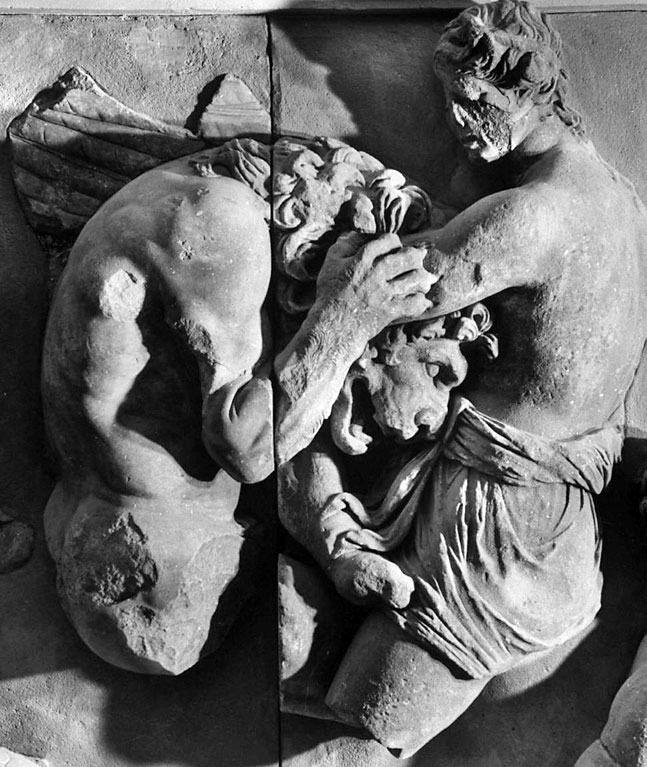
This tauroctony relief is distinguished by the rare depiction of Tellus reclining beneath the bull.