Your search Arsha wa Qibar gave 722 results.

A marble torso of a male figure from the Mithraeum at Walbrook in London, flattened at the back, probably one of the attendant deities of Mithras, which would have stood about 2 ft. in complete height.
A relief fragment from the Mithraeum at Walbrook in London, preserving the lower part of a cross-legged figure of Cautopates pointing his torch downwards.
A fragment of a white marble statue from the Mithraeum at Walbrook in London, preserving the naked torso of a reclining figure with long hair and beard, with the end of a staff visible near his left shoulder, identified as Oceanus.
A white marble statue from the Mithraeum at Walbrook in London, depicting Bonus Eventus standing in a long hanging cloak, leaning on a ship's stem, holding a cornucopia against his shoulder and a patera above a burning altar from the back of which a…
A fragmentary inscription found in the foundations of the Theodosian walls at Aquileia, recording a dedication to the Invincible Mithras by ...ntius Manilianus.
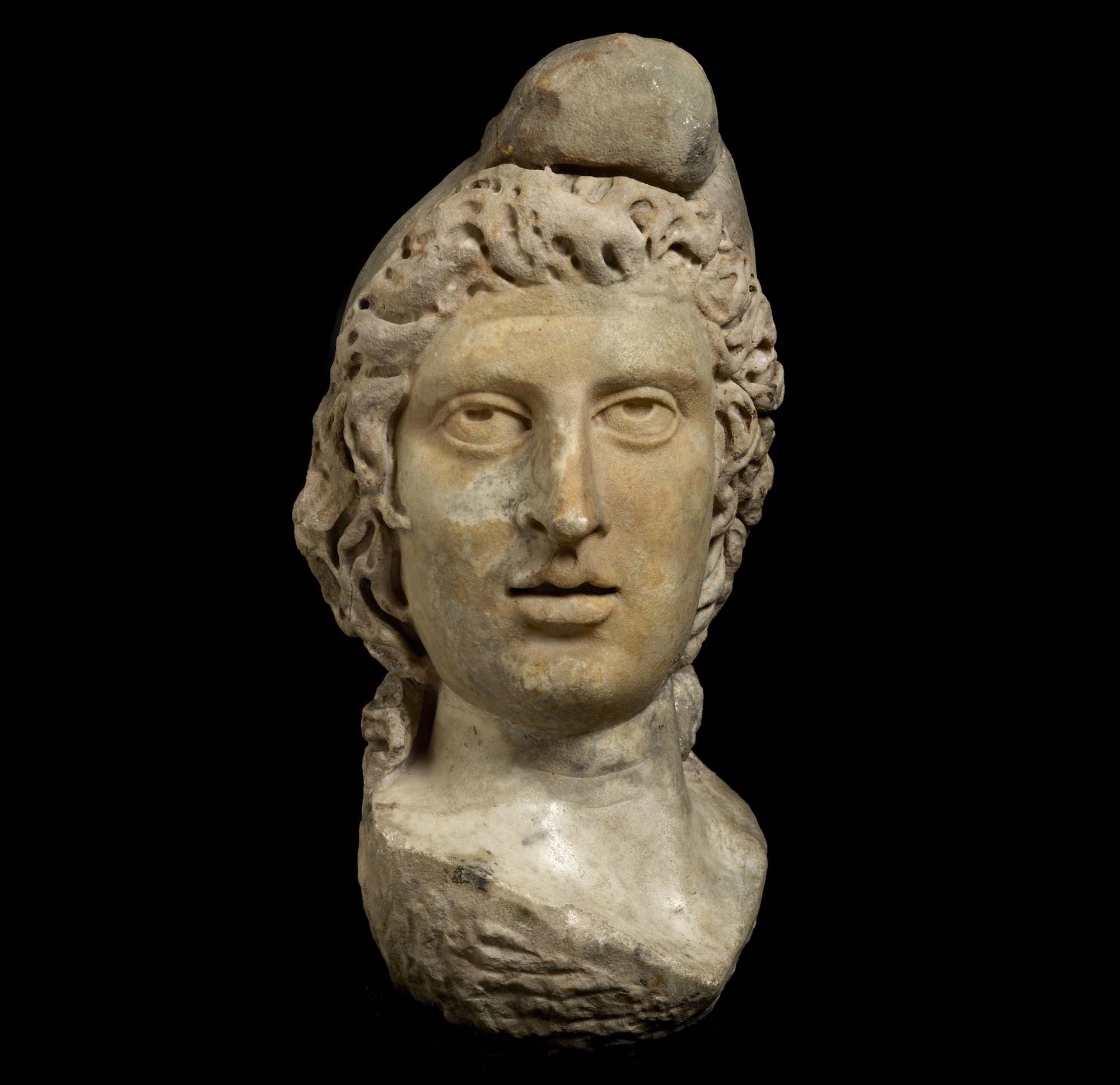
The Mithras's head of Walbrook probable belonged to a life-size scene of the god scarifying the bull.
Wall-painting of Mithras tauroktonos in fresco, discovered in 1886 in an underground room of the house of the Nummi Albani on the Quirinal (Via Firenze); the god wears a red cap and tunic, the torchbearers wear yellow or orange tunic and cap with green or brown anaxyrides…
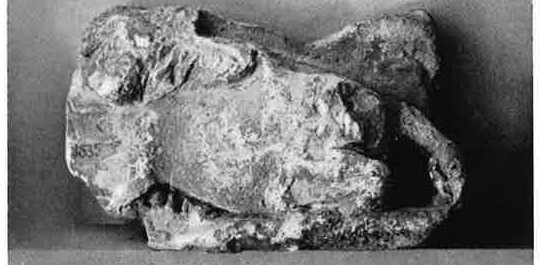
Fragment of a sandstone tauroctony relief from Schwadorf area, ancient Aequinoctium in Pannonia Superior, depicting Mithras killing the bull; the upper part of Mithras's body, the head, and parts of the bull are lost.
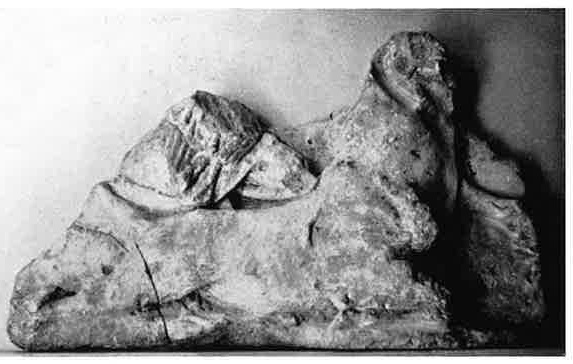
Fragment of a large sandstone tauroctony relief from Schwadorf, ancient Aequinoctium, depicting Mithras killing the bull; the upper part of the god's body, his head, the end of the tail, and the scorpion are lost.
Inscription from Schwadorf, ancient Aequinoctium in Pannonia Superior, dedicated to Petrae genetrici dei — the rock that gives birth to the god — by Aurelius Statorius.
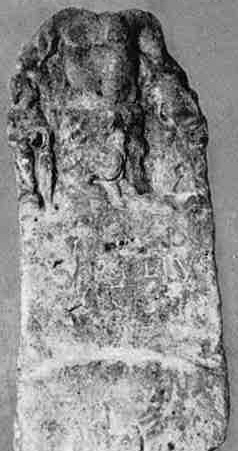
Limestone relief from Schwadorf, ancient Aequinoctium in Pannonia Superior, depicting the naked Mithras being born from the rock with a serpent encircling it, flanked by torchbearers; one of the finest examples of this iconographic type from the Danubian region…
Rectangular sandstone water-basin from the Mithraeum at Königshoffen, placed near the great tauroctony relief; only the bottom, front, and part of the left side survive, and the front inscription records the flow of water as a votive act.
Circular limestone water-basin from the entrance area of the Mithraeum at Königshoffen, equipped with a spout and two handles; traces of red paint survive on the interior.
Fragment of a red ware dish from Rome, now in the Akademisches Kunstmuseum at Bonn, with a representation of Mithras as a bull-killer sitting astride the bull with a flying cloak.
Under-layer wall-paintings in the S. Prisca Mithraeum on the Aventine showing a further procession of Mithraic initiates in different colours, with partially legible dipinti including liturgical verses and acclamations.
Partially legible graffito scratched on the back wall of room M in the Palazzo dei Musei Mithraeum, Rome.
Wall-painting on the last column but one of the Palazzo Barberini Mithraeum, showing a standing person in a short tunic with a wreath of ivy, carrying fruits in his left hand.
Wall-painting on the last column of the left bench in the Palazzo Barberini Mithraeum, showing a standing person pressing his left hand to his breast and extending his right hand towards a kneeling person whose head is covered with ivy.
Relief in plaster, fixed on the wall beside the Mithraic wall-painting (No. 386) in the house of the Nummi Albani on the Quirinal, with traces pointing to a representation of Mithras slaying the bull.
Fragmentary inscription on wall plaster from the Mithraeum of Dura-Europos, Syria, with partially legible text.
