Your search As Salhiyah gave 2381 results.

White marble slab showing Mithras as a bull-killer on a rocky base, found in 1928 by the Comtesse de Robillant in a cellar of the Palazzo del Grillo behind the Forum of Augustus; Mithras' head, both arms, and the bull's head and tail are lost.
Fragment of a marble vase found near Portus by Prince Torlonia, showing a bearded head in radiate crown (Sol) and Cautes with upraised torch, with a Mithras representation now lost, now itself lost.
Base in the form of an altar with five small bacchic herms and eleven lamps, from the Mitreo Sabazeo at Ostia.
A few pieces of tuff worked as rocks, forming a cone representing the remnants of the rock-birth of Mithras, found around the altar in the Mitreo del Palazzo Imperiale at Ostia.
Two marble fragments of a statue of Mithras as bull-killer, preserving the head in Phrygian cap and right hand with dagger, with traces of red paint, from the Mitreo del Palazzo Imperiale at Ostia.
Two inscriptions dedicated to Mithras found at Volubilis near the Fertassa aqueduct fountain, probably indicating the presence of a Mithraeum.
Second limestone base from the Forum Vetus at Leptis Magna bearing the inscription of Aristius Antiochus, with fragments of a torchbearer figure in Eastern attire.
Fragment of a white marble relief depicting the head of Mithras with Phrygian cap and nimbus, found on the Syrian coast between Lattakieh and Tartous, first half of 2nd century A.D.
Great royal inscription of Antiochus I of Commagene carved on the thrones at Nemrud Dağı, invoking Apollo-Mithras-Helios among the guardian deities of the kingdom, 69–34 B.C.
Brief dedicatory inscription to Mithras the Just, found at Tyana (modern Kemerhisar), Cappadocia.
Gold coin of the Scythian king Hooerkes, reverse showing Mithras (MIIPO) in tunic with lance and sword, north-west India, c. 87–129 A.D.
Gold coin of the Scythian king Hooerkes, reverse showing Mithras (MOPO) standing with wreath and staff, north-west India, c. 87–129 A.D.
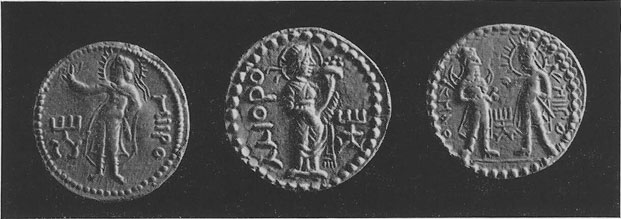
Gold coin of the Scythian king Hooerkes, reverse showing MIOPO (Mithras) as a goddess with cornucopia, north-west India, c. 87–129 A.D.
Similar red painted vase from Mithraeum II at Stockstadt, preserving only the serpent's body and tail
White painted clay vase from Mithraeum II at Stockstadt with seven holes in the border and a serpent creeping round one handle
Two fragments of a large reddish sandstone basin from Mithraeum I at Stockstadt, its exterior decorated with the Zodiac including Gemini and Sagittarius
Fragmentary inscription from the base of a statue at Mithraeum I, Stockstadt, found in context but formerly misattributed to the praetorium
Red sandstone base from Mithraeum I at Stockstadt preserving the feet of a standing figure beside part of a serpent, possibly Aion
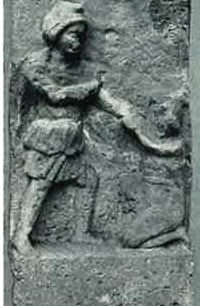
Red sandstone relief from Mithraeum I at Stockstadt depicting Mithras in Oriental dress approaching kneeling Sol with outstretched arms
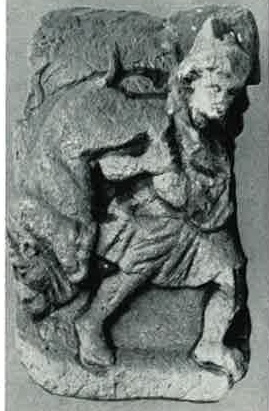
Grey sandstone relief from Mithraeum I at Stockstadt showing Mithras in Oriental dress walking to the right while carrying a bull on his shoulders
