Your search As Salhiyah gave 2391 results.
Inscription from near Mintia, ancient Micia in Dacia, dedicated to Deus Mithras by Rutus ex voto.

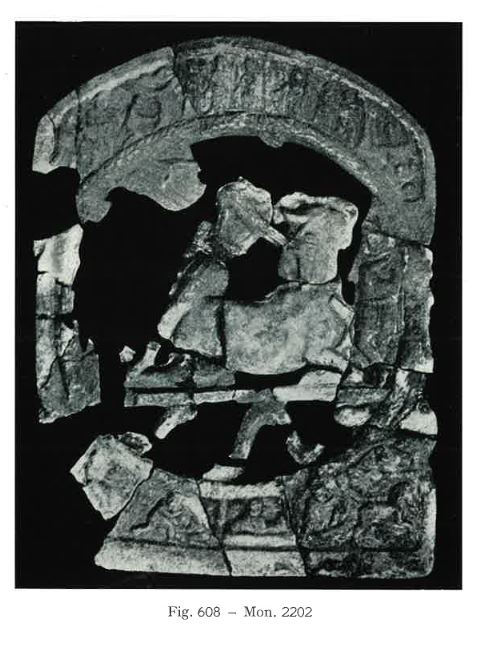
Left portion of a large limestone tauroctony relief from Mintia, ancient Micia in Dacia, depicting Mithras killing the bull with a belt, the bull's tail ending in corn-ears, together with subsidiary Mithraic scenes.

Small relief found in 1956 at Oarda de Sus near Alba Julia, Dacia, framed by a border; the upper part depicts the dressed bust of Mithras in Phrygian cap, the lower portion the bull-slaying scene.
Sandstone altar from Alsóbajom near Mediaș, Dacia, with Mithras killing the bull between Cautes and Cautopates on its front face and no animals depicted; Sol appears in the upper left corner and Luna in the upper right.
Limestone base from Decea Mureșului, ancient Bruckla in Dacia, dedicated to Invicto Mithrae by Iulius Quintus, centurio.
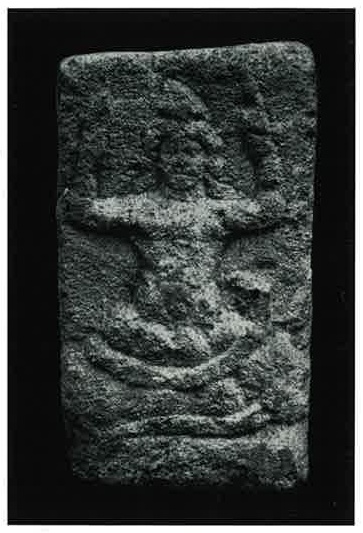
White sandstone altar from Decea Mureșului near Aiud, ancient Bruckla in Dacia, depicting on its front the naked Mithras being born from the rock, holding a torch in his right hand and a dagger in his left, with a coiled serpent below.
Altar from Carevac in Glamoč Polje south-east of Jajce, Dalmatia, dedicated to Invicto by Sisimbrius, erected by decree of the decuriones.

Two limestone relief fragments from Bihać, Dalmatia, found near Kástel Stasi and the Croate Church of Saint Martha, preserving portions of a Mithraic bull-slaying scene.
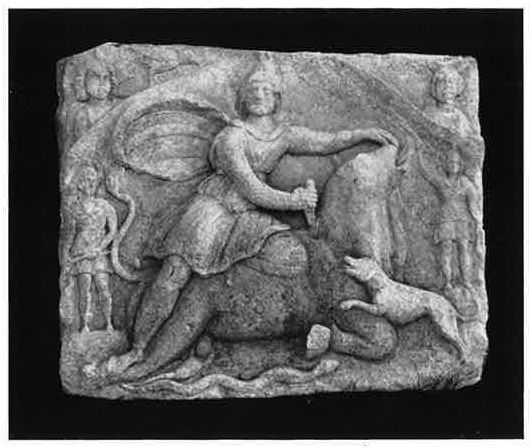
Sandstone tauroctony relief from Pritok near Bihać, Dalmatia, lost during World War II, depicting Mithras in Oriental dress killing the bull in a grotto with the bull's tail ending in corn-ears.
Finds from the Mithraeum at Konjic, Dalmatia, comprising a large roof nail, fragments of a concentric-circle basin, pottery, glass, animal bones, 32 coins from Gallienus to Constantine, and a pine apple.
Inscription from Han Potoci, Dalmatia, dedicated to Deo Soli invicto Meteri by Aurelius Maximinus, Flavius Marcellinus, and Flavius Marcellus; Meteri is interpreted as a variant spelling of Mithrae.
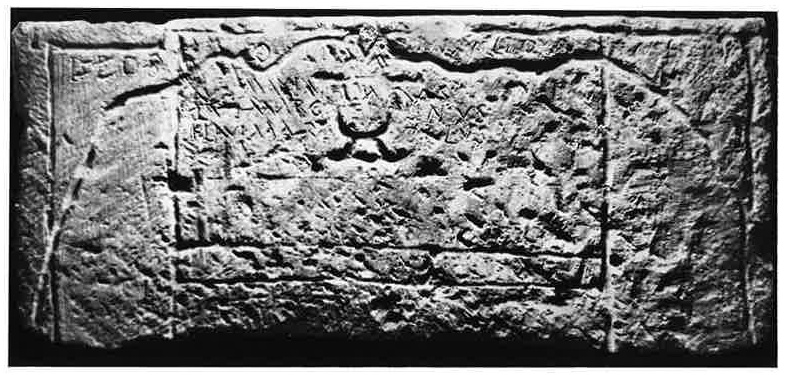
Limestone slab from a Roman settlement at Bijelo Polje north-east of Mostar, ancient area of Han Potoci in Dalmatia, found in 1902 and probably dating to the fourth century AD, depicting a Mithraic scene.
Monument in the Zagreb Archaeological Museum catalogued as an Aion but correctly identified as Icarus; not a Mithraic monument.
Inscription from Nefertara, Dalmatia, dedicated to Invicto Augusto by Aurelius, probably dated to the consulship of Aspro and Orfito.
Mithraic sanctuary in a steep rock face called Preslica at Nefertara near Plevlje, Dalmatia, described as carved into the cliff above a ravine with a carved tauroctony scene.
Tauroctony relief mentioned from a mountaintop at Krivošije near Risn, Boka Kotorska, Dalmatia, found before World War I; the relief was lost.
Fragmentary inscription from Aequum, Dalmatia, preserving only the phrase invicti posuit.
Rocky pass about twenty minutes south of Prozor, Dalmatia, containing a rock niche with a carved Mithraic scene; probably a secondary cult place related to the Vitalj sanctuary.
Natural rock enclosure at a quarter-hour's walk from Veliki Vitalj near Prozor, Dalmatia, used as a Mithraic sanctuary, with a tauroctony carved directly into the rock.
Altar found at Osijek in 1922 when the fortress was demolished, ancient Mursa in Pannonia Inferior, now in the Zagreb Archaeological Museum, bearing a dedication to Deo Aeterno — the Eternal God.
