Your search Ay-Todor gave 1062 results.

Graffito on the outside of the left wall of the niche in the S. Prisca Mithraeum, recording a birth before daybreak on 20 November 202 A.D., a Saturday with an eighteenth-day moon, under the consulate of Severus and Antoninus.
Marble slab from the S. Prisca Mithraeum with a dedication to Sol Invictus Mithre thanking his divine will for repeatedly answering prayers and enjoining the fulfilment of vows.
Two small fragments of a relief showing Mithras slaying the bull with the two torchbearers in a grotto, with traces of polychrome colouring, dated to the second half of the 2nd century A.D.
Marble relief fragments from the cult niche of the Mitreo della Planta Pedis at Ostia, preserving the bust of Sol in radiate crown, the raven's tail, the bust of Luna in crescent, and parts of the rocky border.
Marble altar bearing a bust of Sol in radiate crown with Cautopates on the right and Cautes on the left, both cross-legged, from the Mitreo delle Pareti Dipinte at Ostia.
Two small tuff altars walled into the corners of the benches, each bearing a representation of a jug, from the Mitreo delle Sette Sfere at Ostia.
Fragment of a relief showing Mithras as bull-killer with unusual eagle-headed dagger handle and Sol in a quadriga, from Tivoli (ancient Tibur), known only through an inaccurate engraving by Barbault.
Fragment of a white marble statue of Mithras tauroktonos with dog, serpent and scorpion, upper body and right leg missing, found at Praeneste (modern Palestrina).
Relief depicting Mithras killing the bull in scaled armour, with Luna and Sol busts in the upper corners, found at the cavalry barracks of Sétif in 1861.
Second limestone base from the Forum Vetus at Leptis Magna bearing the inscription of Aristius Antiochus, with fragments of a torchbearer figure in Eastern attire.
Fragment of a white marble relief depicting the head of Mithras with Phrygian cap and nimbus, found on the Syrian coast between Lattakieh and Tartous, first half of 2nd century A.D.
Great royal inscription of Antiochus I of Commagene carved on the thrones at Nemrud Dağı, invoking Apollo-Mithras-Helios among the guardian deities of the kingdom, 69–34 B.C.
Sepulchral inscriptions from Lycaonia bearing the titles leo and aetos, previously interpreted as Mithraic grades but now understood as referring to tomb architecture.

Fragment of a silvered bronze plate from Mithraeum II at Stockstadt depicting Mithras grasping the bull for the kill
Fragmentary white sandstone altar from Mithraeum I at Stockstadt dedicated to Iupiter Dolichenus and Iuno Regina
Two fragments of a large reddish sandstone basin from Mithraeum I at Stockstadt, its exterior decorated with the Zodiac including Gemini and Sagittarius

White sandstone statuette of Mercury from Mithraeum I at Stockstadt, standing in a shoulder cape, holding a purse and wearing wings in his hair
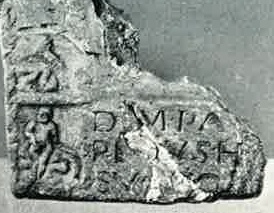
Double-sided white sandstone relief from Mithraeum I at Stockstadt, with Mithraic imagery on both faces
Late Roman funerary inscription from Antium commemorating the senator, governor of Numidia and Mithraic pater Alfenius Ceionius Iulianus Kamenius.
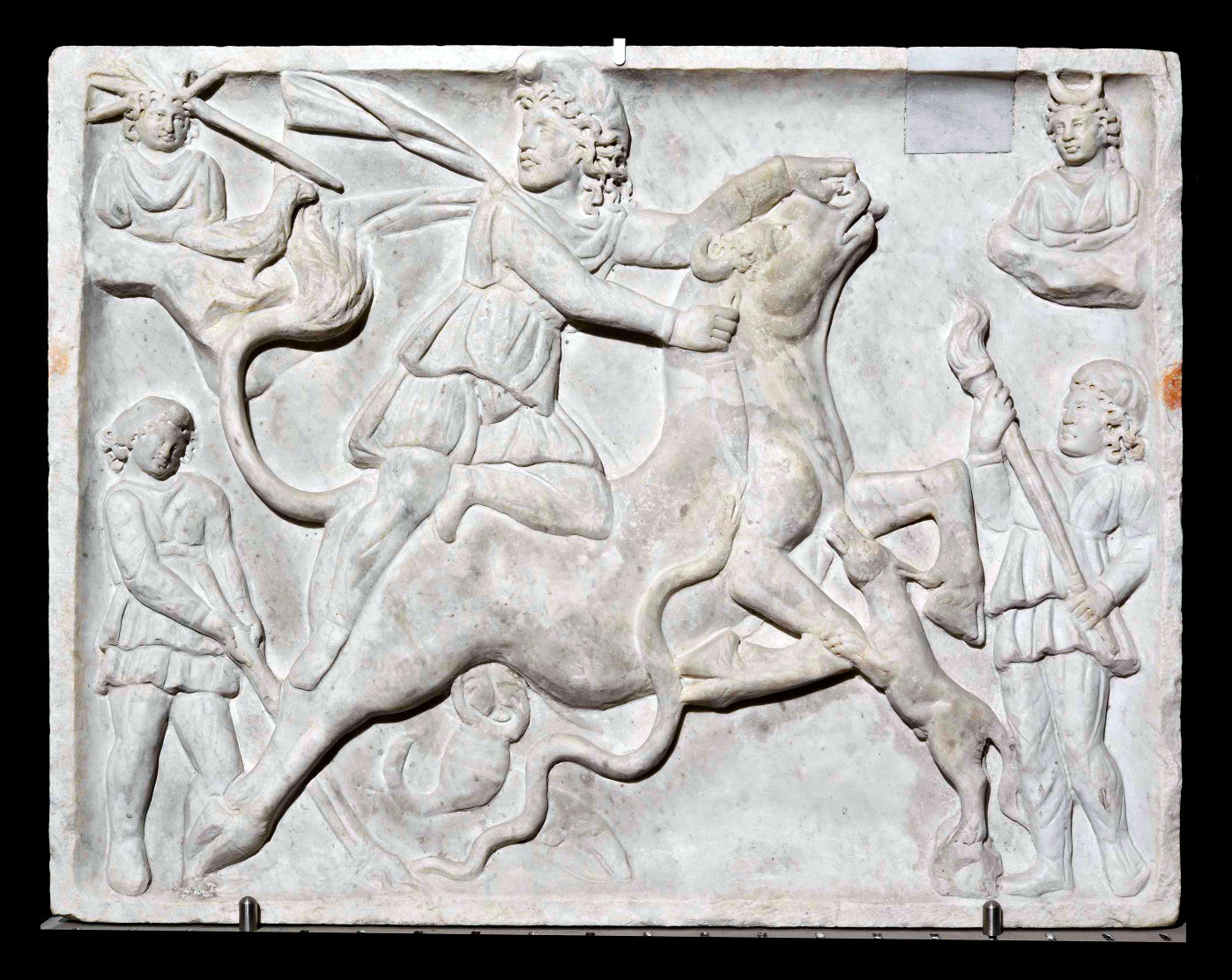
It is not certain that the marble relief of Mithras killing the bull was found on Capri, in the cave of Matromania, where a Mithraeum could have been established.
