Your search Bu Njem gave 1882 results.
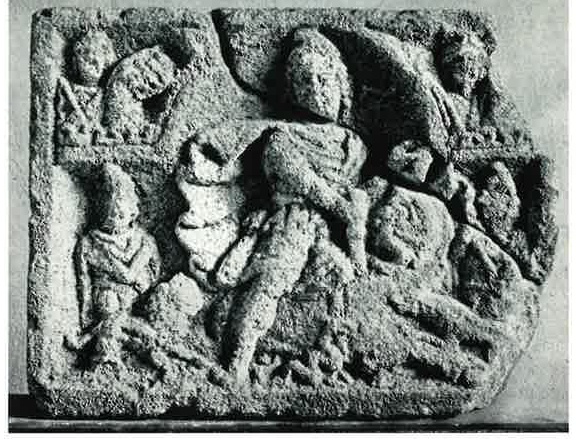
Bachern marble tauroctony relief from the Mithraeum at Pohanica, Noricum, notable for the prominent inclusion of a lion entering from the left — an unusual compositional element — alongside the standard dog, serpent, and torchbearers.

Two fragments of a larger circular marble relief from the Mithraeum at Linz, ancient Lentia, preserving only the legs of the torchbearers and the outer border, with subsidiary scenes including the rock-birth and an ibex.
Small Mithraic sanctuary (8 × 8 m) excavated in 1950–52 on a slope west of Schloss Moosham, Noricum, on the left bank of the river Mur; the finds include a marble epistylium, a Mithras head, and fragmentary altars.
Altar from Vidy near Lausanne, ancient Leusonna, dedicated to Soli Genio Lunae sacrum by Publius Clodius Primus, curator of the vici Lousonnenses, sevir Augustalis, and curator of the Roman citizens of the Helvetian conventus; not earlier than AD 161–169…
Round perforated bronze plaque from Augst, ancient Augusta Rauricorum, bearing a dedication of an aurichalcum image of Sol to Deo invicto; interpreted by Cumont as evidence for identifying the dedicatee as Mithras.
Small altar from Augst, ancient Augusta Rauricorum, dedicated to Deo invicto by Secundus; found in the early nineteenth century and subsequently transferred to Colmar.
Lost stone altar from the thermal baths at Baden, ancient Aquae Helveticae, dedicated to Deo invicto by Tiberius Cassius Sanctus and Tiberius Sancteius Valens following a vision.
Set of six triangular bronze votive hatchets from Thun-Allmendingen, each inscribed with the name of a deity: Iovi, Neptuni, Minervae, Mercurio, Matribus, and Matroni; forming a unique ensemble of polytheistic dedications within a Mithraic context.
Fragmentary limestone relief from Thun-Allmendingen of the same dimensions as the bull relief, depicting a swine; both may have formed part of the sanctuary's ritual décor.
Red sandstone altar fragments from the Mithraeum at Königshoffen, reused as a step or threshold in the sanctuary's third building phase, preserving only the opening of a dedication to Deo invicto Mithrae.
Grey sandstone slab from the Mithraeum at Königshoffen, a companion piece to the preceding, recording the same act of repainting a cult image by Caius Celsinius Matutinus, veteran of Legio VIII Augusta Alexandriana.
Altar from the Mithraeum at Königshoffen, dedicated to Deo Cissonio — a Celtic god identified with Mercury — by Gittonius Pippausus; the dedicant's Celtic name may be etymologically connected to that of the deity.
Stone torso of a naked winged figure from the Mithraeum at Königshoffen, identified as Aion; the head is lost, but remnants of a wing survive at the right shoulder, and the statue likely stood on a preserved base with traces of two feet.
Sandstone plate from Beihingen in the Neckar valley, depicting on one side a youth in Oriental dress with a bow in an arched niche, and on the other a corresponding figure; both may represent torchbearers or Mithraic grades.
Second sandstone lion from Brumath, ancient Brocomagus, of uncertain Mithraic attribution; larger than the inscribed companion piece.
Sandstone lion from Brumath, ancient Brocomagus, with a votive inscription on its base recording a dedication by Tertius; a common Mithraic cult animal.
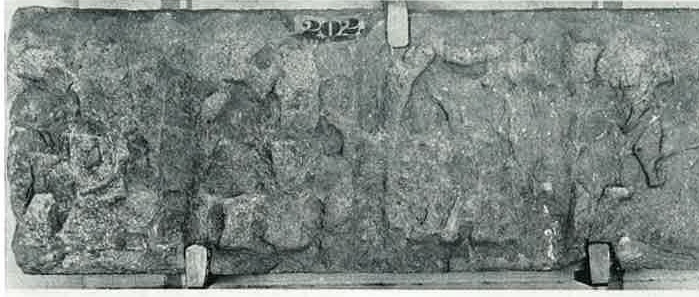
Badly damaged red sandstone relief from Hölzern, Germania Superior, depicting the standard bull-slaying scene; possibly forming part of the border zone of a larger composition.
Rock-cut tauroctony relief at the Mithraeum near Schwarzerden, beginning at 0.70 metres from the floor, with clearly visible scorpion and serpent
Inscribed altar from Lengfeld near Aschaffenburg dedicated to Numini augusto deo invicto by Caius Atulius Maior ex voto
Grey limestone relief fragment from Rockenhausen found at the Pfingstborn spring, preserving part of the bull-slaying scene
