Your search Cabrera de Mar gave 1578 results.

Marble altar from the Mithraeum at Modrič, Pannonia Superior, dedicated to Deo invicto Mithrae by Ulpius Secundinus, beneficiarius consularis.
Small Mithraic sanctuary (9.28 × 4.52 m) found at Modrič near Našice in Slavonia, Pannonia Superior, in 1911; the sanctuary has the standard corridor and bench division with a water-basin in the pronaos, and yielded a rich assemblage of marble reliefs…
Limestone slab from the Mithraeum at Pohanica, Noricum, elaborately carved on both faces; a metal plate originally attached by pins to its interior was removed, probably by the Mithraists themselves — paralleled at Poetovio.
Small Mithraic sanctuary found in the slope of a ravine called Zlodjer (Devil's Ditch) at Ober-Pohanica near Zdole, Noricum; the finds are among the finest marble Mithraic sculpture from the eastern Alpine provinces.
Sandstone altar found between Celeia and Emona, Noricum, dedicated to Invicto Mithrae by Surio; the misspelling Mitre for Mithrae reflects local phonology.
Altar from the Drave valley between Teurnia and Virunum, Noricum, now reused as a pedestal for a cross, dedicated to Invicto deo Mithrae for the welfare of Marcus Publius Potens by his freedman Ursulus.
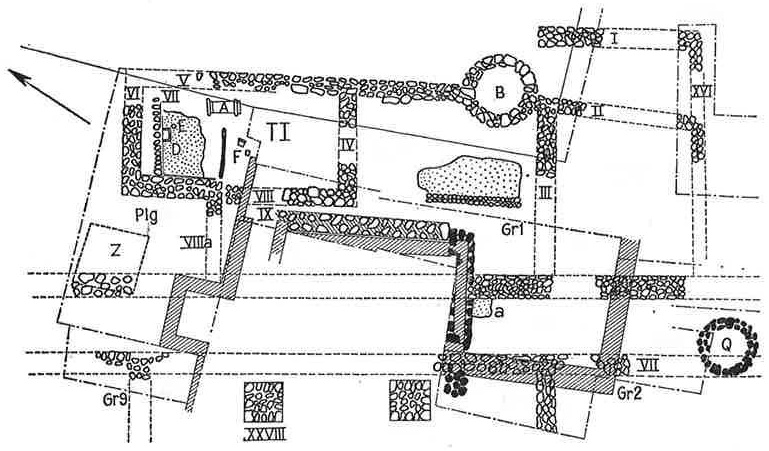
Mithraic sanctuary found in the Tummelplatz at Linz, ancient Lentia in Noricum, constructed within an existing building; the sanctuary yielded marble reliefs, an altar, cult pottery, and a silver votive object.
Altar from Höglwörth, ancient Bedaium in Noricum, dedicated to Deo invicto Mithrae for the welfare of Marcus Lollius Priscus by his freedmen Ianuarius and Lupercus.
Small Mithraic sanctuary (8 × 8 m) excavated in 1950–52 on a slope west of Schloss Moosham, Noricum, on the left bank of the river Mur; the finds include a marble epistylium, a Mithras head, and fragmentary altars.
Limestone relief fragment showing Cautopates beside traces of a tauroctony scene.
A Sol statue headless and lacking arms and feet, mentioned by Martelli as existing at Nersae alongside a fragmentary inscription, with no further details obtainable by Vermaseren or Cumont.
Small marble altar from the house of the guardian of the Cancelleria in Rome, with a dedication of an altar to Sol by L. Spedius Quadratus.
Fragment of a small tauroctony relief in the Museo Lateranense, Rome, preserving the bull's head and the upper part of Cautopates pointing his torch downwards with both hands, and the bust of Luna with crescent in the upper corner.
Marble inscription from the Villa Giustiniani near Porta Flaminia, dedicated by M. Aurelius Euprepes, freedman of the three Emperors, to Sol Invictus Mithras through the priests Calpurnius and Ianuarius, dated to 194 A.D.
Fragment of a marble tabula ansata with a palm-branch in the ansa and a partially legible inscription mentioning Sol, from the Mithraeum of S. Lorenzo in Damaso, probably dated to 253 A.D.
Inscription CIL VI 752 recording the transmission of the leontica grade by Nonius Victor Olympius and Aurelius Victor Augentius at the Mithraeum of Piazza S. Silvestro in Capite, dated to 359 and 358 A.D.
Brief inscription on a marble vase fragment dedicated to the Invincible Sun God, from Portus.
Gold coin of the Scythian king Hooerkes, reverse showing Mithras (MIIPO) in tunic with lance and sword, north-west India, c. 87–129 A.D.
Yellow sandstone altar from Mithraeum I at Stockstadt dedicated to Iovi optimo maximo et Iunoni reginae, with inscription largely obliterated
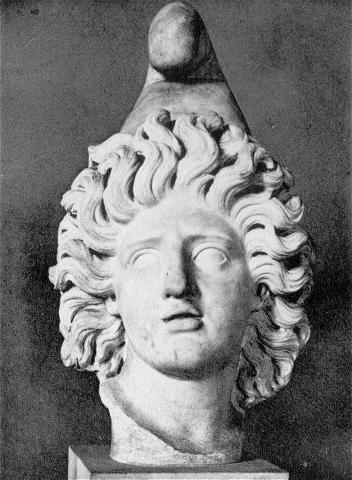
The head of Mithras had seven holes made for fastening rays.
