Your search Castle Park, Colchester, Essex gave 83 results.

One of the rooms in a sustantive masonry building in Hollytrees Meadow was considered to be a Mithreum, a theory that has now been discarded.
.jpg)
This limestone statue of Cautes is now exposed at Great North Museum of Newcastle.
A fragmentary inscription from Scaleby Castle near Cambeckfort (ancient Petrianae), preserving a partial dedication to Sol Mithras.
Sandstone altar combining imagery of Apollo, Mithras and the torchbearers Cautes and Cautopates near the Roman fort of Whitley Castle.

Camulodunum, modern Colchester, was among the earliest coloniae established in Britannia after the Roman conquest.

Two small marble heads in Phrygian caps from the Castle at Cataio in the Veneto, cited by Dütschke, which may belong to torchbearer figures.
A large relief in Italian marble kept in the gallery of the Castle at Cataio in the Veneto, depicting a standing torchbearer who holds his torch with both hands.
A marble statue from the south wall of the gallery of the Castle at Cataio in the Veneto, depicting a cross-legged torchbearer in Eastern attire (Cautopates) with a sorrowful expression, standing beside a rock at which he points his torch.
A decorated inscription with egg-and-dart moulding found in the castle of La Fratta near Montefalco in Umbria, bearing a brief dedication to Sol Invictus.
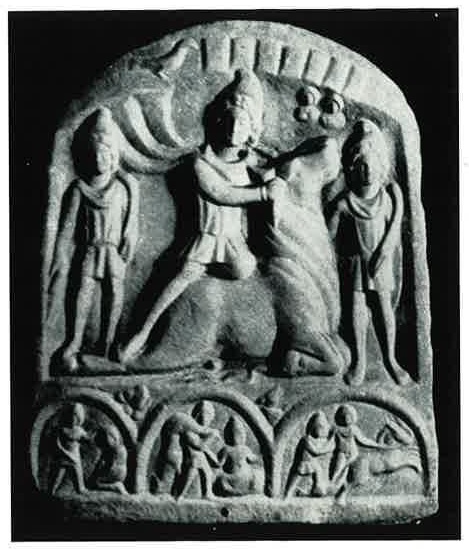
White marble tauroctony relief from the ruins of the Roman castle near Koniovo, Moesia Superior, depicting the standard bull-slaying scene.
Small altar preserved in the castle of Freudenberg at St. Thomas am Zeiselberg, Noricum, recording a dedication to Hermes invicto Mitrae — an unusual conflation of Hermes and the invincible Mithras.
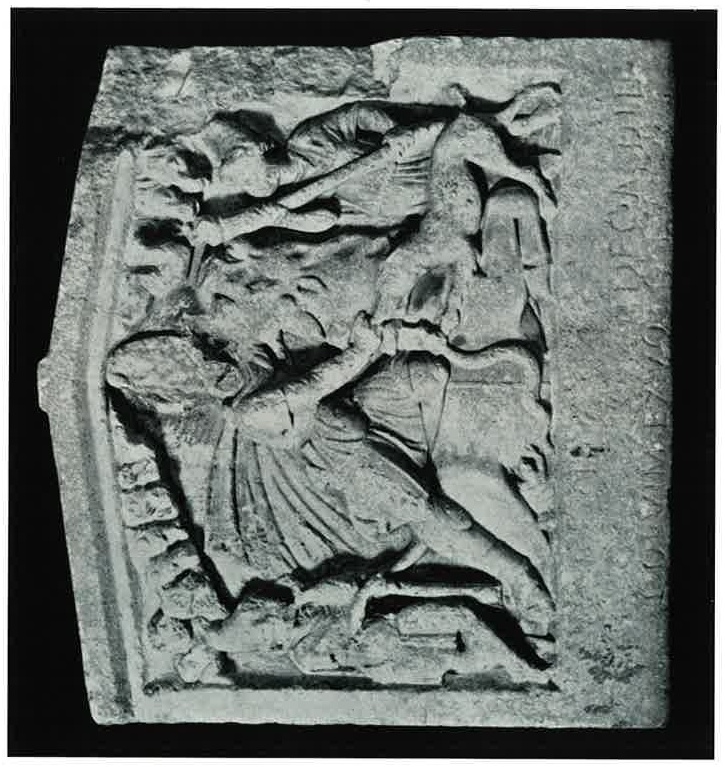
White marble tauroctony relief from Kostolac, ancient Viminacium in Moesia Superior, formerly walled into the Castle of George Branković at Smederevo, depicting the standard bull-slaying.
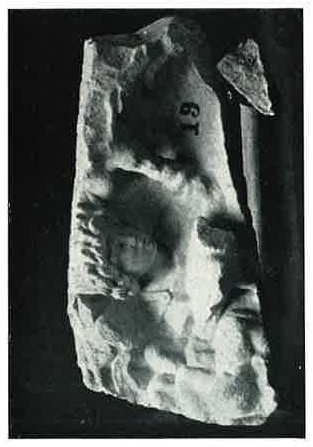
Three Italian marble fragments from the Zollfeld at Virunum, Noricum, forming a tauroctony relief; the iconography is well preserved and the use of imported Italian marble reflects the high status of the dedicants.
Pons Aelius, or Newcastle Roman Fort, was an auxiliary castra and small Roman settlement on Hadrian's Wall in the Roman province of Britannia Inferior, situated on the north bank of the River Tyne close to the centre of present-day Newcastle upon Tyn
