Your search Han Potoci gave 881 results.
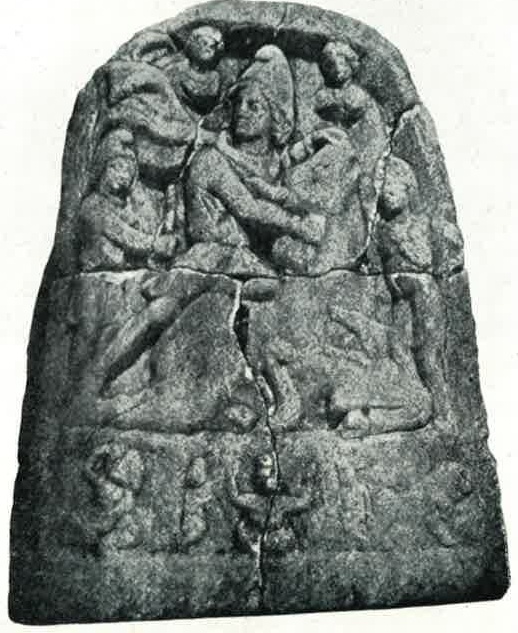
White marble tauroctony relief in five fragments from Dupljane near Călan, ancient Aquae in Dacia, found in 1900, depicting the bull-slaying with the standard iconographic programme.

Fragment of a marble tauroctony relief from Vețel, ancient Micia in Dacia, preserving only the upper part of the arched centre with the upper portion of Mithras killing the bull.
Left portion of a large limestone tauroctony relief from Mintia, ancient Micia in Dacia, depicting Mithras killing the bull with a belt, the bull's tail ending in corn-ears, together with subsidiary Mithraic scenes.
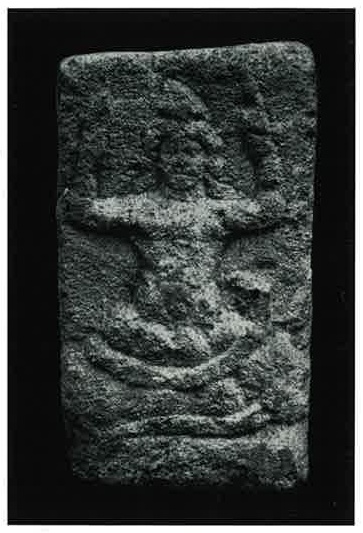
White sandstone altar from Decea Mureșului near Aiud, ancient Bruckla in Dacia, depicting on its front the naked Mithras being born from the rock, holding a torch in his right hand and a dagger in his left, with a coiled serpent below.

Two limestone relief fragments from Bihać, Dalmatia, found near Kástel Stasi and the Croate Church of Saint Martha, preserving portions of a Mithraic bull-slaying scene.
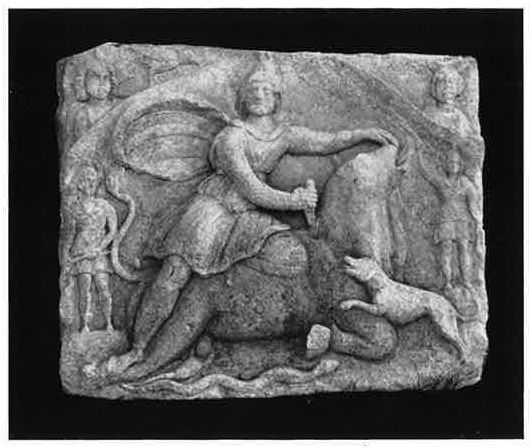
Sandstone tauroctony relief from Pritok near Bihać, Dalmatia, lost during World War II, depicting Mithras in Oriental dress killing the bull in a grotto with the bull's tail ending in corn-ears.
Tauroctony relief carved directly into the rock of the Mithraeum on the Colle S. Giorgio near Cavtat, ancient Epidaurum in Dalmatia; the composition includes Sol, Luna, Cautes, and Cautopates flanking the central scene.
Rocky pass about twenty minutes south of Prozor, Dalmatia, containing a rock niche with a carved Mithraic scene; probably a secondary cult place related to the Vitalj sanctuary.
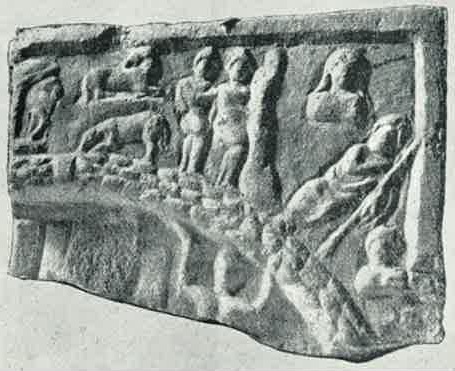
Fragment of a Mithras relief from Zsámbék near Aquincum, Pannonia Inferior, showing seven altars alternated with trees — a processional or decorative border rather than a main tauroctony scene.
White marble statuette from Budapest, ancient Aquincum or vicinity, depicting a badly damaged Mithras killing the bull with dog and serpent; the god's head is lost.

First Mithraic sanctuary in the potter's quarter of Aquincum, Pannonia Inferior; destroyed during the Marcoman wars; the rectangular building is known only from the four altars found side by side.
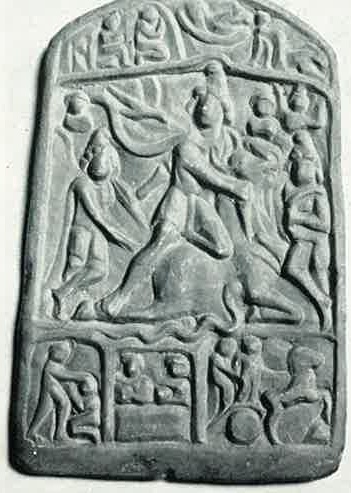
Limestone tauroctony relief found in a grotto at Nagy-Kovácsi, Pannonia Inferior, depicting the standard bull-slaying with flanking torchbearers and divine busts in the upper register.
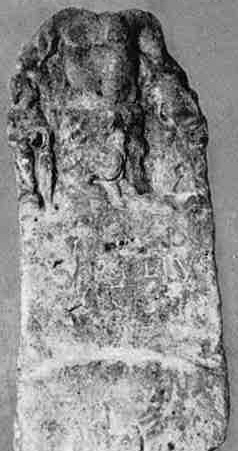
Limestone relief from Schwadorf, ancient Aequinoctium in Pannonia Superior, depicting the naked Mithras being born from the rock with a serpent encircling it, flanked by torchbearers; one of the finest examples of this iconographic type from the Danubian region…
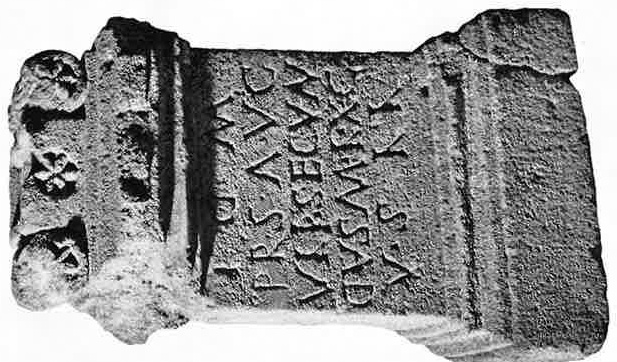
Limestone altar from Vienna, ancient Vindobona in Pannonia Superior, found in 1896 together with two terracotta lamps; the dedicant and full text are not known from the summary description.
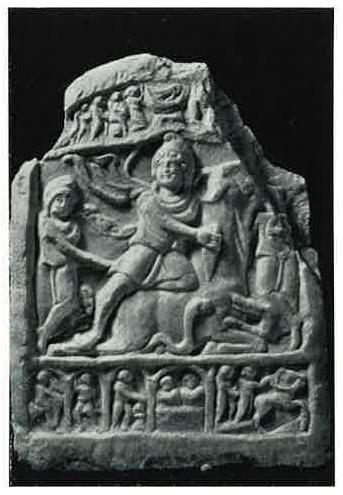
Small limestone tauroctony relief from Enns, ancient Lauriacum in Noricum, found about 100 metres east of the north-east corner of the castra, depicting Mithras killing the bull with dog and serpent and flanking torchbearers.
Altar from the Mithraeum at Königshoffen, dedicated to Deo Cissonio — a Celtic god identified with Mercury — by Gittonius Pippausus; the dedicant's Celtic name may be etymologically connected to that of the deity.
Stone statue fragments from the Mithraeum at Mackwiller depicting Mithras's rock-birth, preserving the head in Phrygian cap, torso, and right hand holding part of a torch.
Reconstructed tauroctony relief from the Mithraeum at Mackwiller, assembled from multiple stone fragments and preserving Mithras's head, shoulders, dagger hand, flying cloak, and parts of the bull and torchbearers.
Second sandstone lion from Brumath, ancient Brocomagus, of uncertain Mithraic attribution; larger than the inscribed companion piece.
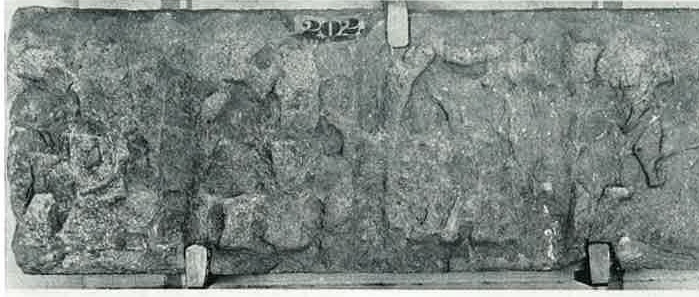
Badly damaged red sandstone relief from Hölzern, Germania Superior, depicting the standard bull-slaying scene; possibly forming part of the border zone of a larger composition.
