Your search Han Potoci gave 881 results.

White marble statue of Cautopates in Eastern attire, cross-legged, pointing his torch downwards with both hands, probably found in Rome and now in the Altes Museum at Berlin; the head and front part of the left arm are restored.
Small bronze figure from Rome, probably used as a handle for a patera or knife, depicting the lion-headed Aion with four large wings, entwined in three coils of a serpent, holding a torch in his right hand and a key in his left.
Fragment of a small tauroctony relief in the Museo Lateranense, Rome, preserving the bull's head and the upper part of Cautopates pointing his torch downwards with both hands, and the bust of Luna with crescent in the upper corner.
White marble statue of the lion-headed Aion standing on a cone decorated with a crescent, entwined in seven coils of a serpent and pressing claw-like hands against his body, each grasping a key; formerly in the Museo Torlonia, Rome.
Marble base with a dedication by G. Magius Donatus Severianus, vir clarissimus and pater sacrorum of Invictus Mithras, hierophant of Liber Pater and of the Hecatae, commemorating his taurobolium on 15 April 313 A.D.
Marble statue of the naked Mithras emerging from the rock, holding a dagger in his right hand and a torch in his left, visible to the knees, from the Mithraeum of S. Lorenzo in Damaso; the head is lost.
Wall-painting on the last column of the left bench in the Palazzo Barberini Mithraeum, showing a standing person pressing his left hand to his breast and extending his right hand towards a kneeling person whose head is covered with ivy.
Marble slab with a fragmentary Latin inscription, walled into the right-hand side of the cult-niche in the Mitreo delle Pareti Dipinte at Ostia.
Fragment of a relief showing Mithras as bull-killer with unusual eagle-headed dagger handle and Sol in a quadriga, from Tivoli (ancient Tibur), known only through an inaccurate engraving by Barbault.
Upper part of a limestone torchbearer statue in tunic and hanging cloak, arms and lower legs lost, from the Mithraeum near Memphis, Egypt.
White painted clay vase from Mithraeum II at Stockstadt with seven holes in the border and a serpent creeping round one handle
Three fragments of a cone-shaped sandstone mortar with a handled rim, from Mithraeum I at Stockstadt
Two grey sandstone fragments of a large raven from Mithraeum I at Stockstadt, considerably bigger than the smaller raven statuette
Red sandstone relief from Mithraeum I at Stockstadt showing a male figure stooping and walking to the right with outstretched hands, head veiled
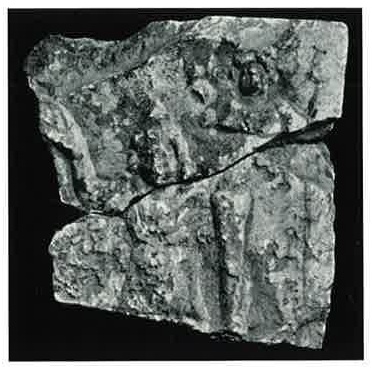
Two bluish marble fragments from the Mithraeum at Sarmizegetusa, Dacia, preserving the upper part of Cautes holding a torch in each hand, with traces of red on his neck, dress, and the torches.
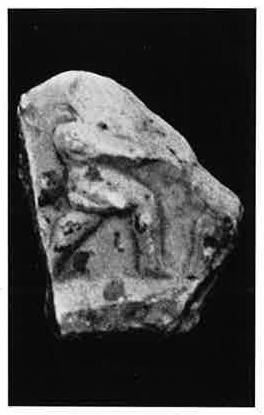
White marble relief fragment from the Mithraeum at Sarmizegetusa, Dacia, probably belonging to the preceding piece, depicting a man walking to the right stretching his hand towards a rock.
Fragment of a marble relief from the Mithraeum at Sarmizegetusa, Dacia, preserving the bust of a person in a tunic with a right arm and hand holding a torch pointed downward.
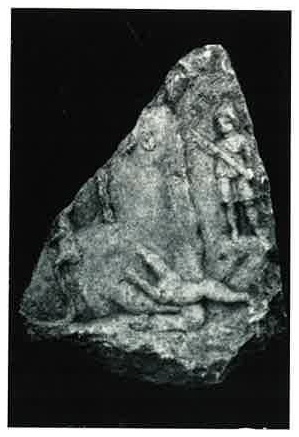
Foremost part of a white marble tauroctony from the Mithraeum at Sarmizegetusa, Dacia, showing the badly weathered bull-slaying with cross-legged Cautes raising the torch with both hands.
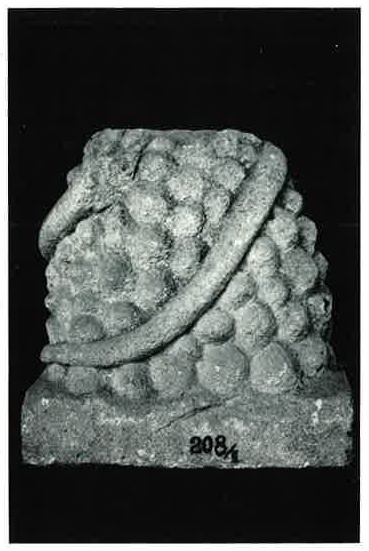
Dark sandstone statue from Mureș Port, Dacia, depicting Mithras's rock-birth with the rock encircled by a serpent; the statue's attribution to Mureș Port rather than Apulum is uncertain.
Large sandstone altar from Mithraeum I at Carnuntum, Pannonia Superior, with Cautopates cross-legged carved on the left side and Cautes walking on the right, both holding their torches with two hands; the front bears an inscription.
