Your search Mühltal am Inn gave 1066 results.

Inscription from Decea Mureșului, ancient Bruckla in Dacia, dedicated to Invicto Mithrae; the dedicant's name is only partially preserved.
Lost altar from Carevac in Glamoč Polje, Dalmatia, dedicated to Deo invicto Soli Mithrae.
Altar from Carevac in Glamoč Polje south-east of Jajce, Dalmatia, dedicated to Invicto by Sisimbrius, erected by decree of the decuriones.
Trapezium-shaped limestone tauroctony relief from Nagytétény, ancient Campona in Pannonia Inferior, depicting Mithras killing the bull in an arched niche with scorpion, serpent, and torchbearers.
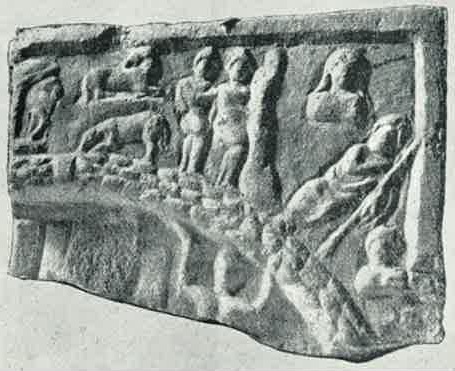
White marble statuette from Budapest, ancient Aquincum or vicinity, depicting a badly damaged Mithras killing the bull with dog and serpent; the god's head is lost.
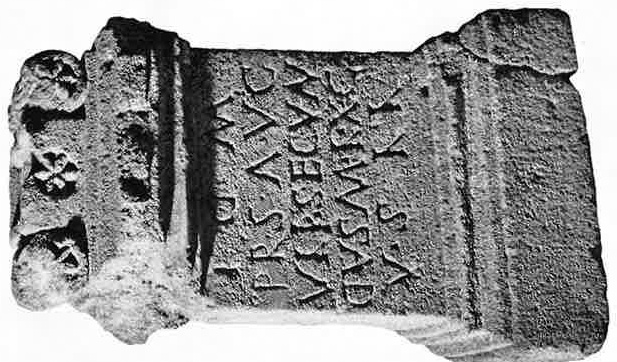
Limestone altar from Vienna, ancient Vindobona in Pannonia Superior, found in 1896 together with two terracotta lamps; the dedicant and full text are not known from the summary description.
Marble altar fragment from the Mithraeum at Sopron, ancient Scarabantia, dedicated to Deo invicto Mithrae by a dedicant whose name includes Secundinus.
Fragmentary inscription from Pregrade, Pannonia Superior, preserving only the end of a dedicant's name (-rentianus) and the closing formula.
Sandstone altar with akroteria from the Mithraeum at Pohanica, Noricum, dedicated to Deo invicto Mithrae by Marcianus; the frame bears two outward-pointing darts as a decorative motif.
Sandstone altar with akroteria from the Mithraeum at Pohanica, Noricum, dedicated to Deo invicto Mithrae by Metilius Iustinianus; the sculptor initially misspelt the name Justianus before correcting it.
Small Mithraic sanctuary found in the slope of a ravine called Zlodjer (Devil's Ditch) at Ober-Pohanica near Zdole, Noricum; the finds are among the finest marble Mithraic sculpture from the eastern Alpine provinces.
Column found at Sankt Peter in Holz, ancient Teurnia in Noricum, dedicated to Cautes by Lucius Albius Atticus and Caius Albius Avitus — probably father and son — making it a rare joint family dedication to a Mithraic torchbearer.
Two-fragment stone altar from the Mithraeum at Linz, ancient Lentia in Noricum, dedicated to Deo Soli invicto Mithrae sacrum by Tiberius Iulius Ursalus, a veteran, for himself and his family.
Fragmentary inscription from Günzburg, ancient Guntia in Raetia, recording a dedication to Deo invicto Mithrae by two dedicants, Tetto and a companion whose name begins Sex-.
Dark-red clay vase from the refuse pit of the Roman camp at Windisch, ancient Vindonissa, with three handles each encircled by a coiling serpent; a vessel type closely associated with Mithraic ritual.
Serpent-vases (Schlangengefässe) attested at Augst, ancient Augusta Rauricorum, a ceramic type commonly associated with Mithraic cult assemblages in the Rhine provinces.
The six divine names inscribed on the bronze hatchets from Thun-Allmendingen — Iovi, Neptuni, Minervae, Mercurio, Matribus, Matroni — reflecting the polytheistic religious landscape of the Mithraic community at this site.
Set of six triangular bronze votive hatchets from Thun-Allmendingen, each inscribed with the name of a deity: Iovi, Neptuni, Minervae, Mercurio, Matribus, and Matroni; forming a unique ensemble of polytheistic dedications within a Mithraic context.
Fragmentary limestone relief from Thun-Allmendingen of the same dimensions as the bull relief, depicting a swine; both may have formed part of the sanctuary's ritual décor.
Assemblage of cult objects from the Mithraeum at Königshoffen including painted lamps, glass and terra-sigillata fragments with potters' stamps and graffiti (including Deo invicto Mithrae), two iron bells, an iron shield-knob, and stone fragments.
