Your search Rohr im Kremstal gave 1036 results.

Limestone tauroctony relief fragment of unknown provenance, preserving the upper part of Mithras as bull-slayer with the flying cloak on which the raven is perched.
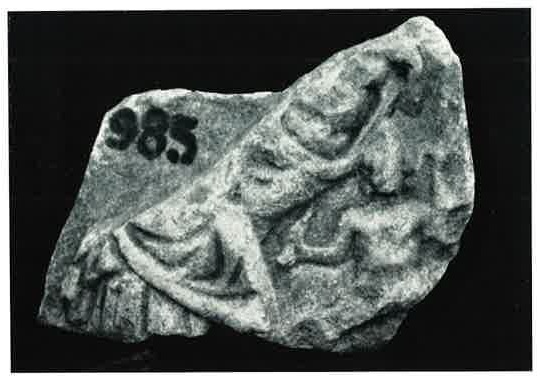
Limestone tauroctony relief fragment of unknown provenance, preserving the upper part of the right torchbearer of a bull-slaying scene.
Two limestone statue fragments from Mithraeum II at Aquincum, Pannonia Inferior, representing Mercury in a shoulder-pinned garment with wings in his hair; probably stood in room A on base y.

Glanum was an important Roman town in Narbonensis near modern Saint-Rémy-de-Provence.
Plevna occupies an important position in the lower Danube hinterland historically connected with Roman Moesia.
Troesmis served as an important military and administrative centre on the lower Danube frontier.
Tomis became one of the principal urban and maritime centres of the western Black Sea coast.
The island of Thasos occupied an important position in the northern Aegean maritime network.
Teurnia became an important late Roman urban centre in the province of Noricum.
Tabernae became an important settlement and production centre in the Rhine frontier region.
Stein am Rhein occupied a strategic position near the western limits of the Danubian frontier system.
Solicinium occupied an important position within the frontier region of southwestern Germania.
Saifnitz occupied a position near important Alpine crossing routes between Italy and Noricum.
Pola developed into one of the principal urban and maritime centres of the northern Adriatic.
Philippi became an important Roman colony in eastern Macedonia along the Via Egnatia.
Pautalia became an important urban and thermal centre in the southwestern Balkans.
The locality of Osmakovo is associated with the central Balkan settlement landscape of Roman times.
The fort of Niederbieber formed part of the defensive system of the Upper Germanic-Raetian limes.
