Your search Roman cemetery of St. Matthias gave 2764 results.

Fragment of yellowish chalcedony in the Cabinet des Médailles, Paris, formerly in the Millingen collection, depicting the standard tauroctony.
White carnelian with red stripes, reportedly acquired at Epidaurum, depicting what may be Mithras as bull-slayer before a burning altar surmounted by a crescent and a nine-rayed star.
Oval jasper gem in the Cairo Museum depicting Mithras slaying the bull with Sol, Luna, a leontocephalic figure and seven stars.
A small stone pedestal and the fallen statue of a seated Mother-goddess from the Mithraeum at Procolitia (modern Carrawburgh), depicting a figure of ungainly proportions enfolding in her arms a basket resting on her knees, found in the corner behind the screen at the east end of the temple…
A marble fragment with an inscription in a tabula ansata from the Mithraeum at Walbrook in London, reading [Au]gggg(ustis) invicto..., a dedication to the Invincible probably addressing multiple emperors.
A fragmentary limestone tauroctony relief found on the south slope of the Castellhügel at Pola (modern Pula) during the demolition of a wall, now in the Lapidary Museum at Pula, preserving the bull's body, the dog, the serpent, the scorpion and a standing cross-legged torchbearer…
A brief inscribed fragment found in the ruins of the Temple of Isis at Aquileia, attesting to the veneration of Sol in proximity to the Isiac sanctuary.
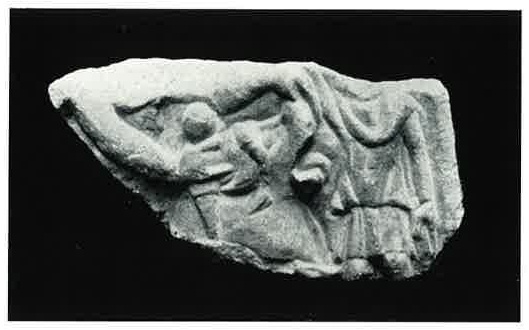
Marble tauroctony relief fragment from an unknown provenance, preserving part of Mithras's body, his right arm and dagger, and his left arm grasping the bull by the nostrils.
Limestone tauroctony relief fragment of unknown provenance, preserving the upper part of Mithras as bull-slayer with the flying cloak on which the raven is perched.
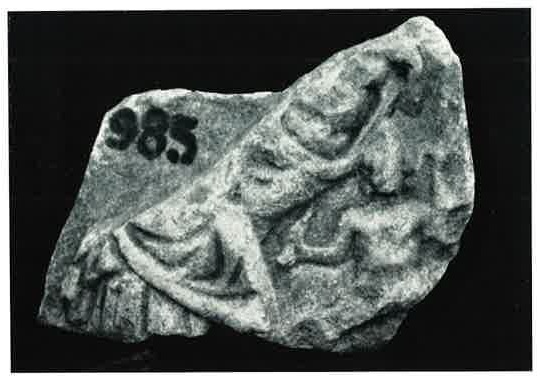
Limestone tauroctony relief fragment of unknown provenance, preserving the upper part of the right torchbearer of a bull-slaying scene.
White marble tauroctony relief fragment of unknown provenance, preserving the foremost part of the bull and part of Mithras as bull-slayer.
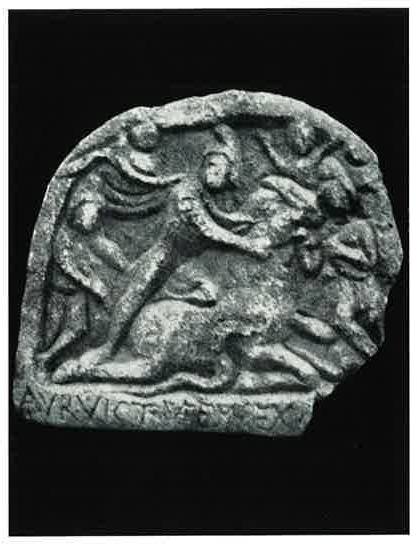
Arched white marble tauroctony relief of unknown provenance, depicting the standard bull-slaying in the usual attitude with dog and serpent.
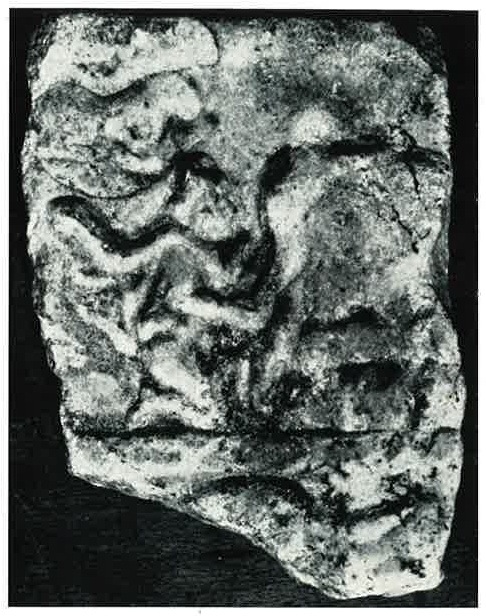
Marble tauroctony relief fragment from Dacia, preserved in Bucharest, with only Mithras's head and part of his flying cloak visible; above this a water-miracle scene and above that the bull in a small boat.

The Roman remains of Benifaió, or Benifayó in Spanish, are located on the outskirts of the city. Of particular interest is a rustic villa inhabited between the 1st and 4th centuries according to the numismatic and ceramic remains found.
Cataio is associated with archaeological material from the Euganean area of Venetia.
Arverni refers to the territory of the Arverni in central Gaul, centred on the region of modern Clermont-Ferrand.
The findspot of this monument is unknown, though it has traditionally been associated with the historical region of Wallachia.
Plevna occupies an important position in the lower Danube hinterland historically connected with Roman Moesia.
Zwiefalten belongs to the upland territory historically associated with the province of Raetia.
