Your search Spittal an der Drau gave 570 results.

Lost tauroctony relief from Apulum, Dacia, formerly at the Palace of the Prince at Alba Julia, recorded only in early modern sources.
Fragment of an open-work marble tauroctony from the Mithraeum at Apulum, Dacia, preserving Mithras's head with only the snout of the bull; the relief is framed by a border.
Lost white marble tauroctony relief from Turda, ancient Potaissa in Dacia, depicting the bull-slaying with dog, serpent, and scorpion; the inscription in the lower border named the dedicant Iulius Iulianus.
Oval relief fragment from the outskirts of Split near ancient Salona, Dalmatia, preserving two zodiacal signs — probably from a border decoration of a Mithraic monument.
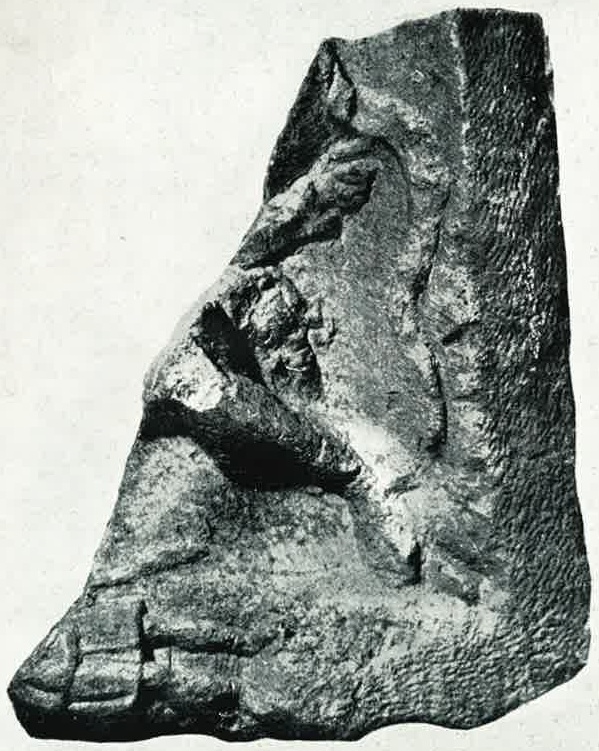
Right upper corner of a white marble tauroctony relief from Budapest, ancient Aquincum or its vicinity, in the National Museum since 1868, preserving part of the grotto border and divine busts.
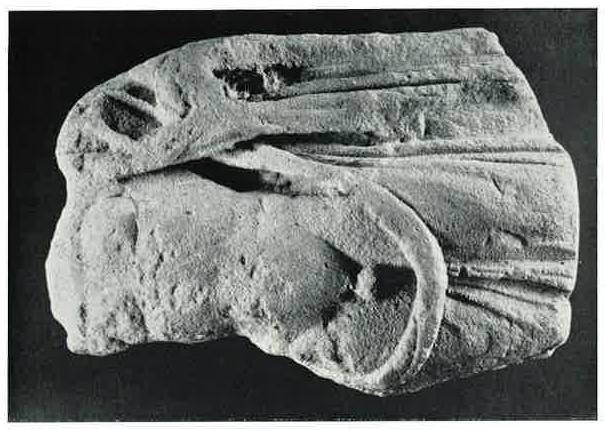
Marble statue from Carnuntum, Pannonia Superior, depicting a standing youth with a large mantle draped over his left shoulder and arm; head, right arm, and most of the legs are lost.
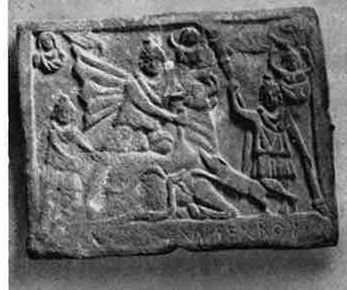
White marble tauroctony relief from Stix-Neusiedl, Pannonia Superior, depicting Mithras killing the bull with the raven perched on the rim of the god's flying cloak — an unusual detail placing the raven on the cloak rather than on the grotto border…
Damaged marble relief from Mithraeum III at Ptuj, ancient Poetovio, preserving Cautopates with torch downward on the right and the outline of a standing Cautes on the other side, with a fragmentary inscription in the lower border.
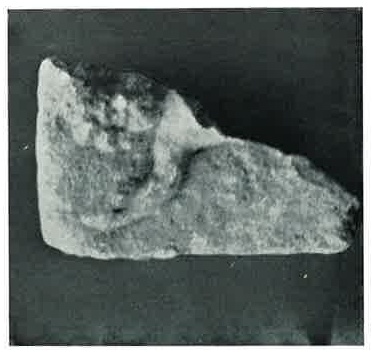
Left upper corner of a marble relief from Mithraeum II at Ptuj, ancient Poetovio, depicting Jupiter with the thunderbolt in his raised right hand, identified as a scene from the Battle against the Giants.
Left upper corner of a marble relief from Mithraeum II at Ptuj, ancient Poetovio, preserving part of the grotto's border, Sol's head, and below it a primitive torchbearer's head.
Marble relief from Mithraeum II at Ptuj, ancient Poetovio, depicting standing Jupiter with sceptre and thunderbolt beside standing Hercules with the Hesperides' fruit and club — a divine pair with Mithraic associations.
Marble lion from Mithraeum II at Ptuj, ancient Poetovio, holding a swine's head under its left fore-leg — a sacrificial animal pairing associated with the Mithraic lion grade.
Right lower corner of a marble relief from Mithraeum II at Ptuj, ancient Poetovio, preserving the border of the grotto and, outside it, Luna in a two-horse chariot holding a whip; only the horses' heads are shown.
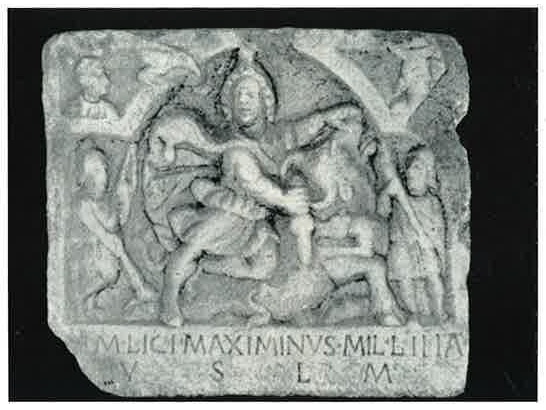
White marble tauroctony relief from Mithraeum II at Ptuj, ancient Poetovio, depicting Mithras in Oriental dress killing the bull with a girdle and the raven perched on the grotto's border.
Inscription from Mithraeum I at Ptuj, ancient Poetovio, set up by Primitivos, contrascrip of the imperial procurator Caius Antonius Rufus, in memory of Hyacinthus — probably the founder of the sanctuary.
Lost altar from the Zollfeld at Virunum, Noricum, dedicated to Deo invicto Mithrae by Ulpius Valerius, speculator of Legio I Noricorum, who fulfilled a vow undertaken by his father.
Small rectangular Mithraic sanctuary (spelaeum 8.00 m long) found in 1935–36 in a gravel terrace at Schachadorf near Wartberg an der Krems, Noricum; the building is divided into a pronaos and an inner cult room, and shows traces of fire destruction.
Sandstone relief fragment from the Mithraeum at Gimmeldingen preserving the upper bodies of two standing deities: a bearded male, possibly Vulcanus, and a helmeted Minerva with lance.
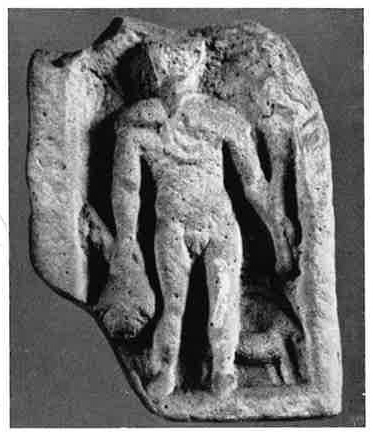
Sandstone relief from the Mithraeum at Gimmeldingen depicting a standing Mercury with caduceus and purse, accompanied by a ram and a cock; the head and upper caduceus are damaged.
Lower portion of a sandstone relief from the Mithraeum at Gimmeldingen, preserving a cross-legged torchbearer in a long cloak, probably Cautes.
