Your search Sulz am Neckar gave 1039 results.

The Neusiedl lake region formed part of the western frontier landscape of Roman Pannonia.
Bingen occupied a strategic position at the confluence of the Rhine and Nahe rivers.
A settlement of Cappadocia located within the inland communications network of central Anatolia during the imperial period.
Aequinoctium occupied an important position along the Danubian frontier communications routes.
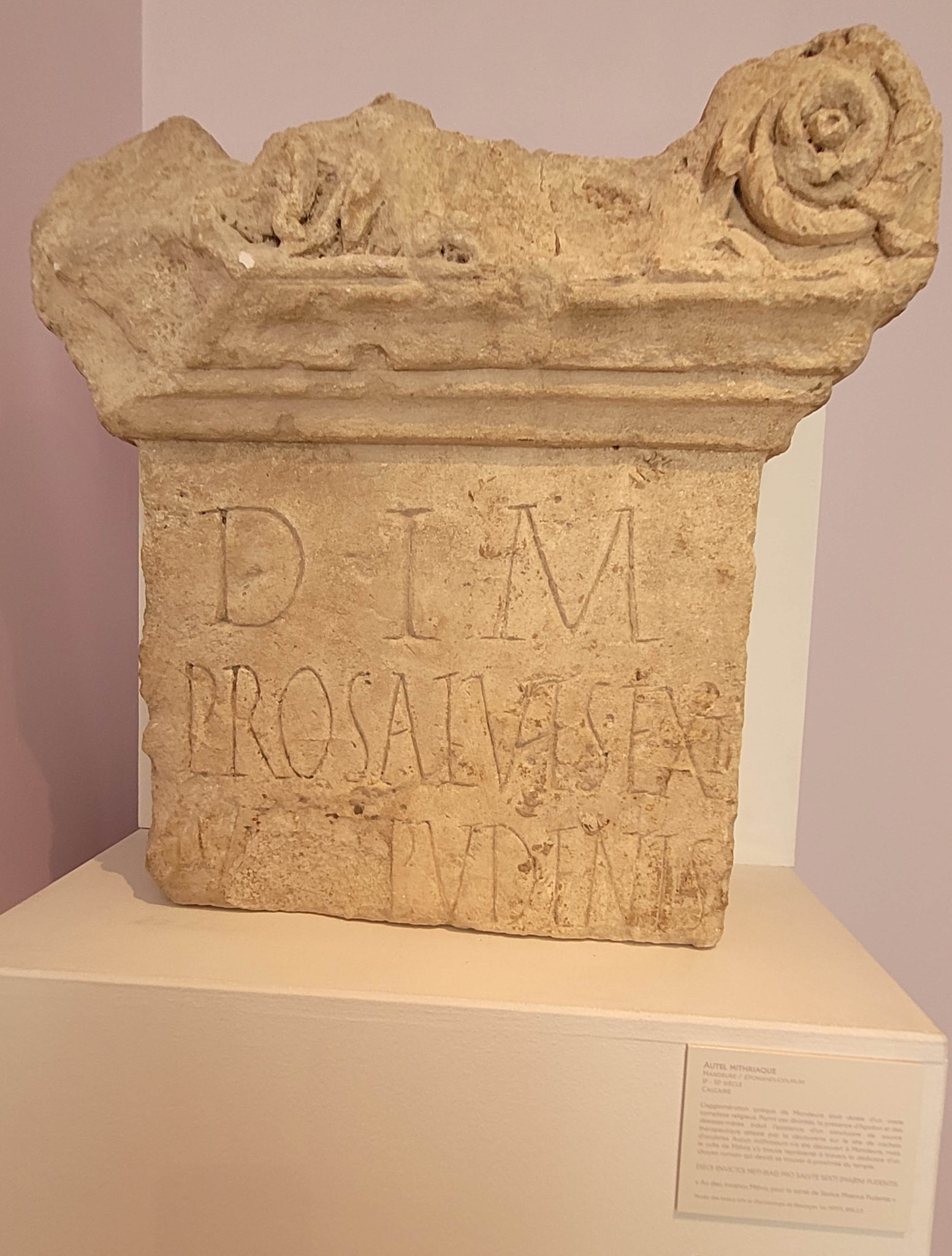
Stela dedicated to Mithras Invictus, found in 1895–1896 at Epamantodurum (modern Mandeure), in the territory of the civitas Sequanorum (Gallia Belgica). The inscription records a vow to Mithras Invictus made for the welfare of Sextus Maenius Pudens.

Altar from Kokardscha near Adam Klissi, ancient Tropaeum Traiani in Moesia Inferior, dedicated to Deo invicto for the welfare of Emperor Marcus Antoninus Verus by Annius Saturninus, centurion of Legio XI Claudia.
Limestone relief from Schwadorf, ancient Aequinoctium in Pannonia Superior, depicting the naked Mithras being born from the rock with a serpent encircling it, flanked by torchbearers; one of the finest examples of this iconographic type from the Danubian region…
Finds discovered near the crossing of the criptoporticus of the Mithraeum at Capua, including marble plate fragments, a tuff base, red lamps, and animal bones.
Miscellaneous finds from the middle of the Mithraeum of Capua, including a terracotta antefix with centaurs, basins, marble bases, lamps with a Sol head, and coins of M. Aurelius and Constantine.
Badly damaged fresco fragment showing a person in red attire in a kneeling position, from the initiation sequence of the Mithraeum of Capua.
Head in Phrygian cap with a sorrowful expression, used as a protome in the Amphitheatre of Capua and interpreted as a head of Mithras.
Altar inscription dedicated to Sol Augustus by the decurion Valerius Carpus, from Timgad (ancient Thamugadi).
Great royal inscription of Antiochus I of Commagene carved on the thrones at Nemrud Dağı, invoking Apollo-Mithras-Helios among the guardian deities of the kingdom, 69–34 B.C.
Group of nearby religious dedications associated with soldiers of the Legio III Augusta and the wider sacred landscape around the Mithraeum.
Reworked limestone altar dedicated by the governor of Numidia during the period of the Diocletianic persecutions.
Limestone altar dedicated to Sol Invictus Mithras by the governor and military commander Marcus Valerius Maximianus.
Assemblage of lamps, keys, torches, an iron knife, pottery, glass fragments, and five coins from Mithraeum III at Heddernheim, ancient Nida
Damaged red sandstone altar from Mithraeum II at Heddernheim, ancient Nida, with the representation of an axe on its front face
Tall sandstone column base from Mithraeum I at Heddernheim, ancient Nida, with an inscription set between two columns, possibly naming Mithras
Assemblage of lamps, serpent-vases and painted ritual pottery from the sanctuary complex.
