Your search Sulz am Neckar gave 1039 results.

Two-fragment stone altar from the Mithraeum at Linz, ancient Lentia in Noricum, dedicated to Deo Soli invicto Mithrae sacrum by Tiberius Iulius Ursalus, a veteran, for himself and his family.
Fragmentary inscription from Günzburg, ancient Guntia in Raetia, recording a dedication to Deo invicto Mithrae by two dedicants, Tetto and a companion whose name begins Sex-.
Dark-red clay vase from the refuse pit of the Roman camp at Windisch, ancient Vindonissa, with three handles each encircled by a coiling serpent; a vessel type closely associated with Mithraic ritual.
Serpent-vases (Schlangengefässe) attested at Augst, ancient Augusta Rauricorum, a ceramic type commonly associated with Mithraic cult assemblages in the Rhine provinces.
The six divine names inscribed on the bronze hatchets from Thun-Allmendingen — Iovi, Neptuni, Minervae, Mercurio, Matribus, Matroni — reflecting the polytheistic religious landscape of the Mithraic community at this site.
Set of six triangular bronze votive hatchets from Thun-Allmendingen, each inscribed with the name of a deity: Iovi, Neptuni, Minervae, Mercurio, Matribus, and Matroni; forming a unique ensemble of polytheistic dedications within a Mithraic context.
Fragmentary limestone relief from Thun-Allmendingen of the same dimensions as the bull relief, depicting a swine; both may have formed part of the sanctuary's ritual décor.
Assemblage of cult objects from the Mithraeum at Königshoffen including painted lamps, glass and terra-sigillata fragments with potters' stamps and graffiti (including Deo invicto Mithrae), two iron bells, an iron shield-knob, and stone fragments.
Altar from the Mithraeum at Königshoffen, dedicated in honour of the Domus Divina to Deo invicto Mithrae by a dedicant whose name is partially preserved and may be read as Secundus or Secundinus.
Grey sandstone slab from the Mithraeum at Königshoffen, a companion piece to the preceding, recording the same act of repainting a cult image by Caius Celsinius Matutinus, veteran of Legio VIII Augusta Alexandriana.
Sandstone altar from the Mithraeum at Königshoffen, dedicated to Deo invicto by a dedicant whose name begins Primu[s]; the remainder of the text is fragmentary.
Altar from the Mithraeum at Königshoffen, dedicated to Deo Cissonio — a Celtic god identified with Mercury — by Gittonius Pippausus; the dedicant's Celtic name may be etymologically connected to that of the deity.
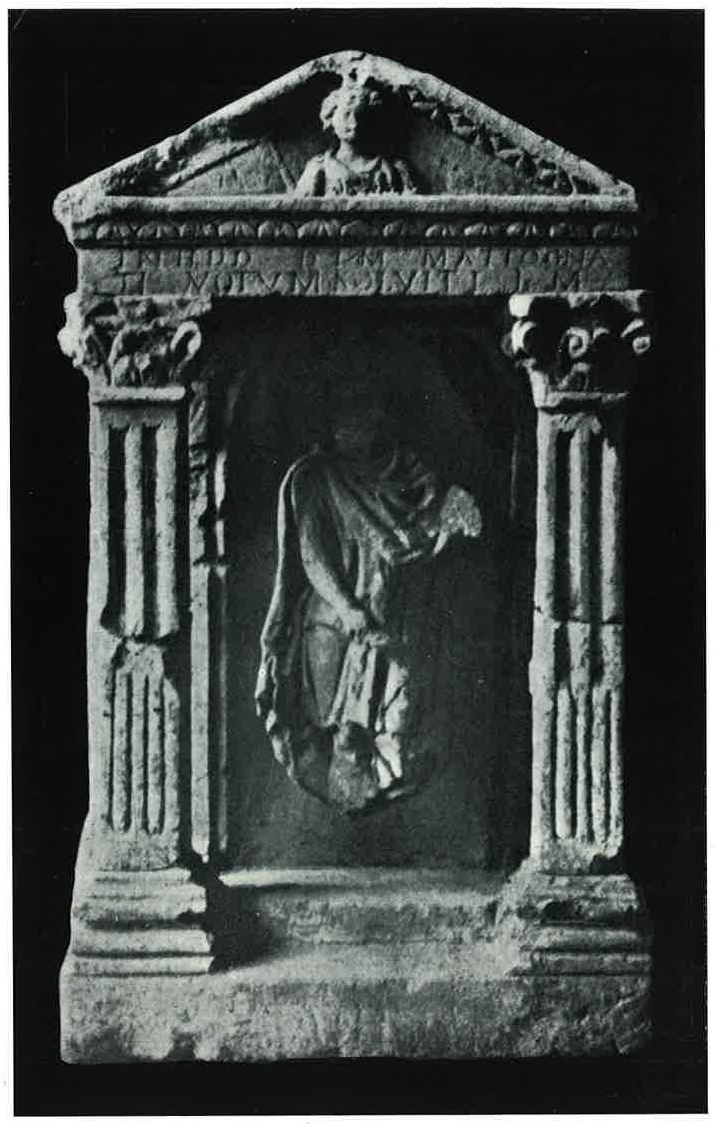
Sandstone monument in the form of a temple façade from the Mithraeum at Königshoffen, accessible by a step and framed by two Corinthian columns; the pediment is decorated with the bust of Luna, and the architrave carries an inscription.
Grey sandstone hand holding a globe from the Mithraeum at Königshoffen, with a lead bar indicating attachment to a larger statue; a second globe with a partial hand was found at the same spot.
Fragmentary altar from the Mithraeum at Königshoffen preserving only the opening of a dedication to Deo invicto Mithrae and a partially legible dedicant's name beginning with C.
Badly damaged sandstone statue of a togatus from the Mithraeum at Mackwiller, preserving only fragments of the head and garment.
Sandstone slab from Kindenheim, Germania Superior, depicting a standing winged Aion with traces of a lion's mane on the breast and objects in both hands; the head and part of the body are damaged.
Fragmentary inscription from Fellbach, Germania Superior, preserving only the abbreviated name of Mithras.
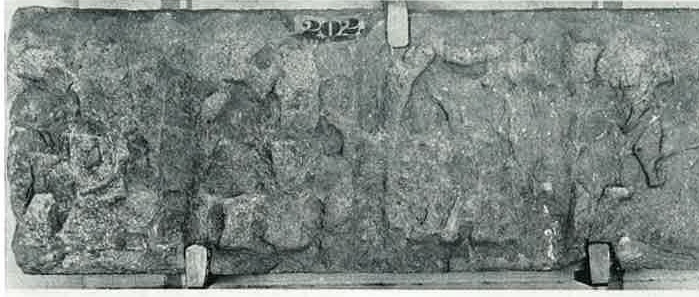
Badly damaged red sandstone relief from Hölzern, Germania Superior, depicting the standard bull-slaying scene; possibly forming part of the border zone of a larger composition.
Small yellow sandstone fragment from the Mithraeum at Dieburg showing the foremost part of an animal, probably a dog or ram, with head turned right
