Your search Tal hal Hariri / Es-Sâlihiyeh / As Salhiyah gave 3731 results.

Marble inscription fragment from Mithraeum II at Ptuj, ancient Poetovio, preserving only scattered letters with no legible text.
Marble inscription fragment from Mithraeum II at Ptuj, ancient Poetovio, preserving only the beginning of a name: Aulus Po-.
Marble torso from Mithraeum II at Ptuj, ancient Poetovio, probably representing a winged, reclining bull with two vertical attachment ligaments on the reverse.
Marble statuette fragments from Mithraeum II at Ptuj, ancient Poetovio, preserving the torsos and partial bodies of Sol's horses together with a two-wheeled car — a rare three-dimensional representation of this scene.
Marble plate fragment from Mithraeum II at Ptuj, ancient Poetovio, recording a dedication to Deo invicto Mithrae for the welfare of the Emperors and the restoration or construction of a templum.
Fragmentary inscription from Mithraeum II at Ptuj, ancient Poetovio, preserving only the end of a dedicant's name (-ciano) and the closing formula.
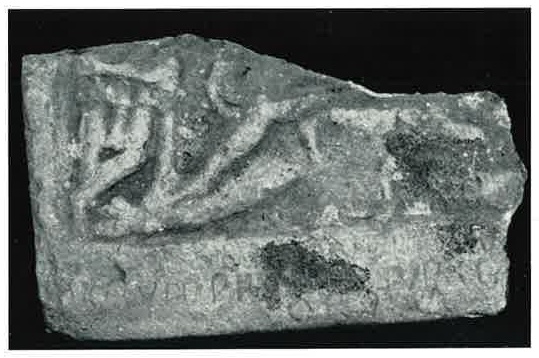
Marble relief from Mithraeum II at Ptuj, ancient Poetovio, preserving the lower part of the tauroctony with a bull in full extension, the scorpion, and a serpent with upraised head, together with Cautopates behind the bull.
Upper portion of a marble altar from Mithraeum II at Ptuj, ancient Poetovio, dedicated to Deo Soli invicto Mithrae for the welfare of Aurelius; the rest of the name is lost.
Marble lion from Mithraeum II at Ptuj, ancient Poetovio, holding a swine's head under its left fore-leg — a sacrificial animal pairing associated with the Mithraic lion grade.
Inscription from Mithraeum II at Ptuj, ancient Poetovio, dedicated to Deo Soli invicto Mithrae for the welfare of Flavius Iovinus, who had vowed the gift after witnessing the birth of the god; dated to the consulship of Peregrinus and Aemilianus, AD 244.
Fragmentary marble inscription from Mithraeum II at Ptuj, ancient Poetovio, preserving only the abbreviated dedication to Deo Soli invicto Mithrae.
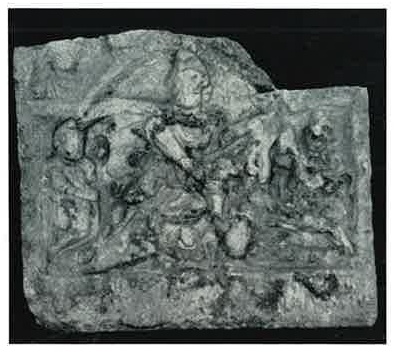
Marble tauroctony relief from Mithraeum II at Ptuj, ancient Poetovio, distinguished by the bull represented with fully stretched legs; Cautopates is shown resting his head on his hand in a pensive posture.
Circular white marble fragment from Mithraeum II at Ptuj, ancient Poetovio, depicting a lion's head with leaves below and a small globe above.
Right lower corner of a marble relief from Mithraeum II at Ptuj, ancient Poetovio, preserving the border of the grotto and, outside it, Luna in a two-horse chariot holding a whip; only the horses' heads are shown.
Small marble relief fragment from Mithraeum II at Ptuj, ancient Poetovio, preserving the middle portion of a torchbearer.
Fragment of a large marble relief from Mithraeum II at Ptuj, ancient Poetovio, preserving the forepart of the bull, the leaping dog, and the serpent approaching the wound.
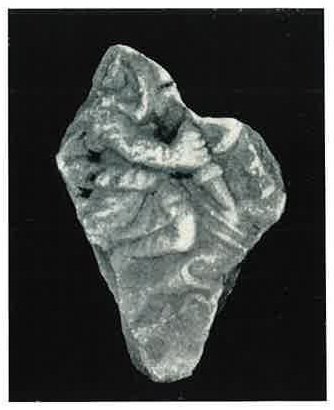
Marble tauroctony relief fragment from Mithraeum II at Ptuj, ancient Poetovio, preserving the central scene with the leaping dog, serpent, and scorpion; the bull's body is encircled by two girdles.
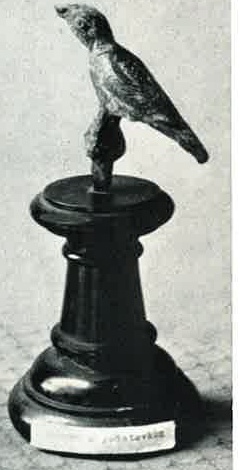
Small bronze raven perched on a dagger from Mithraeum I at Ptuj, ancient Poetovio — a Mithraic grade symbol representing the corax, the lowest of the seven Mithraic initiation grades.
Duplicate inscription from Mithraeum I at Ptuj, ancient Poetovio, set up by Primitivos in memory of Hyacinthus; a companion piece to no. 1501, suggesting that the two inscriptions flanked the cult niche.
Inscription from Mithraeum I at Ptuj, ancient Poetovio, set up by Primitivos, contrascrip of the imperial procurator Caius Antonius Rufus, in memory of Hyacinthus — probably the founder of the sanctuary.
