Your search Tal hal Hariri / Es-Sâlihiyeh / As Salhiyah gave 3730 results.

Small circular marble basin from Mithraeum II at Ptuj, ancient Poetovio, probably used for libations or purification within the sanctuary.
Small marble relief fragment from Mithraeum II at Ptuj, ancient Poetovio, preserving the central scene of the Nutrices — nursing goddesses — a rare motif in a Mithraic context.
Foremost portion of a marble tauroctony relief from Mithraeum II at Ptuj, ancient Poetovio, preserving the bull's forepart, the serpent's head, the turning dog, and Cautes raising the torch with both hands.
Marble altar fragment from Mithraeum II at Ptuj, ancient Poetovio, dedicated by a tabularius et vilicus of the statio Confluentes, a customs station at the junction of Pannonia Inferior and Moesia.
Large marble water-basin on a column from Mithraeum II at Ptuj, ancient Poetovio, decorated with a central rosette; it probably stood near the entrance of the sanctuary.
Right portion of a marble tauroctony relief from Mithraeum II at Ptuj, ancient Poetovio, preserving standing Cautes with upraised torch and the bust of Luna above him.
Upper portion of a marble altar from Mithraeum II at Ptuj, ancient Poetovio, preserving only the abbreviated dedication to Deo invicto Mithrae.
Marble relief fragment from Mithraeum II at Ptuj, ancient Poetovio, preserving the greater part of Cautes in high relief; the head, most of the right arm, and legs below the knee are lost.
Right portion of a marble relief from Mithraeum II at Ptuj, ancient Poetovio, preserving Cautes holding the upraised torch with both hands; not cross-legged; head, feet, right hand, and torch top are lost.
Left lower corner of a marble relief from Mithraeum II at Ptuj, ancient Poetovio, preserving Cautopates with downward torch and a staff; not cross-legged; head, left arm, and left foot are lost.
Inscription from Mithraeum I at Ptuj, ancient Poetovio, dedicated to Cautes sacrum by Venulus, slave of Aponius Ingenuus.
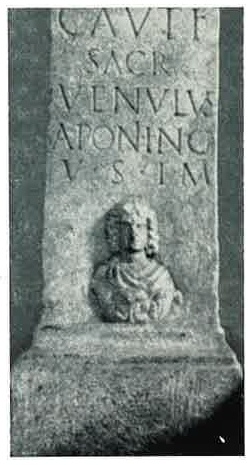
White marble votive altar from Mithraeum I at Ptuj, ancient Poetovio, distinguished by a dressed bust of Cautes emerging from foliage below the inscription — an unusual iconographic feature for an altar.
Altar from Mithraeum I at Ptuj, ancient Poetovio, dedicated to Deo invicto Mithrae by Optimus Vitalis, vicarius of Sabinus Veranus, vilicus of the publicum portorium.
Marble altar with akroteria from Mithraeum I at Ptuj, ancient Poetovio, dedicated to Invicto Mithrae by Festus, vicarius of Primus, vilicus of the publicum portorium.
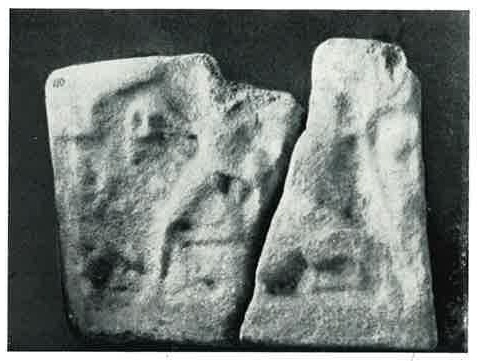
Weathered marble tauroctony relief in two fragments from Ruše, Noricum, depicting the bull-slaying with only the dog visible, flanked by two torchbearers both holding their torches upraised; no Sol or Luna.
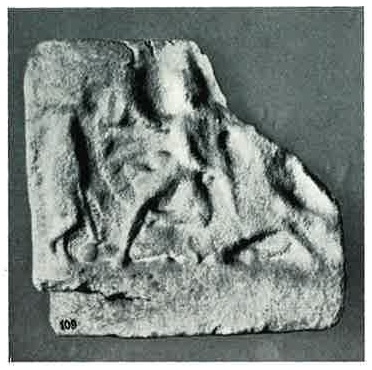
Marble tauroctony relief from Ruše, Noricum, showing a grotto scene in which Cautopates holds the torch downward against the rocky ground and supports his head with his left hand in a pensive attitude; the upper left corner preserves a bust of Sol.
Lower portion of a sandstone relief from the Mithraeum at Gimmeldingen, preserving a cross-legged torchbearer in a long cloak, probably Cautes.
Statue of Cautopates from Neuenheim, holding a downward torch with both hands, now in the Kurpfälzisches Museum at Heidelberg
Square bronze plate from Mithraeum III at Heddernheim, ancient Nida, probably a cult tessera bearing barely legible engraved letters

Fragment of a statuette on a sandstone base found in Mithraeum III at Heddernheim, ancient Nida, formerly in the Häberlin collection
