Your search for Timziouine (near Saïda) gave 358 results.
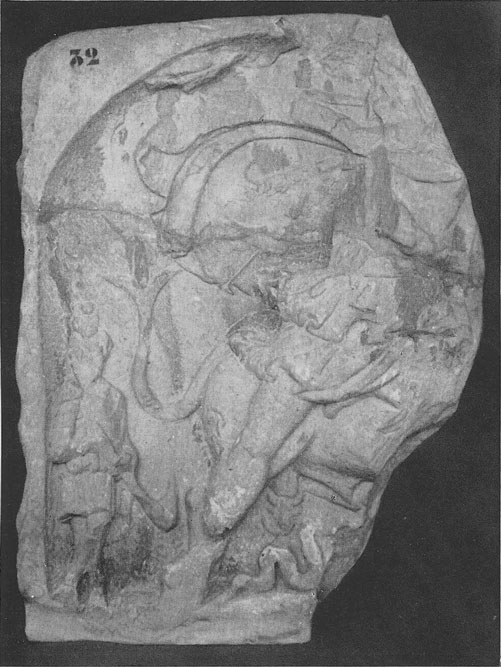
This fragmentary tauroctony relief from Timziouin near Saïda depicts Mithras slaying the bull within a cave-like frame, accompanied by the raven, serpent, scorpion, and Cautopates.

Large marble slab found in 1648 near S. Silvestro in Capite, inscribed with a Latin dedicatory poem forming a cypher-acrostic for TAMESIUS and AUGENTIUS, with records of leontica and chrysos initiations, dated to 362 A.D.

The Sacello delle Tre Navate near the Therms of the Sette Sapienti at Ostia, whose identification as a Mithraeum remains uncertain, with a decorated cult-niche but lacking typical Mithraic iconography.
A suggestion by H. Corot that a Mithraeum may have existed near the sources of the Seine (ancient Sequana) in Lugdunensis, a hypothesis awaiting archaeological confirmation.
A fragmentary inscription from Scaleby Castle near Cambeckfort (ancient Petrianae), preserving a partial dedication to Sol Mithras.
A white marble relief fragment found in a house at Ganaceto near Modena in 1845, now in the Museo Lapidario in Modena, showing Cautes in Eastern attire and anaxyrides cross-legged, with a fragment of Mithras' flying cloak according to Cumont.
Wall remnants found deep underground at San Zeno near Trento, possibly indicating a Mithraeum, discovered alongside Roman coins, lost bronze figures and a small gold disc decorated with an ear of corn or a sword.
A fragmentary inscription on the lower border of the limestone tauroctony relief from San Zeno di Romedio near Trento, partially reading a dedication to the Invincible Mithras by Marius.
A limestone low-relief tauroctony fragment found in 1869 near the entrance of the valley of San Zeno di Romedio in the Trentino, now in the Museum at Trento, showing a primitive Mithras bullkiller with Cautes upraised, the bust of Luna and an inscription on the lower border…
A brief inscription reading "Deo Invicto Mithrae", found in the ruins of the Castello di Tuenno near San Zeno at the entry to the Tovel valley in Trentino, alongside the decorated relief No. 723.
A scholarly note recording that finds at Heiligkreuz, including a lion's head and leg fragment, the head of a genius, and a knife with a gold handle, support the hypothesis of a Mithraeum at that location in Augusta Treverorum (modern Trier) in Belgica.
A bronze votive slab bearing a dedication to the unconquered god, found on a hill at Heiligkreuz near the proposed Mithraeum at Augusta Treverorum (modern Trier) in Belgica.
An altar found not far from the eastern entrance of the cult-room at Borcovicium (modern Housesteads), bearing a brief dedication to Deus Sol.
A badly damaged tauroctony relief carved in peperino, fixed high into a wall of the old farm known as Le Capanacce on the Via Cassia near Vicus Matrini in Etruria, showing Mithras as a bullkiller in a vaulted cave with serpent, the head and left arm of the god lost…
A subterranean room with a stucco depiction of Mithras slaying the bull, probably from the fourth century, discovered at Agurzano near Ponte Mammolo on the Via Tiburtina outside Rome.
Marble inscription found near the Church of S. Susanna on the Quirinal, with a dedication to Sol Invictus as a votive offering by Cornelius Maximus, centurion of the tenth praetorian cohort.
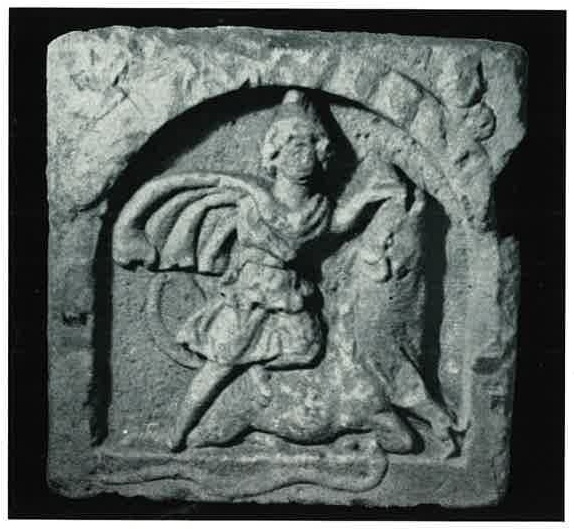
Limestone tauroctony relief from Bechli, 8 km from Ghighen, ancient Oescus in Moesia Inferior, depicting the standard bull-slaying scene in a grotto.
Inscription from Șard near Apulum, Dacia, dedicated to Soli invicto in Latin and to Helios aniketo in Greek by Abeallathos — a rare bilingual Mithraic dedication.
Inscription from the village of Șard near Apulum, Dacia, dedicated to Soli invicto for the welfare of the Emperor, the Roman people, and the ordo of the Colonia Apuli by Caius Iulius Valens.

