Your search Tulln an der Donau gave 577 results.

Small stone block inscribed to Deo Soli, found walled up in an Arabic wall near a Roman spring at Sicca Veneria (modern Kef).

One of the rooms in a sustantive masonry building in Hollytrees Meadow was considered to be a Mithreum, a theory that has now been discarded.
Limestone stele recording endowments for the feast of the Mithrakana by Antipater and his son Gaios, found at Amorium (modern Hisarköy), Phrygia.
Rough-hewn statuette found at Emir Ghasi in Lycaonia, once thought to represent a Mithraic soldier; according to Cumont, a modern forgery.
Fragment of a marble tauroctony relief found between Sinitovo and Tatar-Bazardjik, Thracia, preserving only the upper portion with the busts of Sol and Luna; the Greek inscription in the border names the dedicant.
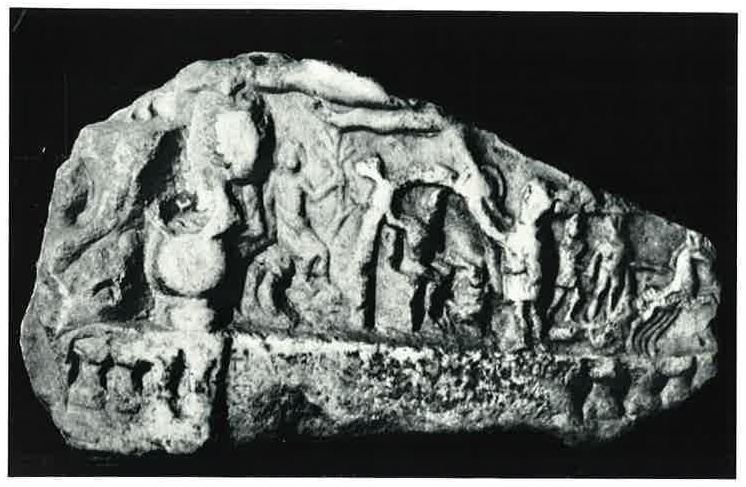
Lower part of a marble tauroctony relief from Sinitovo, Thracia, found walled into a well, depicting the lower portion of the bull-slaying scene; the Greek inscription in the lower border records a thanksgiving to Helios Mithras invictos.
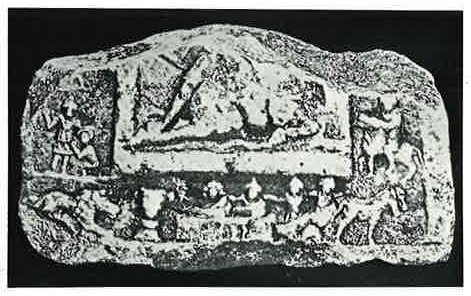
Marble tauroctony relief from Elli Dere near Tatar-Bazardjik, ancient Bessapara in Thracia, with the upper part broken off; the lower portion preserves the standard bull-slaying scene.
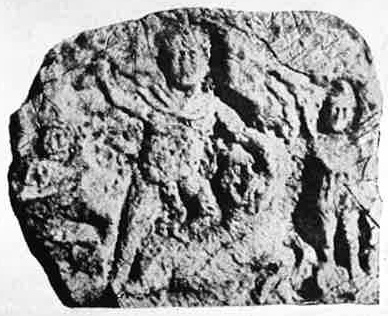
Rough relief from Gaganica, Thracia, depicting Mithras as bull-slayer in an unusual frontal attitude, wearing only a shoulder-cape and holding the dagger upwards; with dog, serpent, scorpion, and a non-cross-legged Cautes.
Marble relief fragment from near Debeli-Lak, Thracia, depicting Cautopates in Oriental dress holding the torch downwards with both hands, not cross-legged; head, shoulder, and feet are lost.
Yellowish marble tauroctony relief from Acbunar, Moesia Inferior, depicting Mithras killing a bull described as unusually buffalo-like; the god looks back at the raven on the grotto's border.
Stone altar with akroteria from Dražinovići, Moesia Superior, found in 1934 near the brook Savina Voda, dedicated to Invicto deo Mithrae for the welfare of Emperor Severus Alexander.
White marble tauroctony relief from Slăveni-Romanați, Dacia, with the raven perched on the grotto's border; the right upper corner is broken off.
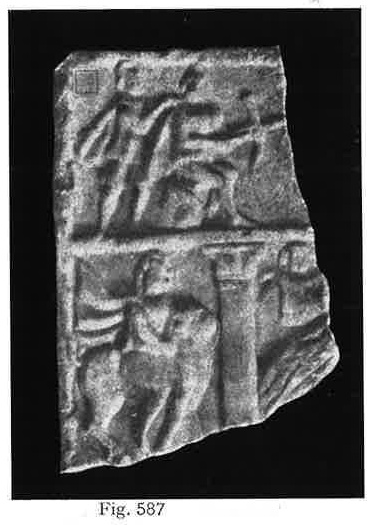
Left upper corner of a white marble tauroctony relief from the Roman camp at Drubeta, Dacia, found in 1896–99, preserving the grotto border and, outside it, Sol in his quadriga with cracking whip.

Small relief found in 1956 at Oarda de Sus near Alba Julia, Dacia, framed by a border; the upper part depicts the dressed bust of Mithras in Phrygian cap, the lower portion the bull-slaying scene.
Small red sandstone fragment from the Mithraeum at Konjic, Dalmatia, preserving an oblong object — possibly an arm — within a border.
Fragment of a Mithras relief from Zsámbék near Aquincum, Pannonia Inferior, showing seven altars alternated with trees — a processional or decorative border rather than a main tauroctony scene.
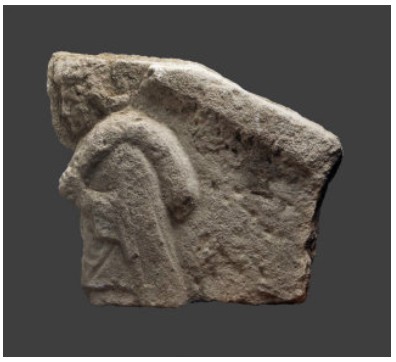
Fragment of a relief from Potz Neusiedl near Stix-Neusiedl, Pannonia Superior, brought to Eisenstadt in 1926, depicting part of a Mithraic bull-slaying scene.
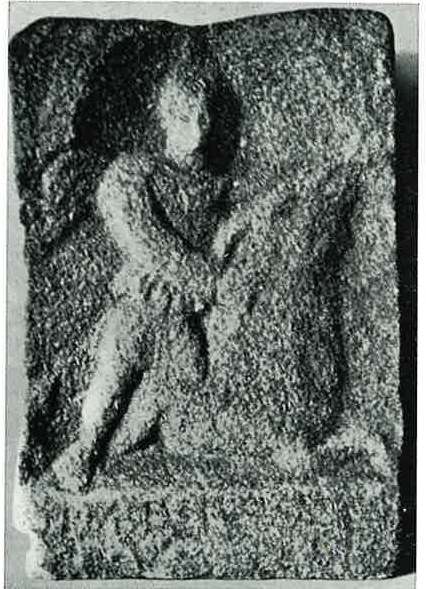
Marble tauroctony relief from the Mithraeum at Modrič, Pannonia Superior, with Cautopates and Cautes flanking the bull-slaying scene and a dedication inscribed in the lower border.
Column found at Sankt Peter in Holz, ancient Teurnia in Noricum, dedicated to Cautes by Lucius Albius Atticus and Caius Albius Avitus — probably father and son — making it a rare joint family dedication to a Mithraic torchbearer.

Three-fragment terracotta plate from the Mithraeum at Linz, ancient Lentia, with a seven-hole border and a graffito in the centre invoking Iupiter Optimus Maximus; found in the second room of the sanctuary.
