Your search Val di Non gave 2351 results.

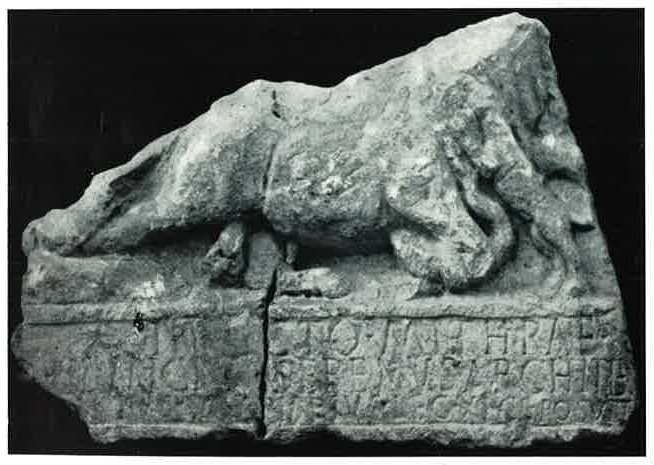
Inscription from Dionysopolis, Moesia Inferior, dedicated to Invicto Mithrae by Quintus Samacius Serenus, architectus salariarius of Legio XI Claudia.
Sandstone tauroctony relief from Balcic, ancient Dionysopolis in Moesia Inferior, depicting the standard bull-slaying scene; the attribution to Dionysopolis rather than another site is disputed.
Limestone altar from the Territorium Troesmense, Moesia Inferior, dedicated to Invicto Mithrae sacrum by Lucius Valerius Fuscus, centurion of a legion.
Fragmentary inscription from Transdierna, Moesia Superior, preserving only the opening of a dedication to Deo invicto Mithrae.
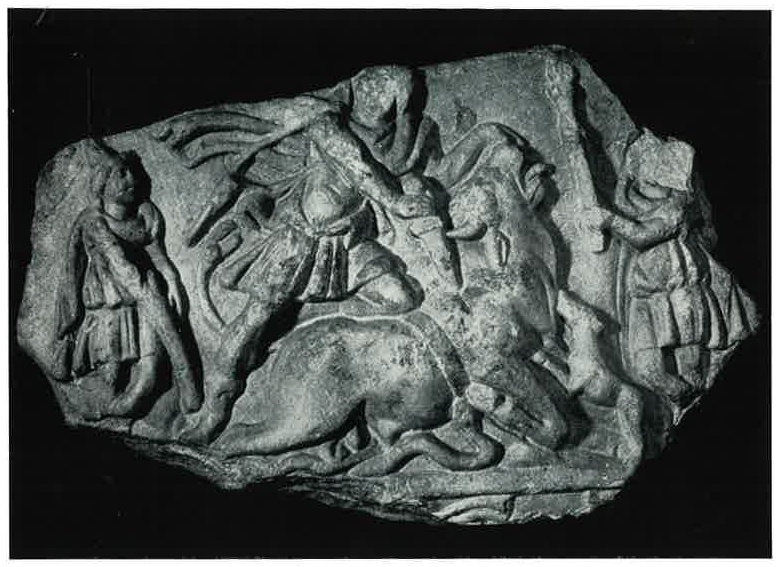
Marble tauroctony relief fragment from Tekija in east Serbia, ancient Transdierna in Moesia Superior, depicting the standard bull-slaying scene.
Marble altar from near Osmakovo, Moesia Superior, now in the Niš museum, dedicated to Soli invicto by Valerius Iucundus.
Votive altar from Păuleni, Dacia, dedicated to Soli invicto for the welfare of Caius Iulius Valentinus, conductor salinarum, by Caius Iulius Ornucio.
Inscription from the village of Șard near Apulum, Dacia, dedicated to Soli invicto for the welfare of the Emperor, the Roman people, and the ordo of the Colonia Apuli by Caius Iulius Valens.
Votive stone found at Epfach in 1830, ancient Abudiacum in Raetia, dedicated to Soli sacrum by Tiberius Claudius Mace, son of Tiberius Claudius Mace, apparently a dedication by a son continuing his father's cult.
Dark-red clay vase from the refuse pit of the Roman camp at Windisch, ancient Vindonissa, with three handles each encircled by a coiling serpent; a vessel type closely associated with Mithraic ritual.
Deposit of 1,200 coins spanning Augustus to Constantine and a small bronze bell from Thun-Allmendingen, representing the longest chronological range of any coin assemblage from a Mithraic context in Germania.
The six divine names inscribed on the bronze hatchets from Thun-Allmendingen — Iovi, Neptuni, Minervae, Mercurio, Matribus, Matroni — reflecting the polytheistic religious landscape of the Mithraic community at this site.
Set of six triangular bronze votive hatchets from Thun-Allmendingen, each inscribed with the name of a deity: Iovi, Neptuni, Minervae, Mercurio, Matribus, and Matroni; forming a unique ensemble of polytheistic dedications within a Mithraic context.
Limestone left hand holding a caduceus from Thun-Allmendingen, belonging to a statue of Mercury associated with the possible Mithraeum.
Fragmentary limestone relief from Thun-Allmendingen of the same dimensions as the bull relief, depicting a swine; both may have formed part of the sanctuary's ritual décor.
Large limestone relief from Thun-Allmendingen depicting a bull walking to the left; the head is lost. At approximately 2.91 × 2.43 m one of the largest single-animal reliefs from a Mithraic context.
Two small limestone heads in Phrygian caps from the Stockhorn Mountains near Thun-Allmendingen, each approximately fist-sized, probably belonging to statues of the torchbearers.
Site excavated by C. F. L. Lohner in 1824–25 at the Renzenbühl near Thun-Allmendingen, Germania Superior, where the outline of five rooms was identified, one or more of which may have served as a Mithraic sanctuary.
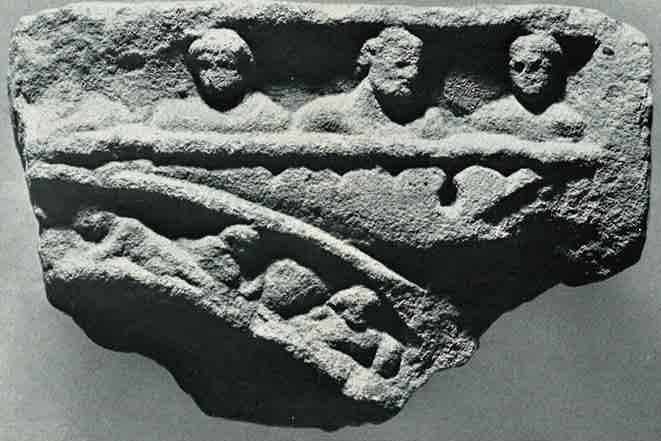
Fragment of a red sandstone relief found in the Frankfurterstrasse at Dieburg, depicting four divine busts in the upper corner of the composition
Assemblage of plates, jugs, dishes, cups, censers, two bronze coins, and animal bones from the Mithraeum at Dieburg
