Your search Villa of Domitian at the Castel Gandolfo gave 3663 results.

Column found at Sankt Peter in Holz, ancient Teurnia in Noricum, dedicated to Cautes by Lucius Albius Atticus and Caius Albius Avitus — probably father and son — making it a rare joint family dedication to a Mithraic torchbearer.
Small marble head from Saifnitz, Noricum, wearing a Phrygian cap; possibly representing Attis or a Mithraic torchbearer.

Three-fragment terracotta plate from the Mithraeum at Linz, ancient Lentia, with a seven-hole border and a graffito in the centre invoking Iupiter Optimus Maximus; found in the second room of the sanctuary.
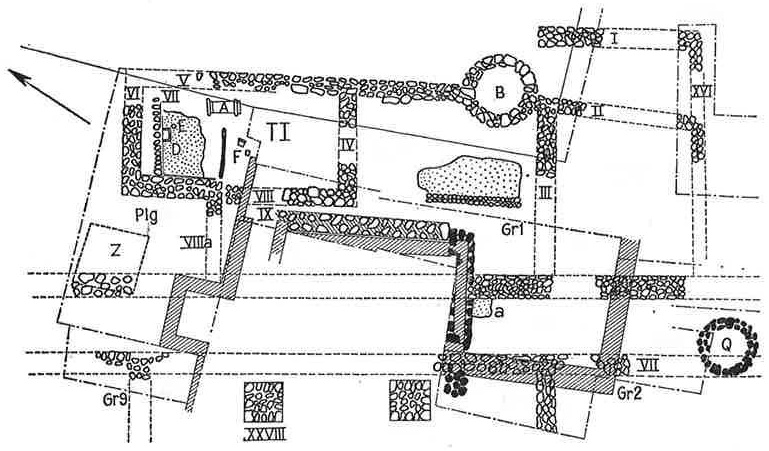
Mithraic sanctuary found in the Tummelplatz at Linz, ancient Lentia in Noricum, constructed within an existing building; the sanctuary yielded marble reliefs, an altar, cult pottery, and a silver votive object.
Altar from the Mithraeum at Moosham, Noricum, dedicated to Deo invicto Mithrae for the welfare of Lucius Albius Atticus; the dedicant's name has been deliberately abraded.
Small Mithraic sanctuary (8 × 8 m) excavated in 1950–52 on a slope west of Schloss Moosham, Noricum, on the left bank of the river Mur; the finds include a marble epistylium, a Mithras head, and fragmentary altars.
Limestone statue fragment from Nyon, ancient Colonia Iulia Equestris, depicting a lion encircled by a serpent with schematic scorpions engraved in small triangles on each flank; a composition associated with Mithraic lion symbolism.
Small red limestone altar from Nyon, ancient Colonia Iulia Equestris, dedicated to Invicto by Atius ex voto; one of the few Mithraic monuments from this site.
Underground oblong room at Nyon, ancient Colonia Iulia Equestris, situated on the edge of a second Forum dating to the second half of the first century AD, with a series of pillars along the side walls consistent with Mithraic architecture; its interpretation as a Mithraeum remains tentative…
The six divine names inscribed on the bronze hatchets from Thun-Allmendingen — Iovi, Neptuni, Minervae, Mercurio, Matribus, Matroni — reflecting the polytheistic religious landscape of the Mithraic community at this site.
Set of six triangular bronze votive hatchets from Thun-Allmendingen, each inscribed with the name of a deity: Iovi, Neptuni, Minervae, Mercurio, Matribus, and Matroni; forming a unique ensemble of polytheistic dedications within a Mithraic context.
Site excavated by C. F. L. Lohner in 1824–25 at the Renzenbühl near Thun-Allmendingen, Germania Superior, where the outline of five rooms was identified, one or more of which may have served as a Mithraic sanctuary.
Badly damaged sandstone statue of a togatus from the Mithraeum at Mackwiller, preserving only fragments of the head and garment.
Stone statue fragments from the Mithraeum at Mackwiller depicting Mithras's rock-birth, preserving the head in Phrygian cap, torso, and right hand holding part of a torch.
Two rectangular sandstone reliefs from Zasenhausen near Cannstatt, ancient Clarenna, each depicting a male bust with astral symbols on the forehead, arranged in opposing directions.
Small sandstone head in Phrygian cap from Cannstatt, ancient Clarenna, probably belonging to a statue of Cautes or Cautopates.
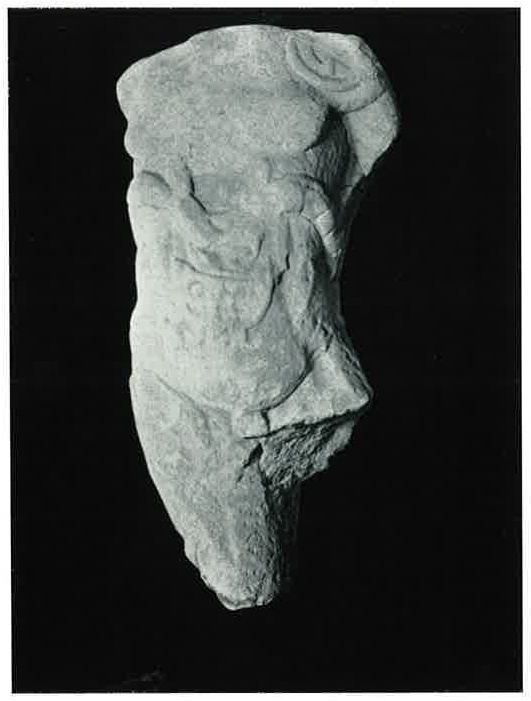
Sandstone statue from Wahlheim, Germania Superior, depicting a naked torso encircled by two serpents holding their heads towards the figure's face — the characteristic iconography of the leontocephaline Aion.
Small bronze statuette recovered from the river Saale near Burg Giebichenstein in 1900, depicting Mithras as bull-slayer without a Phrygian cap; the left leg is lost.
Rock-cut tauroctony relief at the Mithraeum near Schwarzerden, beginning at 0.70 metres from the floor, with clearly visible scorpion and serpent
Inscribed altar from Lengfeld near Aschaffenburg dedicated to Numini augusto deo invicto by Caius Atulius Maior ex voto
