Your search Villa of Domitian at the Castel Gandolfo gave 3663 results.

Square altar from Zwiefalten near Ulm, Raetia, found reused in the apse of a church; local tradition places the original sanctuary on a hilltop between Zell and Zwiefalten, or alternatively near Reichenstein.
Dark-red clay vase from the refuse pit of the Roman camp at Windisch, ancient Vindonissa, with three handles each encircled by a coiling serpent; a vessel type closely associated with Mithraic ritual.
Altar from Vidy near Lausanne, ancient Leusonna, dedicated to Soli Genio Lunae sacrum by Publius Clodius Primus, curator of the vici Lousonnenses, sevir Augustalis, and curator of the Roman citizens of the Helvetian conventus; not earlier than AD 161–169…
Round perforated bronze plaque from Augst, ancient Augusta Rauricorum, bearing a dedication of an aurichalcum image of Sol to Deo invicto; interpreted by Cumont as evidence for identifying the dedicatee as Mithras.
Small altar from Augst, ancient Augusta Rauricorum, dedicated to Deo invicto by Secundus; found in the early nineteenth century and subsequently transferred to Colmar.
Lost stone altar from the thermal baths at Baden, ancient Aquae Helveticae, dedicated to Deo invicto by Tiberius Cassius Sanctus and Tiberius Sancteius Valens following a vision.
Two fragments of a sandstone inscription from Gran in the Vosges, dated to the late second century, recording a dedication to Soli deo invicto by a servant of the dedicant, with possible mention of a portico and columns.
Reconstructed tauroctony relief from the Mithraeum at Mackwiller, assembled from multiple stone fragments and preserving Mithras's head, shoulders, dagger hand, flying cloak, and parts of the bull and torchbearers.
Lower-central fragment of the large cult relief from the Mithraeum at Mackwiller, preserving the forefeet of the dog, part of a serpent, and a cult vessel; the base bears a partially legible inscription mentioning an eques Romanus.
Sandstone plate from Beihingen in the Neckar valley, depicting on one side a youth in Oriental dress with a bow in an arched niche, and on the other a corresponding figure; both may represent torchbearers or Mithraic grades.
Sandstone altar found together with the Vocco altar at Rottenburg am Neckar, ancient Solicinium, bearing a fragmentary dedication and decorated with trees on its lateral faces.

Large grey sandstone tauroctony relief from Fellbach near Cannstatt, depicting the bull-slaying in a vaulted grotto with torchbearers, Sol, Luna, and subsidiary Mithraic scenes along the border.
Terra-sigillata fragment from Rheinzabern, ancient Tabernae, bearing a Mithraic graffito; found in 1902.
Terra-sigillata vase from Rheinzabern, ancient Tabernae, bearing a Mithraic graffito on its flat border.
Large votive altar from Murrhardt, dedicated to Soli invicto Mithrae by Sextus Iulius Florus Victorinus, tribune of Cohors XXIV Voluntariorum civium Romanorum, recording the full restoration of a Mithraic temple from its foundations.
Altar found at Recking near Heilbronn in 1615, dedicated to Soli invicto Mithrae by Publius Nasellius Proclianus, centurion of Legio VIII Augusta, who is also attested as dedicant of altars to Apollo Pythius and Fortuna.
Large inscribed altar from Lengfeld near Aschaffenburg dedicated to Numini augusto Soli deo invicto by Lucius Trougillus ex voto
Inscribed altar from Lobenfeld dedicated to Deo Soli by Vitalius Severus
Grey limestone relief fragment from Rockenhausen found at the Pfingstborn spring, preserving part of the bull-slaying scene
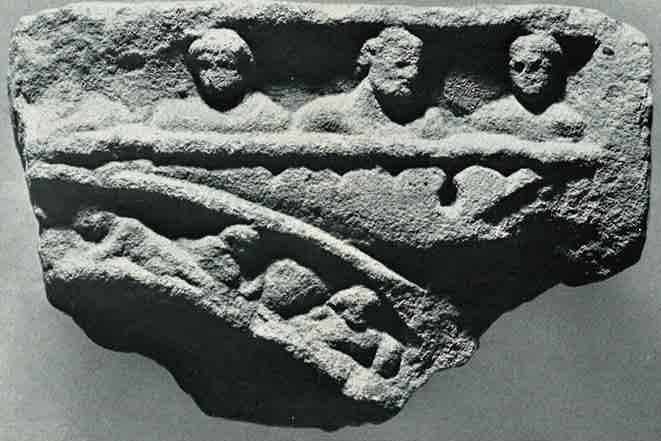
Fragment of a red sandstone relief found in the Frankfurterstrasse at Dieburg, depicting four divine busts in the upper corner of the composition
