Your search Villa of Domitian at the Castel Gandolfo gave 3663 results.

Large sandstone altar from Mithraeum I at Carnuntum, Pannonia Superior, with Cautopates cross-legged carved on the left side and Cautes walking on the right, both holding their torches with two hands; the front bears an inscription.
Cone-shaped sandstone stone encircled by a serpent from Mithraeum I at Carnuntum, Pannonia Superior, probably forming the base of a rock-birth group.
Marble plate from Stix-Neusiedl, Pannonia Superior, dedicated to Deo invicto Mithrae by Vitalis and Silvanus; traces of red colour are preserved in the lettering.
Marble altar from Stix-Neusiedl, Pannonia Superior, dedicated to Invicto deo sacrum by Longinus Secundus, with a triangle in the right rim and red-painted lettering.
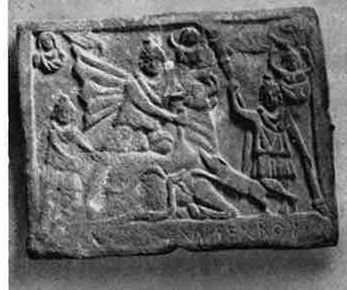
White marble tauroctony relief from Stix-Neusiedl, Pannonia Superior, depicting Mithras killing the bull with the raven perched on the rim of the god's flying cloak — an unusual detail placing the raven on the cloak rather than on the grotto border…
Marble altar from Mithraeum III at Ptuj, ancient Poetovio, dedicated to Deo Soli invicto Mithrae for the welfare of Emperor Marcus Aurelius Severus Alexander and the Domus Divina by Aelius Aurelianus; dated AD 222–235.
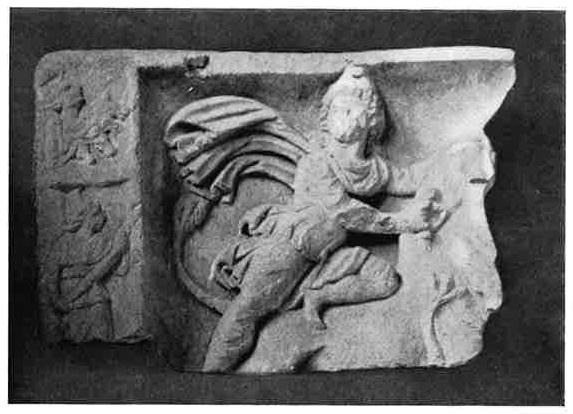
Marble tauroctony relief fragment from Mithraeum III at Ptuj, ancient Poetovio, notable for a three-headed serpent and a dog attempting to lick the blood; the bull's tail ends in three corn-ears.
Inscription from Mithraeum III at Ptuj, ancient Poetovio, recording that Sextus Vibius Hermes, Augustalis of the Colonia Ulpia Traiana Poetovionis, donated a silver signum with its base to Soli invicto Mithrae, with Lucius Vernasius Heraclida presiding as pater…
Marble stele from Mithraeum III at Ptuj, ancient Poetovio, tapering towards the top and bearing a square hollow with five nail-holes designed to hold a small silver plaque — the plaque was removed, perhaps taken by the Mithraists themselves.
Barbara-stone pedestal from Mithraeum III at Ptuj, ancient Poetovio, with a hollow and three attachment holes in the top indicating that a votive object was originally fixed to it.
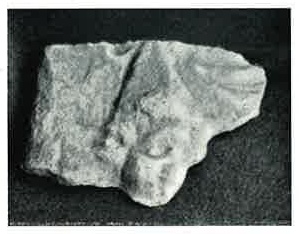
Left marble relief fragment from Mithraeum III at Ptuj, ancient Poetovio, preserving the head of a torchbearer, probably Cautopates, beside remnants of Mithras's flying cloak.
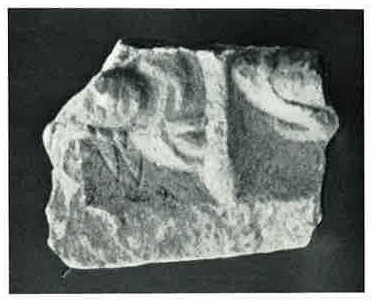
Left upper corner of a marble relief from Mithraeum II at Ptuj, ancient Poetovio, with the dressed bust of Sol in radiate crown above a horizontal rim, beneath which the head of a torchbearer, probably Cautopates.
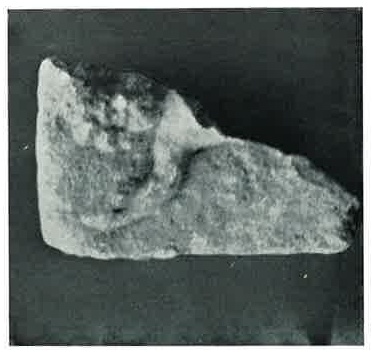
Left upper corner of a marble relief from Mithraeum II at Ptuj, ancient Poetovio, depicting Jupiter with the thunderbolt in his raised right hand, identified as a scene from the Battle against the Giants.
Left upper corner of a marble relief from Mithraeum II at Ptuj, ancient Poetovio, preserving part of the grotto's border, Sol's head, and below it a primitive torchbearer's head.
Small marble relief fragment from Mithraeum II at Ptuj, ancient Poetovio, preserving the central scene of the Nutrices — nursing goddesses — a rare motif in a Mithraic context.
Marble relief from Mithraeum II at Ptuj, ancient Poetovio, depicting standing Jupiter with sceptre and thunderbolt beside standing Hercules with the Hesperides' fruit and club — a divine pair with Mithraic associations.
Marble torso from Mithraeum II at Ptuj, ancient Poetovio, probably representing a winged, reclining bull with two vertical attachment ligaments on the reverse.
Marble statuette fragments from Mithraeum II at Ptuj, ancient Poetovio, preserving the torsos and partial bodies of Sol's horses together with a two-wheeled car — a rare three-dimensional representation of this scene.
Foremost portion of a marble tauroctony relief from Mithraeum II at Ptuj, ancient Poetovio, preserving the bull's forepart, the serpent's head, the turning dog, and Cautes raising the torch with both hands.
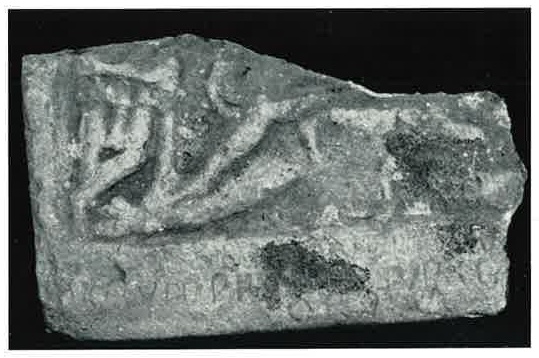
Marble relief from Mithraeum II at Ptuj, ancient Poetovio, preserving the lower part of the tauroctony with a bull in full extension, the scorpion, and a serpent with upraised head, together with Cautopates behind the bull.
