Your selection in monuments gave 62 results.

Limestone slab from the Mithraeum at Pohanica, Noricum, elaborately carved on both faces; a metal plate originally attached by pins to its interior was removed, probably by the Mithraists themselves — paralleled at Poetovio.
Sandstone altar with akroteria from the Mithraeum at Pohanica, Noricum, dedicated to Deo invicto Mithrae by Marcianus; the frame bears two outward-pointing darts as a decorative motif.
Sandstone altar with akroteria from the Mithraeum at Pohanica, Noricum, dedicated to Deo invicto Mithrae by Metilius Iustinianus; the sculptor initially misspelt the name Justianus before correcting it.
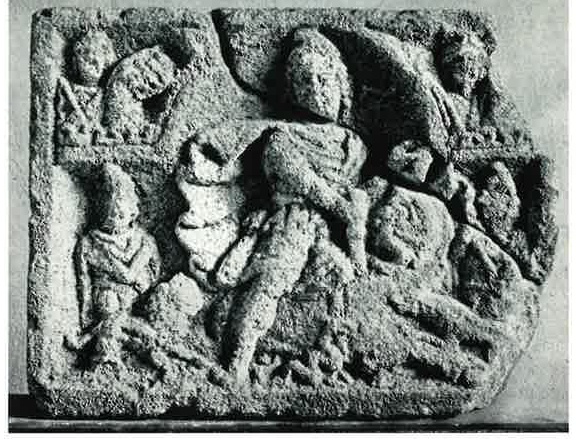
Bachern marble tauroctony relief from the Mithraeum at Pohanica, Noricum, notable for the prominent inclusion of a lion entering from the left — an unusual compositional element — alongside the standard dog, serpent, and torchbearers.
Small Mithraic sanctuary found in the slope of a ravine called Zlodjer (Devil's Ditch) at Ober-Pohanica near Zdole, Noricum; the finds are among the finest marble Mithraic sculpture from the eastern Alpine provinces.
Sandstone altar found between Celeia and Emona, Noricum, dedicated to Invicto Mithrae by Surio; the misspelling Mitre for Mithrae reflects local phonology.
Inscription from Celje, ancient Celeia in Noricum, recording that Aemilianus donated a gift to Mithrae invicto ex imperio — on divine command.
Left upper corner of a sandstone tauroctony relief from Celje, ancient Celeia in Noricum, preserving the bust of Sol, the head of a torchbearer, and the head of Mithras himself.
Marble altar walled into the crypt of the church at Hoče, Noricum, dedicated to Deo Soli invicto Mithrae for the welfare of Marcus Aurelius Felicianus and his son Marcus Aurelius Felicissimus by Helvius Ingenuinus.
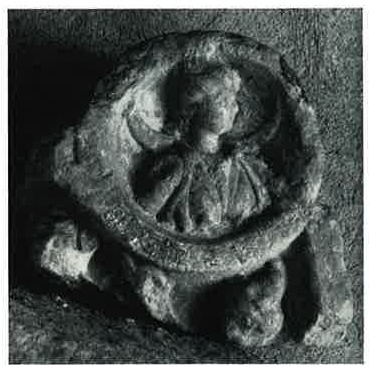
White marble relief fragment from near Klein-Wagna, ancient Flavia Solva in Noricum, preserving part of a tauroctony scene including the bull, Mithras's dagger, and the torchbearers.
Small marble head in Phrygian cap of unknown provenance, associated with the Waggendorf find-group, Noricum; may represent Attis or Mithras.
Crystalline limestone votive altar from Waggendorf near Sörg, Glantal, Noricum, probably third century AD, dedicated to Deo invicto Mithrae.
Natural grotto called the Bichl on the south slope above the Glanegg lake near St. Urban, Noricum, adapted as a Mithraic sanctuary; part of the grotto floor was paved and remnants of water installations survive.
Small altar preserved in the castle of Freudenberg at St. Thomas am Zeiselberg, Noricum, recording a dedication to Hermes invicto Mitrae — an unusual conflation of Hermes and the invincible Mithras.
Small two-fragment altar walled into the church at Schlatten near Rosenbach, Noricum, dedicated to Deo invicto Mithrae by Mocio Aprilis.
Altar from the Drave valley between Teurnia and Virunum, Noricum, now reused as a pedestal for a cross, dedicated to Invicto deo Mithrae for the welfare of Marcus Publius Potens by his freedman Ursulus.
Column found at Sankt Peter in Holz, ancient Teurnia in Noricum, dedicated to Cautes by Lucius Albius Atticus and Caius Albius Avitus — probably father and son — making it a rare joint family dedication to a Mithraic torchbearer.
Small marble head from Saifnitz, Noricum, wearing a Phrygian cap; possibly representing Attis or a Mithraic torchbearer.
Marble altar found in flood gravel at Aguntum, Noricum, dedicated to Deo invicto Soli Mithrae collectively by the Aguntenses, making it one of the rare collective dedications to Mithras.
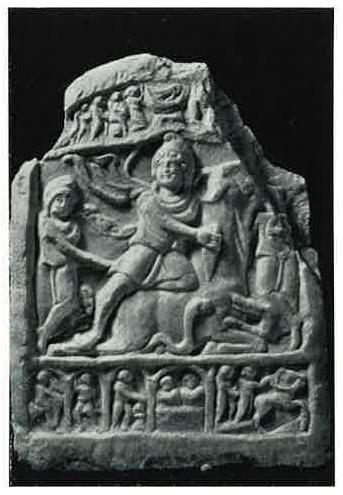
Small limestone tauroctony relief from Enns, ancient Lauriacum in Noricum, found about 100 metres east of the north-east corner of the castra, depicting Mithras killing the bull with dog and serpent and flanking torchbearers.
