Your selection in monuments gave 217 results.

White marble trapezium-shaped tauroctony from the Mithraeum at Sarmizegetusa, Dacia, in the Lugoj collection, depicting Mithras killing the bull with dog and serpent; the lower portion of the composition is lost.
Inscription from the Mithraeum at Sarmizegetusa, Dacia, recording a dedication by Severus, imperial freedman, to Cautopates.
White marble tauroctony relief from the Mithraeum at Sarmizegetusa, Dacia, now in the Lugoj collection; the right lower corner is broken off and the scene depicts the standard bull-slaying.
Bluish marble fragment from the Mithraeum at Sarmizegetusa, Dacia, preserving a sitting lion with its head slightly turned to the right.
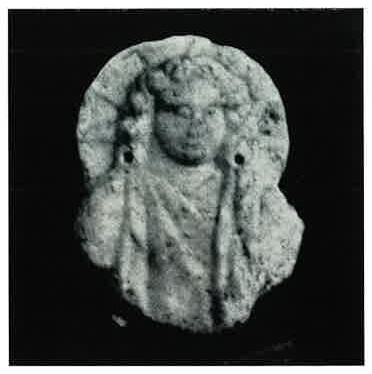
Fragment of a white marble statuette from the Mithraeum at Sarmizegetusa, Dacia, preserving the dressed bust of Sol in a nimbus and seven-rayed crown with traces of red colour; two bolt-holes at the bottom for attachment.
White marble fragment from the Mithraeum at Sarmizegetusa, Dacia, preserving the head of Sol with four attachment holes for rays.
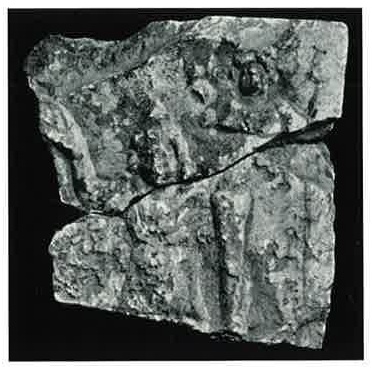
Two bluish marble fragments from the Mithraeum at Sarmizegetusa, Dacia, preserving the upper part of Cautes holding a torch in each hand, with traces of red on his neck, dress, and the torches.
Marble relief fragment from the Mithraeum at Sarmizegetusa, Dacia, preserving Cautes in Oriental dress from the hips to the knees.
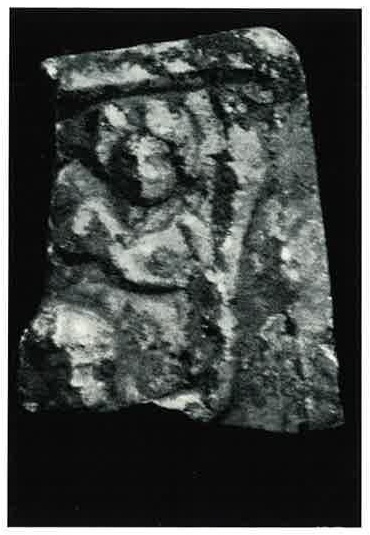
Bluish marble fragment from the Mithraeum at Sarmizegetusa, Dacia, preserving the right upper corner with the head of Cautes and his upraised torch, above which the bust of Luna.
Marble fragment of a border from the Mithraeum at Sarmizegetusa, Dacia, with the fragment of a small altar visible.
Marble fragment from the Mithraeum at Sarmizegetusa, Dacia, preserving the lower part of a leg and the left leg of a kneeling figure.
Small marble lion's head from the Mithraeum at Sarmizegetusa, Dacia, seen frontally.
Marble hand and wrist fragments from the Mithraeum at Sarmizegetusa, Dacia, all preserving remnants of torches, belonging to the torchbearer statues of the sanctuary.
Fragment of a bluish marble tauroctony from the Mithraeum at Sarmizegetusa, Dacia, preserving the left part of the head and a hoof and forefoot of the bull — probably from a Mithras-riding-the-bull scene.
Marble fragment from the Mithraeum at Sarmizegetusa, Dacia, preserving a head of Mithras in Phrygian cap; a small elevation at the side may be the shoulder of a torchbearer.
Marble relief fragment from the Mithraeum at Sarmizegetusa, Dacia, preserving a very fine head of Mithras in Phrygian cap — described by Kiraly as among the best-executed heads from the sanctuary.
Marble fragment from the Mithraeum at Sarmizegetusa, Dacia, preserving the top of Mithras's Phrygian cap and part of Sol's head.
White marble relief fragment from the Mithraeum at Sarmizegetusa, Dacia, preserving part of an arched border below which a head in Phrygian cap, possibly Mithras, above a small building.
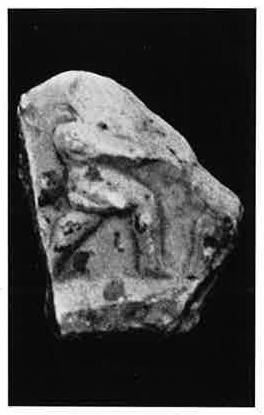
White marble relief fragment from the Mithraeum at Sarmizegetusa, Dacia, probably belonging to the preceding piece, depicting a man walking to the right stretching his hand towards a rock.
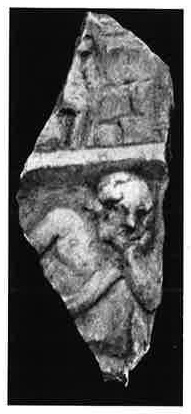
Marble fragment from the Mithraeum at Sarmizegetusa, Dacia, preserving the greater part of a reclining Oceanus and above it a rock before which one of Mithras's legs is visible — the water miracle scene.
