Привет! Имам забележка за превода:
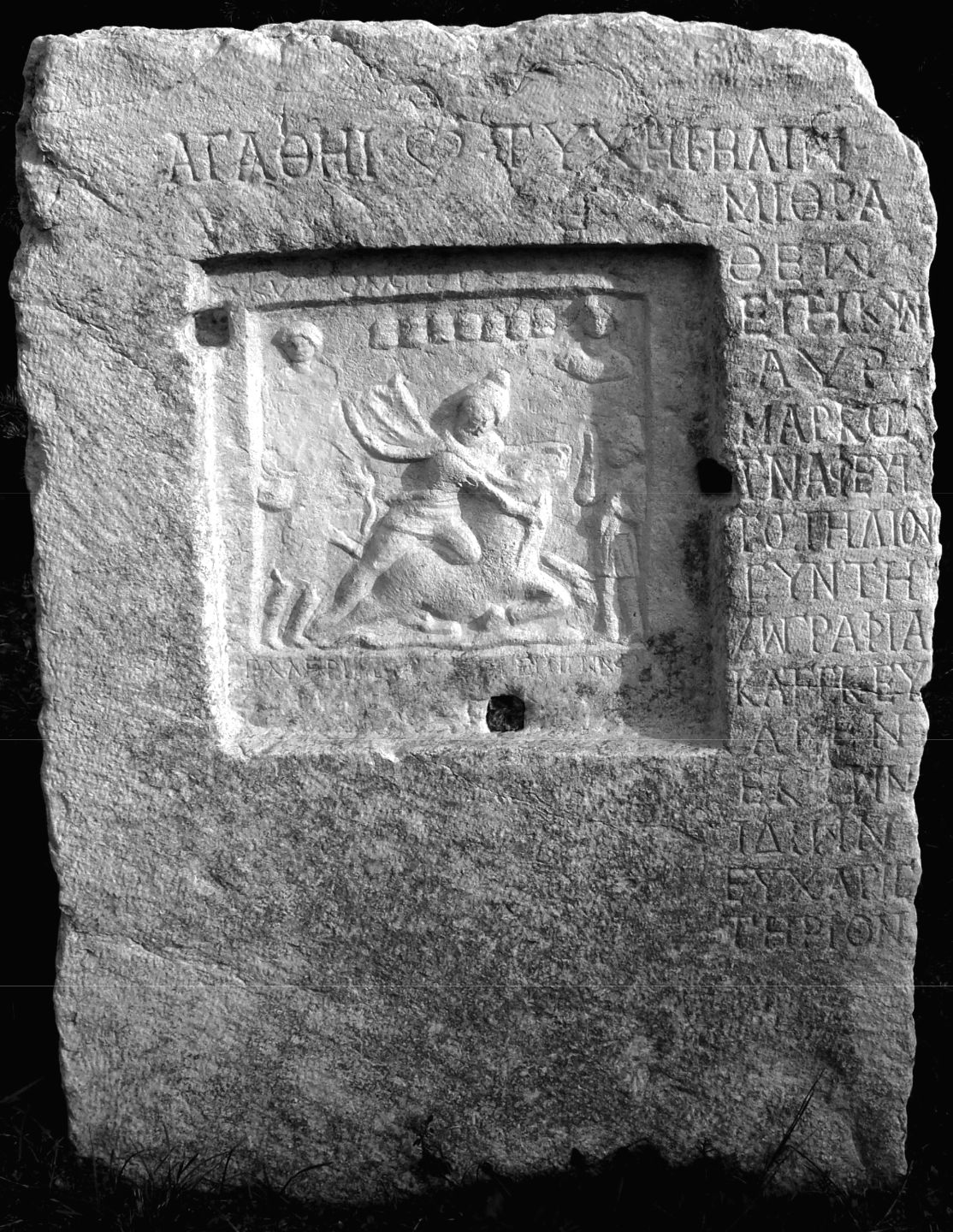
For good fortune.
To Helios Mithras, the god who hears (the prayers), Aurelius Marcus, a fuller (processor of woollen textiles), built this sanctuary together with its painted decoration at his own expense as a votive offering in gratitude.
Or, in a slightly more epigraphic style suitable for a scholarly publication:
For good fortune. To Helios Mithras, the god who hears prayers, Aurelius Marcus, a fuller, constructed this sanctuary together with its painted decoration at his own expense as a thank-offering.
Notes
γναφεύς → fuller (the standard archaeological and epigraphic translation), rather than "washer" or "cloth worker".
ἐπήκοος → the god who hears (prayers) or the prayer-hearing god.
εὐχαριστήριον is best rendered as thank-offering, offering in gratitude, or votive offering in gratitude.
If συήλιον is indeed intended for σπήλαιον, then sanctuary or mithraeum is preferable to the more literal "cave", because it reflects the cultic meaning in a Mithraic context. For a book on Mithraism, mithraeum would be the most precise translation.