The full article is reserved for our members.
Log in or create a free account to access the entire site.

This site uses cookies to offer you a better browsing experience.
Find out more on how we use cookies in our privacy policy.
The full article is reserved for our members.
Log in or create a free account to access the entire site.

Mithraeum II was found at Ptuj at a distance of 20 m south of the Mithraeum I in 1901.
These fragments of a cult relief of Mithras were found at the Mithraeum II of Ptuj, Slovenia.
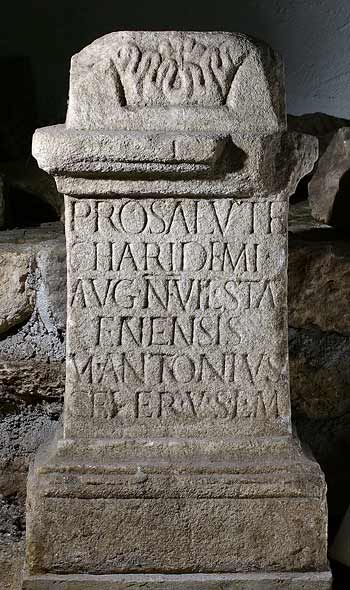
Marble votive altar with inscription to Mithras, featuring coiled, fan-like motifs above the text and associated with the statio Enensis.
These six marble fragments from the Second Mithraeum of Poetovio preserve parts of tauroctonies together with figures of Sol, Cautes, and Cautopates.
Marble tauroctony relief fragment from Mithraeum II at Ptuj, ancient Poetovio, preserving the central scene with the leaping dog, serpent, and scorpion; the bull's body is encircled by two girdles.
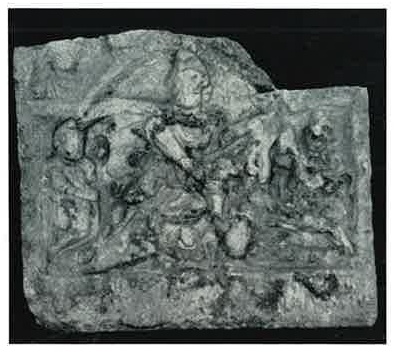
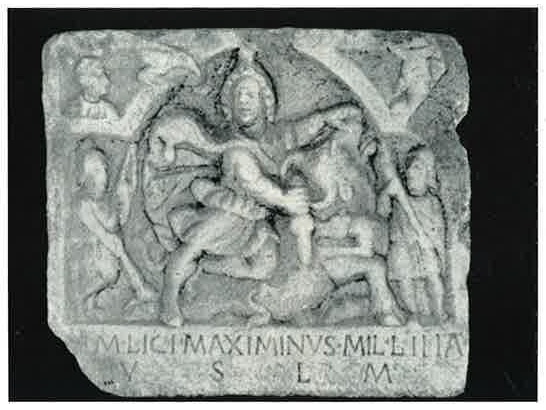
White marble tauroctony relief from Mithraeum II at Ptuj, ancient Poetovio, depicting Mithras in Oriental dress killing the bull with a girdle and the raven perched on the grotto's border.
Inscription from Mithraeum II at Ptuj, ancient Poetovio, dedicated to Deo invicto Mithrae by Licinius Maximinus, miles of Legio II Italica.
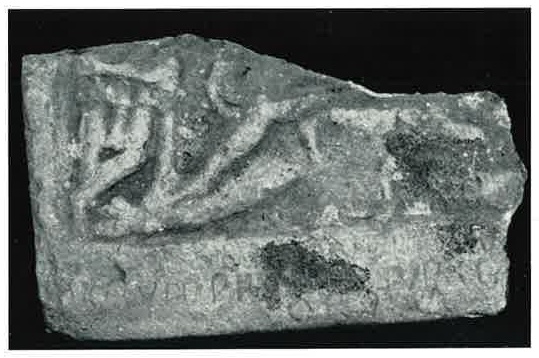
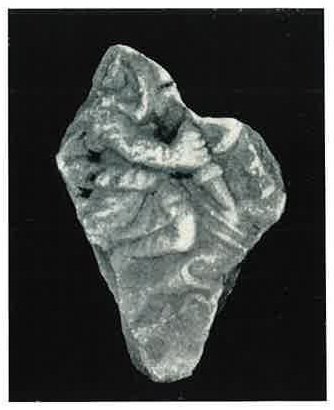
Fragment of a large marble relief from Mithraeum II at Ptuj, ancient Poetovio, preserving the forepart of the bull, the leaping dog, and the serpent approaching the wound.
Left lower corner of a marble relief from Mithraeum II at Ptuj, ancient Poetovio, preserving Cautopates with downward torch and a staff; not cross-legged; head, left arm, and left foot are lost.
Small marble relief fragment from Mithraeum II at Ptuj, ancient Poetovio, preserving the middle portion of a torchbearer.
Right portion of a marble relief from Mithraeum II at Ptuj, ancient Poetovio, preserving Cautes holding the upraised torch with both hands; not cross-legged; head, feet, right hand, and torch top are lost.
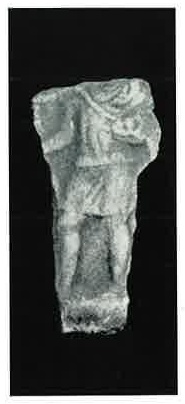
Marble relief fragment from Mithraeum II at Ptuj, ancient Poetovio, preserving the greater part of Cautes in high relief; the head, most of the right arm, and legs below the knee are lost.
Marble relief fragment from Mithraeum II at Ptuj, ancient Poetovio, preserving the hindmost part of the bull and the right leg of Mithras with the scorpion in its usual position.
Right lower corner of a marble relief from Mithraeum II at Ptuj, ancient Poetovio, preserving the border of the grotto and, outside it, Luna in a two-horse chariot holding a whip; only the horses' heads are shown.
Circular white marble fragment from Mithraeum II at Ptuj, ancient Poetovio, depicting a lion's head with leaves below and a small globe above.
Marble tauroctony relief from Mithraeum II at Ptuj, ancient Poetovio, distinguished by the bull represented with fully stretched legs; Cautopates is shown resting his head on his hand in a pensive posture.
Inscription from Mithraeum II at Ptuj, ancient Poetovio, dedicated to Deo Soli invicto Mithrae jointly by Aurelius Valentinus and his son Aurelius Valens.
Upper portion of a marble altar from Mithraeum II at Ptuj, ancient Poetovio, preserving only the abbreviated dedication to Deo invicto Mithrae.
Right portion of a marble tauroctony relief from Mithraeum II at Ptuj, ancient Poetovio, preserving standing Cautes with upraised torch and the bust of Luna above him.
Fragmentary marble inscription from Mithraeum II at Ptuj, ancient Poetovio, preserving only the abbreviated dedication to Deo Soli invicto Mithrae.
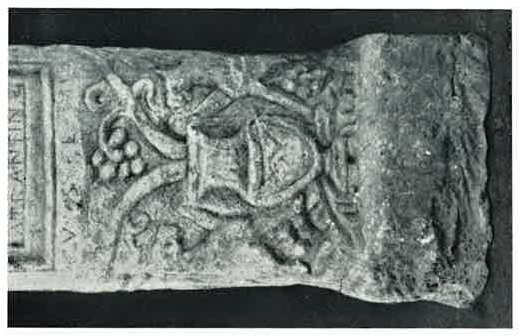
Marble column from the entrance of Mithraeum II at Ptuj, ancient Poetovio, serving as a statue base, its front decorated with a kantharus between panthers and vine tendrils; the inscription names Salvianus, contrascrip of the statio Atrantiana.
Inscription on the column base from Mithraeum II at Ptuj, ancient Poetovio, dedicated to Deo invicto Mithrae for the welfare of the Emperors and Geta Caesar by Salvianus, contrascrip of the statio Atrantiana; Geta's name was subsequently erased.
Marble statue on base from Mithraeum II at Ptuj, ancient Poetovio, depicting the naked Mithras entwined by a serpent as he emerges from the rock; the breast is damaged, and the head and arms are lost.
Inscription from Mithraeum II at Ptuj, ancient Poetovio, dedicated to Deo Soli invicto Mithrae for the welfare of Flavius Iovinus, who had vowed the gift after witnessing the birth of the god; dated to the consulship of Peregrinus and Aemilianus, AD 244.
Marble altar with akroteria from Mithraeum II at Ptuj, ancient Poetovio, dedicated to Fonti perenni by Epictetus and Viator, vicarii of Quintus Sabinius Veranus, vilicus of the publicum portorium.
Large marble water-basin on a column from Mithraeum II at Ptuj, ancient Poetovio, decorated with a central rosette; it probably stood near the entrance of the sanctuary.
Marble lion from Mithraeum II at Ptuj, ancient Poetovio, holding a swine's head under its left fore-leg — a sacrificial animal pairing associated with the Mithraic lion grade.
Marble altar fragment from Mithraeum II at Ptuj, ancient Poetovio, dedicated by a tabularius et vilicus of the statio Confluentes, a customs station at the junction of Pannonia Inferior and Moesia.
Fragmentary inscription from Mithraeum II at Ptuj, ancient Poetovio, recording a dedication to Deo invicto Mithrae by Titus Flavius Restutus, IIIIvir Augustalis of the Colonia Poetovionis.
Upper portion of a marble altar from Mithraeum II at Ptuj, ancient Poetovio, dedicated to Deo Soli invicto Mithrae for the welfare of Aurelius; the rest of the name is lost.
Small marble altar with akroteria from Mithraeum II at Ptuj, ancient Poetovio, dedicated to Deo invicto Mithrae by Secundus Acutus.
Left portion of a marble tauroctony relief from Mithraeum II at Ptuj, ancient Poetovio, preserving the bust of Sol and below it standing Cautopates with a downward torch, together with the bull's hind-leg and Mithras's right leg.
Inscription from Mithraeum II at Ptuj, ancient Poetovio, dedicated to Deo Soli Mithrae by Ulpius Lupus for his own welfare.
Marble relief from Mithraeum II at Ptuj, ancient Poetovio, preserving the lower part of the tauroctony with a bull in full extension, the scorpion, and a serpent with upraised head, together with Cautopates behind the bull.
Inscription from Mithraeum II at Ptuj, ancient Poetovio, dedicated to Deo Soli invicto Mithrae by Ulpius, a veteran, for himself and his family.
Foremost portion of a marble tauroctony relief from Mithraeum II at Ptuj, ancient Poetovio, preserving the bull's forepart, the serpent's head, the turning dog, and Cautes raising the torch with both hands.
Fragmentary inscription from Mithraeum II at Ptuj, ancient Poetovio, preserving only the end of a dedicant's name (-ciano) and the closing formula.
Marble plate fragment from Mithraeum II at Ptuj, ancient Poetovio, recording a dedication to Deo invicto Mithrae for the welfare of the Emperors and the restoration or construction of a templum.
Marble statuette fragments from Mithraeum II at Ptuj, ancient Poetovio, preserving the torsos and partial bodies of Sol's horses together with a two-wheeled car — a rare three-dimensional representation of this scene.
Marble torso from Mithraeum II at Ptuj, ancient Poetovio, probably representing a winged, reclining bull with two vertical attachment ligaments on the reverse.
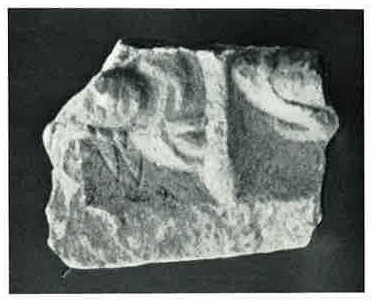
Marble relief fragment from Mithraeum II at Ptuj, ancient Poetovio, depicting a person in Oriental dress with outstretched right arm holding a small fruit basket in his left hand — probably a fragment of the sacred repast scene.
Marble inscription fragment from Mithraeum II at Ptuj, ancient Poetovio, preserving only the beginning of a name: Aulus Po-.
Marble inscription fragment from Mithraeum II at Ptuj, ancient Poetovio, preserving only scattered letters with no legible text.
Upper portion of a marble plate from Mithraeum II at Ptuj, ancient Poetovio, decorated with a central stem flanked by leaf motifs and a small twig — a purely decorative element from the sanctuary.
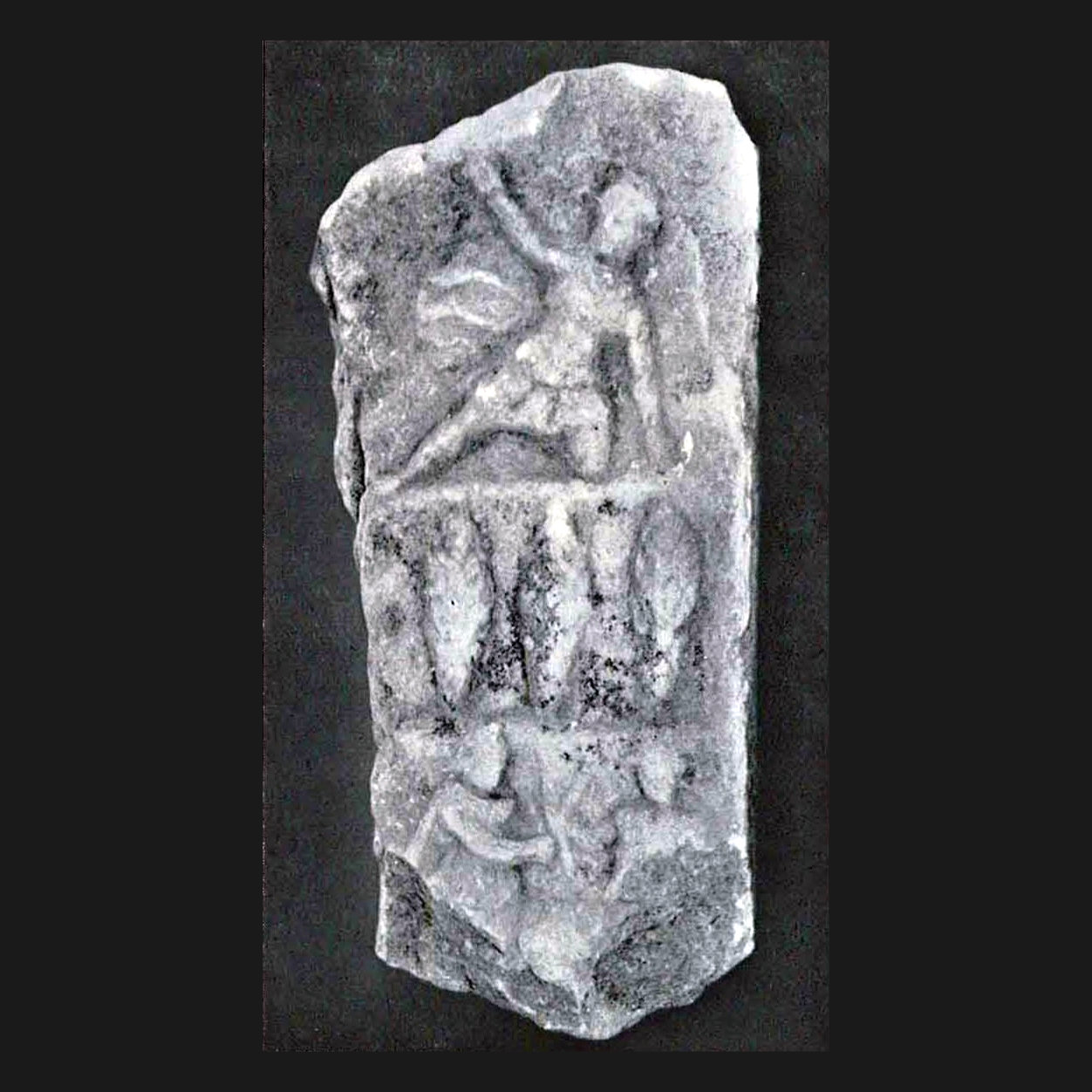
Marble relief from Mithraeum II at Ptuj, ancient Poetovio, depicting standing Jupiter with sceptre and thunderbolt beside standing Hercules with the Hesperides' fruit and club — a divine pair with Mithraic associations.
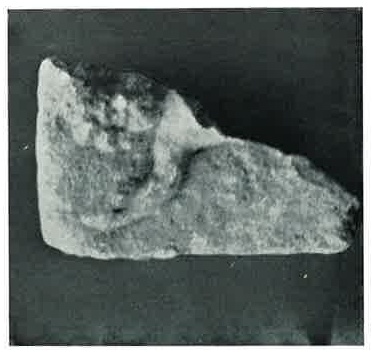
Fragment of a marble relief from Mithraeum II at Ptuj, ancient Poetovio, preserving a woman's head adorned with a wreath; probably a secondary deity from the sanctuary's sculptural programme.
Fragmentary inscription from Mithraeum II at Ptuj, ancient Poetovio, preserving only the beginning of a name: Titus V-.
Terracotta statuette from Mithraeum II at Ptuj, ancient Poetovio, depicting Mithras as bull-slayer with yellow-painted garments; the piece was not recovered during the author's visit and may be lost.
Small marble relief fragment from Mithraeum II at Ptuj, ancient Poetovio, preserving the central scene of the Nutrices — nursing goddesses — a rare motif in a Mithraic context.
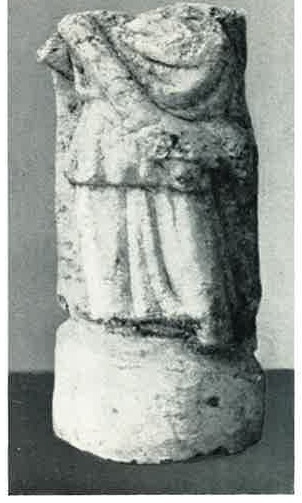
Marble relief fragment from Mithraeum II at Ptuj, ancient Poetovio, depicting a standing woman holding her right hand above an altar and a palm branch in her left; the lower body and base are lost.
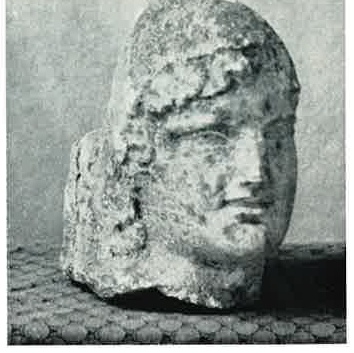
Small marble head from Mithraeum II at Ptuj, ancient Poetovio, depicting a smiling Mithras in Phrygian cap with a profiled reverse — one of the most expressive Mithraic heads from the Danubian provinces.
Small marble head in Phrygian cap from Mithraeum II at Ptuj, ancient Poetovio; the hind part is lost.
Marble right hand holding a patera from Mithraeum II at Ptuj, ancient Poetovio — a fragment of a cult statue performing a libation.
Small circular marble basin from Mithraeum II at Ptuj, ancient Poetovio, probably used for libations or purification within the sanctuary.
Marble right hand holding a dagger from Mithraeum II at Ptuj, ancient Poetovio — a fragment of a tauroctony statue or relief.
Marble left hand holding a torch from Mithraeum II at Ptuj, ancient Poetovio, belonging to a statue of Cautes.
Marble statuette from Mithraeum II at Ptuj, ancient Poetovio, depicting Cautes raising the torch with both hands; head, right hand, and lower legs are lost.
Marble fragments of draped arms and legs from Mithraeum II at Ptuj, ancient Poetovio, belonging to unidentified cult statues within the sanctuary.
Very small marble head in Phrygian cap from Mithraeum II at Ptuj, ancient Poetovio.
Marble relief fragment from Mithraeum II at Ptuj, ancient Poetovio, preserving the raven perched on the grotto's border with only two rays of Sol visible above.
Marble fragment of Mithras's flying cloak from Mithraeum II at Ptuj, ancient Poetovio.
Left upper corner of a marble relief from Mithraeum II at Ptuj, ancient Poetovio, preserving part of the grotto's border, Sol's head, and below it a primitive torchbearer's head.
Marble relief fragment from Mithraeum II at Ptuj, ancient Poetovio, preserving the upper part of Cautopates supporting his head with his left hand in a pensive attitude.
Very small marble head in Phrygian cap from Mithraeum II at Ptuj, ancient Poetovio.
Small marble head in Phrygian cap from Mithraeum II at Ptuj, ancient Poetovio.
Left upper corner of a marble relief from Mithraeum II at Ptuj, ancient Poetovio, depicting Jupiter with the thunderbolt in his raised right hand, identified as a scene from the Battle against the Giants.
Marble relief fragment from Mithraeum II at Ptuj, ancient Poetovio, preserving the body of Cautopates; the upper head and both feet are lost.
Left upper corner of a marble relief from Mithraeum II at Ptuj, ancient Poetovio, with the dressed bust of Sol in radiate crown above a horizontal rim, beneath which the head of a torchbearer, probably Cautopates.
Marble relief fragment from Mithraeum II at Ptuj, ancient Poetovio, preserving a raven as part of a tauroctony scene.